Introduction: The Machine That Works Where Humans Cannot
At depths where sunlight disappears, pressure crushes steel, and human divers cannot survive, one category of engineering equipment has become absolutely indispensable to the global offshore industry: the Work-Class Remotely Operated Vehicle (ROV).
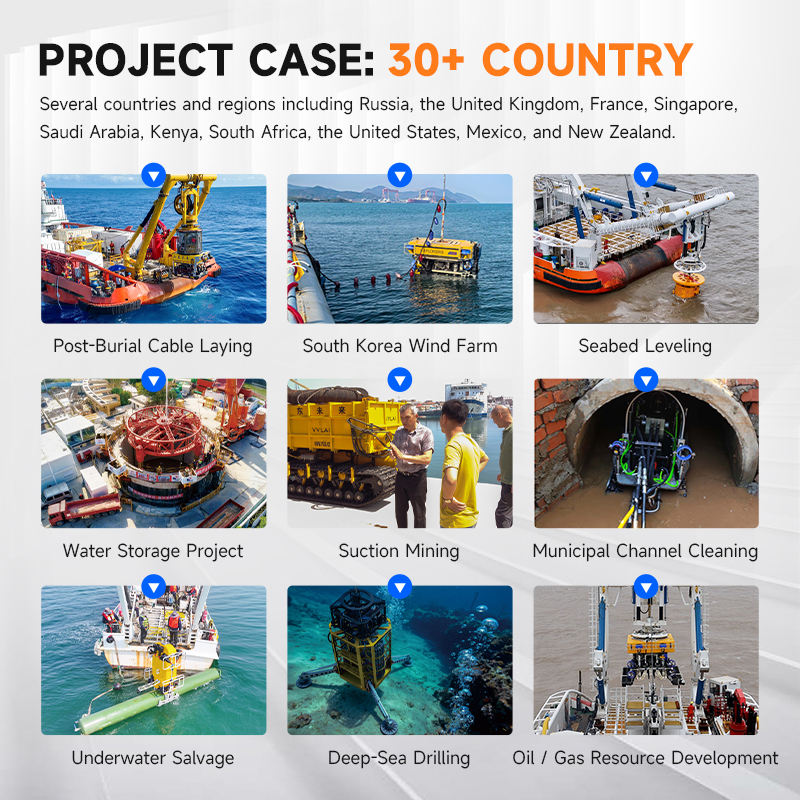
From the oil fields of the North Sea and the Gulf of Mexico to the offshore wind farms of the South China Sea and the subsea pipelines of Southeast Asia, work-class ROVs are the eyes, hands, and tools of the modern offshore industry. They inspect, repair, construct, and intervene in environments that would be impossible — or catastrophically expensive — to access any other way.
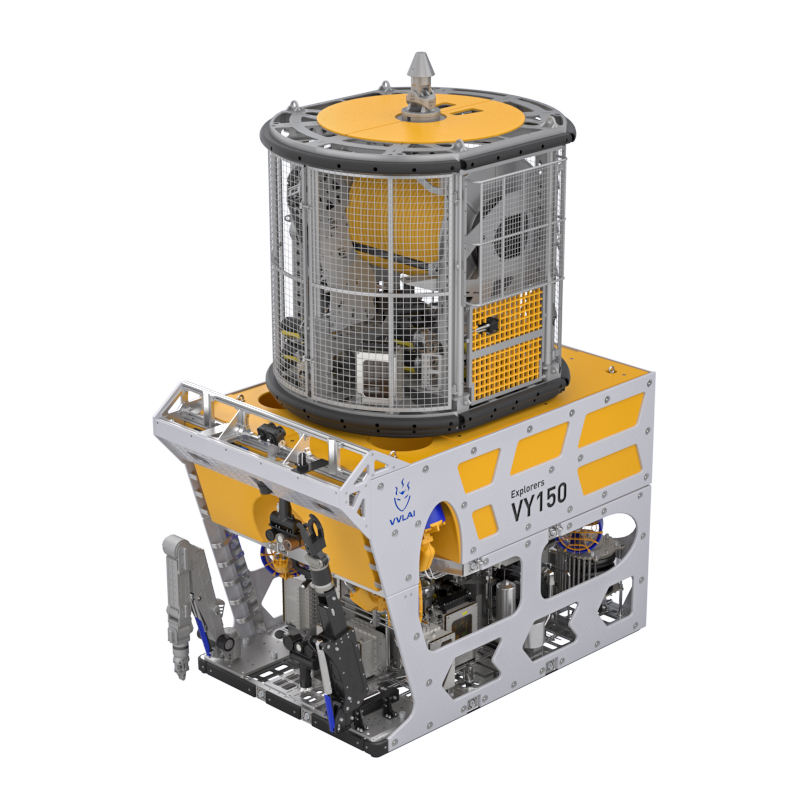
The VVLAI Engineering Equipment Factory Containerized Control Room Work-Class ROV represents a significant advancement in ROV system design: a complete, self-contained work-class ROV system with an integrated containerized control room that can be mobilized on virtually any suitable vessel, transported anywhere in the world, and deployed within hours of arrival on site.
This guide covers everything offshore operators, marine contractors, subsea engineering companies, and equipment procurement teams need to know.
What Is a Work-Class ROV?
A Remotely Operated Vehicle (ROV) is an unmanned, tethered underwater robot controlled from the surface via an umbilical cable that carries power, control signals, and data. ROVs are classified by capability and size:
Observation Class ROVs
- Small, lightweight vehicles for visual inspection only
- No manipulator arms or heavy tooling
- Depth rating: typically 300–1,000m
- Used for: pipeline inspection, hull surveys, environmental monitoring
Light Work-Class ROVs
- Medium-sized vehicles with one or two manipulator arms
- Limited tooling capability
- Depth rating: typically 1,000–2,000m
- Used for: light intervention, valve operation, sample collection
Work-Class ROVs ← This product
- Large, powerful vehicles with full manipulator systems
- Heavy tooling capability — drills, cutters, torque tools, suction pumps
- Depth rating: typically 2,000–4,000m (some to 6,000m+)
- Used for: subsea construction, pipeline repair, wellhead intervention, heavy salvage
Trenching & Heavy Work ROVs
- Specialized vehicles for pipeline burial and heavy seabed work
- Extremely high thrust and power
- Used for: pipeline trenching, cable burial, rock dumping
The work-class ROV is the workhorse of the offshore industry — capable of performing virtually any subsea task that a diver or surface vessel cannot accomplish directly.
The Containerized Control Room: Why It Changes Everything
Traditional ROV systems were permanently installed on dedicated ROV support vessels (ROVSVs) — expensive, specialized ships that cost $50,000–$150,000 per day to charter. This model works for long-term deepwater campaigns but is economically prohibitive for shorter projects or operators without access to dedicated vessels.
The containerized control room concept solves this problem fundamentally.
What Is a Containerized ROV System?
The entire ROV control infrastructure — operator workstations, navigation systems, sonar displays, video recording, power management, and communications — is integrated into one or more standard ISO shipping containers. The ROV vehicle, umbilical winch, and Launch & Recovery System (LARS) are designed to be mobilized on any suitable vessel of opportunity.
Key Advantages of Containerized Design
Vessel Flexibility
- Deploy on any vessel with sufficient deck space, crane capacity, and power supply
- No need for a dedicated ROVSV — use anchor handling vessels, platform supply vessels, construction barges, or even large fishing vessels
- Dramatically reduces day rate costs — a vessel of opportunity may cost $10,000–$30,000/day vs. $80,000–$150,000/day for a dedicated ROVSV
Global Mobility
- Standard ISO container dimensions — fits on any container ship, flatbed truck, or cargo aircraft
- Rapid mobilization — container can be loaded and secured in hours
- Deploy anywhere in the world within days of contract award
Rapid Deployment
- Pre-tested, pre-configured system — no lengthy installation and commissioning on the vessel
- Standardized interfaces for power, data, and umbilical connections
- Experienced crew can have the system operational within hours of vessel arrival
Cost Efficiency
- Lower capital cost than permanently installed systems
- No vessel modification required
- Shared across multiple projects and vessels
- Lower mobilization/demobilization costs
Work-Class ROV System Components
A complete work-class ROV system comprises several integrated subsystems:
The ROV Vehicle
The underwater vehicle itself — the most complex component:
Frame & Structure
- Open-frame aluminum or stainless steel construction
- Syntactic foam buoyancy modules for neutral buoyancy
- Modular design for maintenance access and component replacement
Propulsion System
- Multiple thrusters (typically 6–8) for full 6-degree-of-freedom control
- Vectored thrust for precise station-keeping in currents
- Thrust capacity: work-class vehicles typically generate 200–500+ kgf total thrust
Manipulator Arms
- Typically 2 manipulator arms: one 7-function (dexterous) + one 5-function (grabber)
- Hydraulically actuated for high force output
- Interchangeable jaw/tool interfaces for different tasks
- Force feedback capability on advanced systems
Tooling Interface
- Standard tooling skid mounting points
- Hydraulic and electrical interfaces for powered tools
- Common tools: torque tools, drills, cutters, grippers, suction pumps, water jetting
Sensors & Cameras
- Multiple HD cameras (forward, rear, manipulator-mounted)
- Sonar systems: multibeam, scanning, profiling
- Acoustic positioning (USBL or LBL)
- Depth, heading, altitude sensors
- CP (cathodic protection) probes for pipeline inspection
Power System
- Receives power via umbilical from surface
- Onboard hydraulic power unit (HPU) for manipulators and tools
- Electrical distribution for cameras, sensors, and lighting
The Umbilical System
The lifeline connecting the ROV to the surface:
- Carries electrical power (typically 3-phase, 3,000–6,600V)
- Fiber optic cores for high-bandwidth video and data
- Armored construction for mechanical protection
- Length: typically 3,000–4,000m for deep-water work-class systems
- Stored on a powered winch with level-wind mechanism
The Launch & Recovery System (LARS)
The mechanical system for deploying and recovering the ROV:
- A-frame or crane-mounted LARS
- Active heave compensation (AHC) for operation in rough seas
- Tether management system (TMS) or garage for deep-water deployment
- Rated for the full weight of the ROV in air
The Containerized Control Room
The nerve center of the entire system:
- Operator workstations with multi-screen displays
- Pilot and co-pilot stations
- Navigation and positioning displays
- Sonar operator station
- Video recording and management systems
- Power management and distribution panels
- Communications systems (vessel, surface, subsea)
- Air conditioning and environmental control
- Emergency systems and safety interlocks
Key Technical Specifications to Request
When evaluating work-class ROV systems, request and compare:
| Specification | What to Ask For |
|---|---|
| Depth rating | Maximum operating depth (m) |
| Total thrust | Forward, lateral, vertical (kgf) |
| Payload capacity | Additional weight the ROV can carry (kg) |
| Manipulator type | 7-function + 5-function standard |
| Hydraulic power | HPU output (kW or HP) |
| Electrical power | Total hotel load (kW) |
| Umbilical length | Standard and maximum available (m) |
| Camera system | Number, resolution, low-light capability |
| Sonar systems | Types and frequencies included |
| Positioning system | USBL, LBL, or DVL |
| LARS type | A-frame, crane, active heave compensation |
| Container dimensions | 20ft or 40ft ISO standard |
| Certifications | DNV, ABS, Lloyd’s Register, or equivalent |
| Operating sea state | Maximum Hs (significant wave height) |
Applications: Where Work-Class ROVs Are Deployed
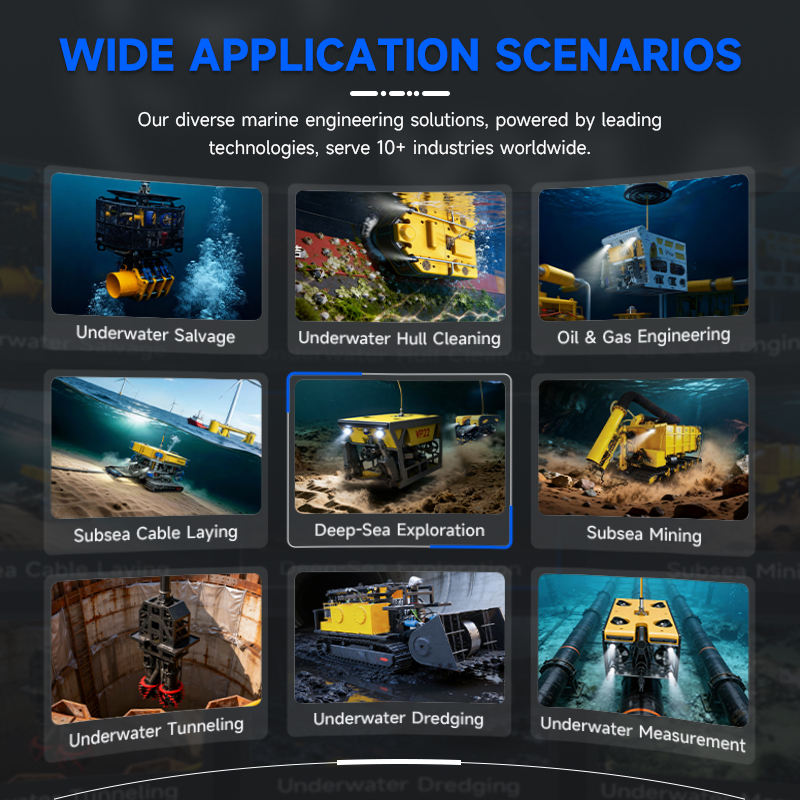
Oil & Gas — Upstream
- Subsea wellhead inspection and maintenance
- Christmas tree installation and intervention
- Riser and flowline inspection
- Subsea valve operation and override
- Blowout preventer (BOP) testing and maintenance
- Pipeline repair and tie-in support
Oil & Gas — Midstream & Downstream
- Subsea pipeline inspection (visual, CP, geometry)
- Pipeline repair — clamp installation, hot tap, stopple
- Subsea manifold inspection and maintenance
- Umbilical and cable inspection
Offshore Wind Energy
- Monopile and jacket foundation inspection
- Inter-array cable inspection and burial monitoring
- Scour protection monitoring
- Subsea electrical connection inspection
Marine Construction & Salvage
- Subsea structure installation support
- Anchor and mooring system inspection
- Wreck survey and salvage support
- Underwater cutting and demolition
Naval & Defense
- Mine countermeasures support
- Submarine rescue support
- Underwater infrastructure security inspection
- Classified subsea operations
Scientific Research
- Deep-sea geological and biological survey
- Hydrothermal vent exploration
- Seafloor mapping and sampling
- Environmental impact monitoring
Market Context: Why ROV Demand Is Growing
The global ROV market was valued at approximately $1.8 billion in 2023 and is projected to reach $3.2 billion by 2030, driven by:
- Offshore oil & gas recovery: As shallow-water fields mature, operators move to deeper water where ROVs are essential
- Offshore wind expansion: Massive offshore wind buildout in Europe, Asia, and North America requires subsea inspection and maintenance
- Subsea infrastructure aging: Aging pipelines and platforms require increasing inspection and maintenance activity
- Deep-sea mining: Emerging industry requiring specialized ROV systems for mineral extraction
- Defense spending: Naval modernization programs globally increasing demand for military ROV systems
For operators and contractors entering or expanding in the offshore market, owning a work-class ROV system is increasingly a competitive necessity rather than a luxury.
Pricing & Investment Considerations
Price Range: $3,500,000 – $6,000,000 USD
The wide price range reflects significant variation in system configuration:
| Configuration Factor | Lower End | Higher End |
|---|---|---|
| Depth rating | 2,000m | 4,000m+ |
| Thruster count/power | 6 thrusters | 8+ high-power thrusters |
| Manipulator system | Standard 7+5 function | Advanced with force feedback |
| Umbilical length | 3,000m | 4,000m+ |
| Sonar package | Basic scanning sonar | Full multibeam + profiling suite |
| Certification | Basic | DNV/ABS class certified |
| LARS type | Standard A-frame | Active heave compensation |
| Control room | Standard container | Enhanced ergonomics + redundancy |
ROI Considerations
Day rate for a chartered work-class ROV system: $25,000–$80,000/day (system only, excluding vessel)
Owned system operating cost: $5,000–$15,000/day (crew, maintenance, consumables)
Breakeven analysis: At $40,000/day charter rate vs. $10,000/day owned cost, a $5,000,000 system pays for itself in approximately 167 operating days — less than one year of active deployment for a busy contractor.
For companies with consistent ROV work, ownership delivers dramatic cost savings and competitive advantage in tendering.
Featured Product: VVLAI Work-Class ROV with Containerized Control Room
MEGA BDM has sourced and verified the VVLAI Engineering Equipment Factory Containerized Control Room Work-Class ROV — a complete, self-contained work-class ROV system designed for easy transport and rapid mobilization across global offshore operations.
This system is built for operators who need genuine work-class intervention capability without the cost and logistical complexity of a dedicated ROV support vessel.
👉 View the VVLAI Work-Class ROV on MEGA BDM
Frequently Asked Questions
What certification standards apply to work-class ROV systems?
Major certification bodies for ROV systems include DNV (Det Norske Veritas), ABS (American Bureau of Shipping), and Lloyd’s Register. Certification requirements depend on the operating region and client specifications. Confirm certification requirements for your target market before ordering.
What vessel requirements are needed to operate this system?
Minimum requirements typically include: sufficient deck space for the container and LARS, crane or A-frame capacity rated for the ROV weight in air, 3-phase electrical power supply (typically 440V or 690V, 50/60Hz), and adequate freeboard for safe ROV deployment. Our sourcing team can provide detailed vessel compatibility specifications.
How many crew members are required to operate the system?
A typical work-class ROV crew comprises: 1 ROV supervisor, 2 ROV pilots (pilot + co-pilot), 1 electrical/electronic technician, and 1 hydraulic/mechanical technician — minimum 5 personnel for 24-hour operations, typically 10 personnel for two-shift rotation.
What is the lead time for delivery?
Lead time varies by configuration and customization requirements. Standard configurations: 16–24 weeks. Custom configurations with specific depth ratings, tooling packages, or certification requirements: 24–36 weeks. Contact our sourcing team for current lead time confirmation.
Can the system be upgraded after delivery?
Yes — work-class ROV systems are designed with modular architecture. Sonar systems, camera packages, tooling skids, and control system software can typically be upgraded independently. Confirm upgrade path options with the supplier at time of order.
What after-sales support is available?
VVLAI provides technical support, spare parts supply, and can arrange field service engineers for commissioning and maintenance. MEGA BDM’s sourcing team can assist in establishing a spare parts agreement and service contract as part of the procurement package.
Conclusion
The work-class ROV with containerized control room is one of the most strategically valuable pieces of equipment an offshore contractor or operator can own. Its combination of genuine heavy intervention capability, containerized mobility, and vessel-agnostic deployment makes it the most flexible and cost-effective solution for subsea operations in today’s offshore market.
At $3.5M–$6M, this is a significant capital investment — but for companies with consistent offshore work, the economics are compelling: ownership pays for itself within months of active deployment, then generates competitive advantage and cost savings for the next 15–20 years of operational life.
MEGA BDM connects buyers with verified global manufacturers of specialized marine and subsea equipment, providing transparent pricing, technical specification support, and dedicated sourcing assistance from inquiry to delivery.
👉 View the VVLAI Work-Class ROV on MEGA BDM and contact our sourcing team to discuss your operational requirements and configuration options.