
Introduction: The $1 Trillion Pipeline Integrity Problem
The world’s offshore oil and gas infrastructure is aging. Hundreds of thousands of kilometers of subsea pipelines — many installed in the 1970s, 1980s, and 1990s — are now operating beyond their original design life. Corrosion, fatigue cracking, free spans, seabed movement, and third-party damage accumulate silently beneath the ocean surface, invisible to operators until a failure occurs.
The consequences of pipeline failure are catastrophic: environmental disasters, production shutdowns costing millions per day, regulatory penalties, and reputational damage that can threaten an operator’s license to operate. The Deepwater Horizon disaster, the Nord Stream pipeline ruptures, and numerous smaller incidents have made pipeline integrity management one of the highest-priority operational concerns in the offshore industry.
The solution is systematic, continuous pipeline inspection — and the tool that makes this economically and operationally feasible is the compact work-class ROV specifically designed for pipeline inspection and integrity monitoring.
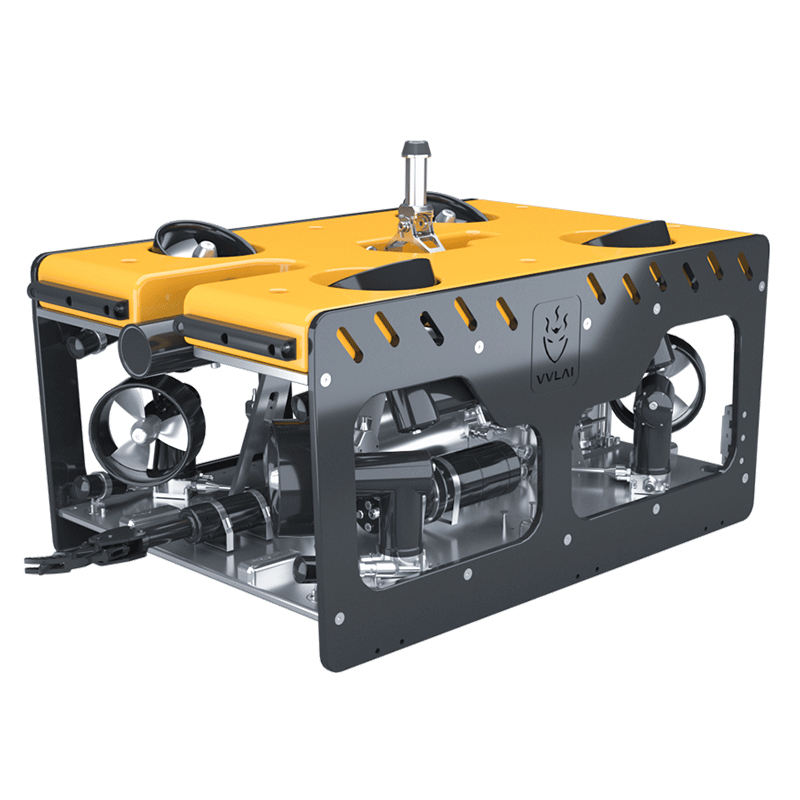
The VVLAI Pipeline Inspection Factory Compact Work-Class ROV represents a purpose-built solution for this critical application: a compact, offshore-rated ROV system optimized for pipeline tracking, visual inspection, cathodic protection measurement, and condition monitoring — at a price point that makes regular inspection economically viable for operators of all sizes.
Pipeline Integrity Management: Why Regular Inspection Is Non-Negotiable
The Regulatory Framework
Offshore pipeline operators are subject to increasingly stringent regulatory requirements for integrity management across all major producing regions:
North Sea (UK/Norway): PSSR (Pipeline Safety Regulations), PFEER, and NORSOK standards require documented inspection programs with defined inspection intervals based on risk assessment.
Gulf of Mexico (US): BSEE (Bureau of Safety and Environmental Enforcement) regulations require regular inspection of all offshore pipelines, with enhanced requirements for high-consequence areas.
Asia-Pacific: National regulations in Australia, Malaysia, Indonesia, and other producing nations increasingly align with international standards (ISO 13623, DNV-ST-F101).
Middle East: Saudi Aramco, ADNOC, and other NOCs have internal standards that often exceed regulatory minimums.
Failure to maintain documented inspection records is not just a safety risk — it is a regulatory violation that can result in production shutdown orders, fines, and loss of operating licenses.
The Cost of Inspection Failure
The economics of pipeline inspection are straightforward:
- Cost of regular ROV inspection: $50,000–$500,000 per campaign (depending on pipeline length, water depth, and vessel day rate)
- Cost of undetected pipeline failure: $10,000,000–$1,000,000,000+ (cleanup, production loss, regulatory penalties, legal liability)
The ROI of proactive inspection is not measured in percentages — it is measured in orders of magnitude.
What Is a Compact Work-Class ROV?
The VVLAI system occupies a strategically important position in the ROV market — between observation-class ROVs (which lack intervention capability) and full work-class ROVs (which require large, expensive support vessels).
The Compact Work-Class Advantage
vs. Observation-Class ROVs:
- Observation ROVs can see problems but cannot fix them
- Compact work-class ROVs carry manipulator arms and tooling — inspect and intervene in a single deployment
- Higher thrust for operation in pipeline-level currents
- More robust construction for close-proximity pipeline work
vs. Full Work-Class ROVs:
- Full work-class systems require large, expensive ROV support vessels ($50,000–$150,000/day)
- Compact work-class systems mobilize on smaller, cheaper vessels of opportunity ($10,000–$30,000/day)
- Lower capital cost — $100,000–$200,000 vs. $3,500,000–$6,000,000
- Faster mobilization — smaller system, simpler logistics
- Lower operating cost — smaller crew, simpler support requirements
The compact work-class ROV is the optimal tool for pipeline inspection — sufficient capability for the task, without the cost and complexity of a full work-class system.
Pipeline Inspection: What the ROV Does
Visual Inspection
The foundation of any pipeline inspection program:
External visual inspection (EVI):
- HD camera survey of the entire pipeline external surface
- Documentation of coating condition, corrosion, marine growth, mechanical damage
- Identification of free spans (pipeline sections unsupported by the seabed)
- Detection of third-party damage (anchor strikes, fishing gear entanglement, dropped objects)
- Anode condition assessment
Close visual inspection (CVI):
- High-magnification camera inspection of specific areas of concern
- Weld inspection for cracking and corrosion
- Flange and fitting inspection
- Riser base and touchdown point inspection
Cathodic Protection (CP) Measurement
Cathodic protection is the primary corrosion prevention system for offshore pipelines. Regular CP measurement confirms the system is functioning correctly:
- Half-cell potential measurement — confirms pipeline is within the protected potential range (-800 to -1100 mV vs. Ag/AgCl)
- Anode depletion assessment — estimates remaining anode life
- CP gradient measurement — identifies areas of inadequate protection
- Data logging — records CP readings at defined intervals along the pipeline
CP measurement requires physical contact with the pipeline — a task that requires at minimum a light work-class ROV with a CP probe tool.
Sonar Inspection
Acoustic sensors provide data that cameras cannot:
Multibeam sonar:
- 3D mapping of the pipeline and surrounding seabed
- Free span measurement — length, height, and shoulder embedment
- Seabed mobility assessment
- Scour detection around pipeline supports and structures
Scanning sonar:
- Obstacle detection in low-visibility conditions
- Pipeline tracking in zero-visibility water
- Structural profiling
Profiling sonar:
- Precise dimensional measurement of pipeline geometry
- Ovality and deformation detection
- Burial depth assessment
Flooded Member Detection (FMD)
For pipelines with internal inspection limitations, external FMD using gamma ray or ultrasonic techniques can detect internal flooding — an indicator of corrosion or cracking.
Intervention Tasks
The work-class capability of the VVLAI ROV enables intervention beyond pure inspection:
- Marine growth removal — cleaning pipeline surface for inspection or CP measurement
- Anode installation — retrofitting sacrificial anodes to under-protected sections
- Clamp installation support — assisting with pipeline repair clamp installation
- Debris removal — clearing fishing gear, ropes, and other debris from the pipeline
- Valve operation — operating subsea isolation valves
- Sample collection — collecting corrosion product or marine growth samples for laboratory analysis
Pipeline Inspection ROV: Key Technical Requirements
When specifying a pipeline inspection ROV, the following parameters are critical:
Depth Rating
Must exceed the maximum operating depth of the pipeline being inspected. Common depth ratings:
- 300m — suitable for most continental shelf pipelines
- 1,000m — covers most offshore pipeline infrastructure
- 2,000m+ — required for deepwater pipeline inspection
Thrust & Current Capability
Pipeline inspection requires the ROV to maintain station and track the pipeline in ambient currents. Minimum requirements:
- Forward thrust: Sufficient to maintain 1–2 knots against prevailing current
- Lateral thrust: For cross-current station keeping during CP measurement
- Vertical thrust: For depth control during pipeline tracking
Sensor Suite
For a comprehensive pipeline inspection program:
- HD forward and downward cameras (minimum)
- Scanning or multibeam sonar
- CP probe (contact measurement)
- Depth, heading, altitude sensors
- USBL acoustic positioning
Pipeline Tracking Capability
Dedicated pipeline inspection ROVs include:
- Pipeline tracking sonar or camera system
- Automated pipeline following mode (on advanced systems)
- Odometer or distance measurement for position logging along the pipeline
Data Recording & Management
- Synchronized video and sensor data recording
- GPS/USBL position overlay on video
- Inspection data management software
- Report generation capability
Vessel Requirements for Compact ROV Deployment
One of the key advantages of the VVLAI compact system is its ability to mobilize on a wide range of vessels:
Minimum vessel requirements (typical):
- Deck space: 20–40m² for ROV system and LARS
- Crane or A-frame: Rated for ROV weight in air (typically 500–2,000 kg for compact systems)
- Power supply: 3-phase, 380–440V, 50–100 kW
- Dynamic positioning (DP): DP1 or DP2 recommended for pipeline inspection work
- Accommodation: For ROV crew (typically 3–5 personnel)
Suitable vessel types:
- Platform supply vessels (PSV)
- Anchor handling tug supply vessels (AHTS)
- Survey vessels
- Offshore patrol vessels
- Converted fishing vessels (for shallow water work)
The ability to use vessels of opportunity rather than dedicated ROVSVs is the primary economic advantage of compact ROV systems — reducing vessel day rates by 50–80% compared to full work-class deployments.
Pipeline Inspection Campaign Planning
Pre-Campaign Requirements
- Pipeline route charts and as-built drawings
- Previous inspection reports and anomaly registers
- Risk assessment identifying priority inspection areas
- Regulatory requirements and inspection interval obligations
- Vessel selection and mobilization planning
- ROV system configuration for specific inspection tasks
Inspection Execution
- Systematic pipeline route survey (typically 100% coverage)
- Anomaly identification and close-up inspection
- CP measurement at defined intervals (typically every 50–100m)
- Free span measurement and assessment
- Sonar seabed mapping along the pipeline corridor
- Real-time data review and anomaly flagging
Post-Campaign Deliverables
- Inspection report — complete documented record of all findings
- Anomaly register — prioritized list of all identified defects and anomalies
- CP data report — cathodic protection status along the full pipeline length
- Free span report — all free spans with dimensions and assessment against acceptance criteria
- Video archive — full inspection video with position overlay
- GIS data — pipeline position and anomaly locations in GIS format
- Fitness-for-service assessment — engineering evaluation of significant anomalies
ROI Analysis: The Economics of Owning vs. Chartering
Chartering a Pipeline Inspection ROV System
- ROV system charter rate: $8,000–$25,000/day
- Vessel day rate: $15,000–$50,000/day
- ROV crew: $3,000–$8,000/day
- Total campaign cost (10-day inspection): $260,000–$830,000
Owning the VVLAI Compact ROV System
- Capital cost: $100,000–$200,000
- Annual operating cost (maintenance, crew, consumables): $50,000–$100,000
- Vessel cost (vessel of opportunity): $10,000–$20,000/day
Breakeven: For operators conducting 2+ inspection campaigns per year, ownership pays for itself within 6–18 months. Beyond breakeven, every campaign generates direct cost savings of $150,000–$600,000 vs. chartering.
Additional revenue opportunity: When not in use for your own pipelines, the system can be chartered to other operators — generating revenue that further accelerates ROI.
Comparison: VVLAI Pipeline ROV vs. Full Work-Class ROV
| Factor | VVLAI Compact Pipeline ROV | Full Work-Class ROV |
|---|---|---|
| Capital cost | $100K–$200K | $3.5M–$6M |
| Vessel requirement | Small vessel of opportunity | Dedicated ROVSV |
| Vessel day rate | $10K–$30K | $50K–$150K |
| Mobilization time | Days | Weeks |
| Pipeline inspection | Optimized | Capable |
| Heavy intervention | Limited | Full capability |
| Best for | Pipeline inspection campaigns | Complex intervention projects |
For operators whose primary need is pipeline inspection and condition monitoring, the compact system delivers 90% of the capability at 5–10% of the capital cost.
Featured Product: VVLAI Compact Pipeline Inspection ROV on MEGA BDM
MEGA BDM has sourced and verified the VVLAI Pipeline Inspection Factory Compact Work-Class ROV — a purpose-built offshore pipeline integrity and condition monitoring system from a verified specialist ROV manufacturer with proven subsea equipment export experience.
👉 View the VVLAI Pipeline Inspection ROV on MEGA BDM
Frequently Asked Questions
What pipeline diameters can the ROV inspect?
Compact pipeline inspection ROVs are typically configured for pipelines from 4″ to 48″+ diameter. The ROV tracks along the pipeline externally — pipeline diameter affects sensor positioning and tracking configuration rather than fundamental capability. Confirm your pipeline diameter range with the supplier.
What is the maximum operating depth?
Confirm the depth rating for your specific configuration. Standard configurations typically cover 300m–1,000m. Deeper-rated configurations are available for deepwater pipeline inspection requirements.
Does the system include CP measurement capability?
Yes — work-class capability means the ROV can carry and deploy a CP probe for cathodic protection potential measurement. Confirm the CP probe specification and measurement range with the supplier.
What positioning system is used for pipeline inspection?
Pipeline inspection ROVs typically use USBL (Ultra-Short Baseline) acoustic positioning for absolute position, combined with DVL (Doppler Velocity Log) for relative velocity and distance measurement along the pipeline. This combination provides accurate position logging for anomaly reporting and re-inspection.
Can the system operate in strong currents?
Work-class ROVs are designed for operation in currents up to 2–3 knots depending on configuration. Confirm the current rating for your specific operational environment — current capability is a critical specification for pipeline inspection in tidal or current-exposed areas.
What crew is required to operate the system?
A compact pipeline inspection ROV typically requires 3–4 personnel: 1 ROV supervisor/pilot, 1 co-pilot/technician, and 1–2 inspection data technicians. Confirm crew requirements with the supplier based on your specific inspection scope.
Conclusion
The VVLAI Compact Work-Class ROV for Pipeline Inspection addresses one of the most pressing operational challenges in the offshore industry: how to conduct regular, comprehensive pipeline integrity inspections cost-effectively, without the prohibitive expense of full work-class ROV systems and dedicated support vessels.
At $100,000–$200,000, this system is accessible to pipeline operators, inspection contractors, and marine service companies of all sizes — delivering genuine work-class inspection and intervention capability on a compact, vessel-agnostic platform that pays for itself within months of active deployment.
As global pipeline infrastructure ages and regulatory requirements for integrity management tighten, the compact pipeline inspection ROV is transitioning from a competitive advantage to an operational necessity for serious offshore operators.