
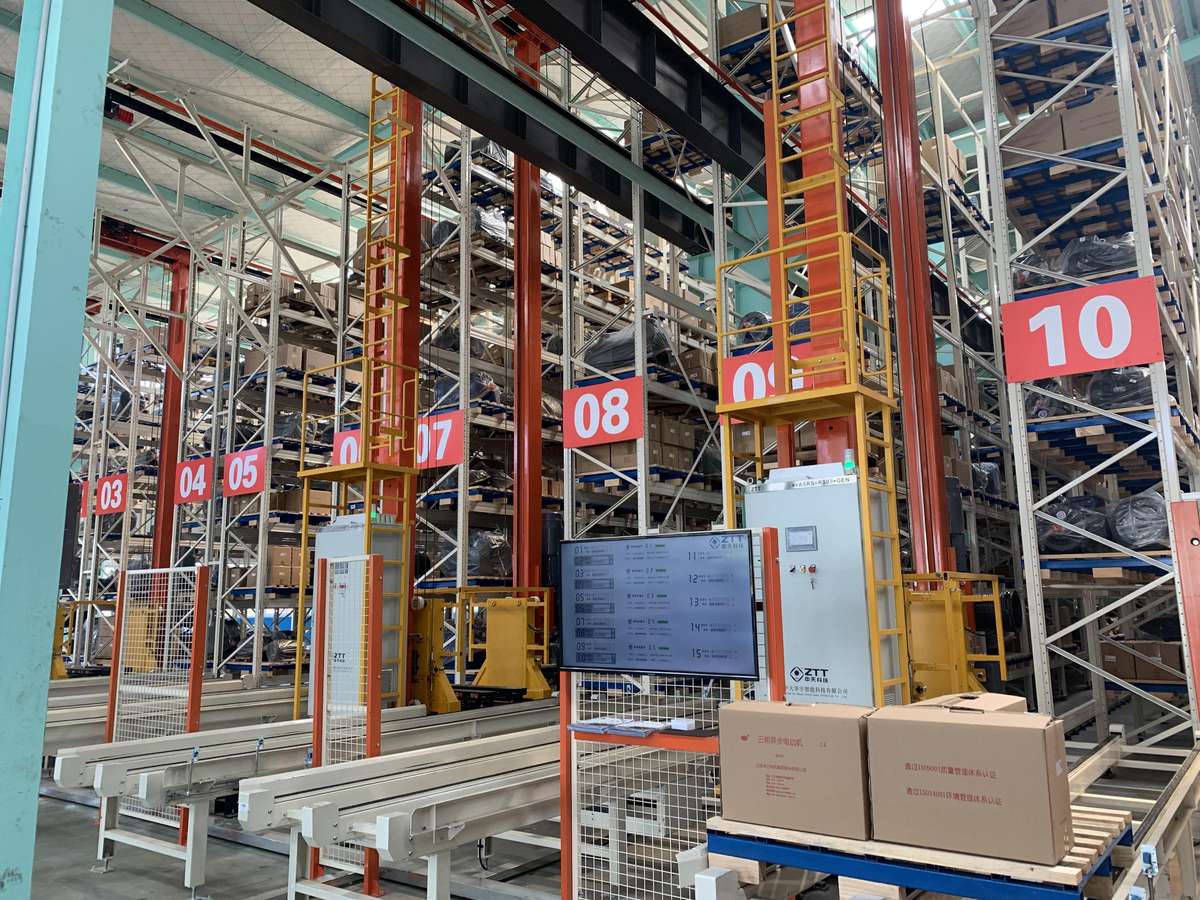
Introduction: The Vertical Dimension — The Last Frontier of Warehouse Automation
Modern warehouse automation has transformed horizontal material flow. Automated conveyor systems, AGVs, and robotic picking systems move goods across warehouse floors at speeds and volumes that manual operations cannot match. But there is a dimension that many warehouses have not yet automated: the vertical dimension.
In multi-level warehouses, distribution centers, and manufacturing facilities, the movement of pallets and goods between floors remains one of the most persistent bottlenecks in material flow. Forklifts navigate ramps or freight elevators, operators wait for elevator doors, and throughput is constrained by the speed and availability of vertical transport equipment. In a facility where horizontal conveyors move 200 pallets per hour, a single freight elevator handling 15 pallets per hour creates a bottleneck that undermines the entire automation investment.
The Vertical Lift Conveyor Sky Transfer Unit with Buffer Module — an automated pallet elevator system that integrates seamlessly with conveyor networks and WMS platforms — eliminates this bottleneck. By automating vertical pallet transfer with the same speed, consistency, and integration capability as horizontal conveyor systems, it completes the automation of material flow in three dimensions.
Available through MEGA BDM at $64,000, this system brings automated vertical transfer capability to logistics operators, distribution centers, and manufacturing facilities at a price point that delivers rapid ROI from labor savings, throughput improvement, and forklift cost reduction.
The Vertical Transfer Challenge: Why Forklifts and Freight Elevators Fail at Scale
The Multi-Level Warehouse Reality
Multi-level warehouses and distribution centers are increasingly common — driven by rising land costs in urban and peri-urban locations, the need to maximize cubic storage utilization, and the construction of purpose-built multi-story fulfillment centers by e-commerce operators.
A typical multi-level distribution center might have:
- Ground floor: Inbound receiving, sortation, and outbound dispatch
- Mezzanine level: Pick-and-pack operations, value-added services
- Upper floors: Bulk storage, automated storage and retrieval systems (AS/RS)
In this environment, pallets must move vertically — from receiving on the ground floor to storage on upper floors, from storage to pick-and-pack on the mezzanine, from pick-and-pack to dispatch on the ground floor. The volume of vertical pallet movements can be enormous — hundreds to thousands of pallet movements per shift.
The Forklift Vertical Transfer Problem
Ramp-based forklift transfer:
- Forklifts drive up and down ramps between floors
- Ramp gradient: Maximum 10–15% for loaded forklifts
- Ramp length for 4m floor height: 27–40m of ramp
- Ramp floor area: 27–40m × 3–4m = 80–160 m² per ramp
- Forklift speed on ramp: 3–5 km/h (loaded)
- Cycle time per pallet: 3–8 minutes (including travel, positioning, ramp transit)
- Throughput: 8–20 pallets/hour per forklift
Freight elevator transfer:
- Forklift drives into elevator, elevator travels to destination floor, forklift drives out
- Elevator cycle time: 2–4 minutes per pallet (including door operation, travel, positioning)
- Throughput: 15–30 pallets/hour per elevator
- Bottleneck: Single elevator serves multiple forklifts — queuing reduces effective throughput
The problems with forklift vertical transfer:
Low throughput: 8–30 pallets/hour per forklift/elevator vs. 60–120 pallets/hour for an automated vertical lift conveyor — a 3–10× throughput disadvantage.
High labor cost: Each forklift requires a licensed operator — $20–$40/hour including benefits. A facility requiring 60 pallet movements/hour needs 3–8 forklifts and operators for vertical transfer alone.
Safety hazards: Forklifts on ramps are among the most dangerous operations in warehouse environments — tip-over risk, collision risk, and pedestrian hazard. Freight elevator operations also carry significant safety risks.
Floor space consumption: Ramps consume 80–160 m² of floor area per floor transition — valuable space that could be used for storage or operations.
Inconsistent throughput: Forklift throughput varies with operator skill, fatigue, and traffic — creating unpredictable bottlenecks in automated conveyor systems that require consistent input rates.
The Vertical Lift Conveyor: Architecture and Operating Principle
Sky Transfer Unit Design
The “Sky Transfer Unit” designation refers to the vertical lift conveyor’s overhead installation configuration — the conveyor travels vertically through the building structure, typically through a purpose-built shaft or opening in the floor slab:
Physical configuration:
- Vertical mast or frame structure anchored to the building structure
- Lift platform (carrier) travels vertically on the mast — guided by rails or linear guides
- Drive system: Electric motor with counterweight or servo drive — lifts the platform and its pallet load
- Upper and lower transfer stations: Conveyor sections at each floor level that transfer pallets to/from the lift platform
- Safety enclosure: Guarding around the lift shaft prevents personnel access during operation
The sky transfer advantage:
- Minimal floor footprint — the lift shaft occupies only slightly more area than the pallet itself (typically 1.5m × 2.0m)
- No ramp required — eliminates 80–160 m² of ramp floor area
- Vertical travel through the building structure — no horizontal travel required
- Multiple floor service — a single lift can serve 3, 4, or more floors with appropriate shaft height
Buffer Module: The Flow Optimization Component
The integrated buffer module is what transforms the vertical lift conveyor from a simple elevator into a flow-optimized automation component:
What the buffer module does: The buffer module is a short conveyor section at each transfer station that accumulates pallets waiting for the lift platform. It decouples the upstream conveyor system from the lift cycle:
Without buffer:
- Upstream conveyor delivers a pallet to the lift station
- If the lift platform is not immediately available (traveling to another floor, loading/unloading), the upstream conveyor must stop — backing up the entire upstream system
- The upstream conveyor’s throughput is limited by the lift cycle time
With buffer module:
- Upstream conveyor delivers pallets to the buffer — the buffer accumulates 1–3 pallets
- The upstream conveyor continues running — it is not stopped by lift unavailability
- The lift platform loads from the buffer when available — the buffer absorbs the timing mismatch between upstream conveyor speed and lift cycle time
- Downstream conveyor receives pallets from the buffer at the destination floor — smoothing the output flow
The buffer module’s operational impact:
- Upstream conveyor utilization increases — no stops waiting for lift availability
- Lift utilization increases — the lift always has a pallet ready to load
- Overall system throughput increases — the buffer eliminates the timing bottleneck
- System resilience improves — brief stoppages of the lift do not immediately stop the upstream conveyor
Drive and Control System
Drive system options:
Counterweight drive:
- Electric motor drives a chain or rope connected to the lift platform
- Counterweight balances the platform weight — motor only lifts the pallet load
- Energy efficient — counterweight reduces motor power requirement
- Suitable for: Standard pallet loads, moderate lift heights
Servo drive:
- Servo motor with ball screw or rack-and-pinion drive
- No counterweight — servo motor provides full lifting force
- Higher positioning accuracy — ±1–5mm
- Faster acceleration and deceleration — shorter cycle time
- Suitable for: High-speed applications, precise positioning requirements
Control system:
- PLC-based control manages lift operation, buffer conveyor, and transfer conveyors
- Automatic pallet detection: Photoelectric sensors detect pallet presence at each station
- Destination routing: WMS or conveyor control system commands the lift to the correct floor
- Safety interlocks: Platform does not move unless all safety conditions are met
- Fault detection: Automatic fault detection and alarm generation
Integration: Connecting the Vertical Lift to the Warehouse Ecosystem
Conveyor System Integration
The vertical lift conveyor is designed to integrate seamlessly with horizontal conveyor systems:
Infeed conveyor integration:
- The lift’s infeed conveyor section connects directly to the upstream horizontal conveyor
- Conveyor speed matching: The infeed conveyor runs at the same speed as the upstream conveyor — smooth pallet transfer without stopping
- Pallet orientation: The infeed conveyor can include a pallet turner if the lift requires a specific pallet orientation
Outfeed conveyor integration:
- The lift’s outfeed conveyor section connects directly to the downstream horizontal conveyor at each floor
- Conveyor speed matching: The outfeed conveyor runs at the same speed as the downstream conveyor
- Divert capability: The outfeed conveyor can include a divert to route pallets to different downstream destinations
Conveyor control integration:
- The lift’s PLC communicates with the conveyor system’s central controller via standard industrial protocols (Profibus, Profinet, EtherNet/IP, Modbus TCP)
- The conveyor controller commands the lift to the correct floor for each pallet
- The lift reports its status (available, busy, fault) to the conveyor controller — enabling the conveyor controller to manage pallet flow
WMS Integration
WMS (Warehouse Management System) integration enables:
Pallet tracking:
- Each pallet is identified by barcode or RFID at the lift infeed
- The WMS records the pallet’s vertical transfer — updating the pallet’s location in the WMS database
- The WMS commands the lift to the correct destination floor based on the pallet’s storage or processing destination
Task management:
- The WMS generates lift tasks — directing pallets to specific floors based on storage assignments, pick requirements, and outbound orders
- The lift executes tasks in the optimal sequence — minimizing empty travel and maximizing throughput
Performance monitoring:
- The WMS records lift cycle times, throughput, and utilization — enabling performance monitoring and optimization
- Fault events are recorded in the WMS — supporting maintenance planning and root cause analysis
Standard WMS integration interfaces:
- REST API: Modern WMS platforms use REST APIs for equipment integration
- SOAP/XML: Legacy WMS platforms may use SOAP/XML interfaces
- OPC-UA: Industrial standard for equipment data exchange
- Confirm integration interface with the supplier for your specific WMS platform
AS/RS Integration
In facilities with Automated Storage and Retrieval Systems (AS/RS), the vertical lift conveyor connects the AS/RS to the rest of the warehouse:
AS/RS infeed:
- Pallets from receiving are conveyed to the vertical lift
- The lift transfers pallets to the AS/RS floor level
- The AS/RS conveyor system receives pallets from the lift and routes them to the AS/RS crane for storage
AS/RS outfeed:
- The AS/RS crane retrieves pallets from storage and delivers them to the outfeed conveyor
- The outfeed conveyor delivers pallets to the vertical lift
- The lift transfers pallets to the picking or dispatch floor level
The vertical lift as the AS/RS gateway: In many multi-level warehouse designs, the vertical lift conveyor is the critical interface between the AS/RS (typically on upper floors) and the ground-floor operations (receiving, picking, dispatch). The lift’s throughput capacity must match the AS/RS’s output rate — confirm cycle time and throughput with the supplier for your AS/RS specification.
Applications: Where Vertical Lift Conveyors Deliver Maximum Value
E-Commerce Fulfillment Centers
E-commerce fulfillment is the fastest-growing application for vertical lift conveyors — driven by the construction of multi-story fulfillment centers in urban markets where land costs make single-story facilities uneconomical:
Typical e-commerce fulfillment center layout:
- Ground floor: Inbound receiving, outbound sortation and dispatch
- Mezzanine: Pick-and-pack operations, returns processing
- Upper floors: Bulk storage, AS/RS, buffer storage
Vertical lift role:
- Inbound: Lift transfers received pallets from ground floor to upper floor storage
- Replenishment: Lift transfers pallets from upper floor storage to mezzanine pick-and-pack
- Outbound: Lift transfers packed orders from mezzanine to ground floor sortation
Volume: A large e-commerce fulfillment center may require 200–500 vertical pallet movements per hour — requiring multiple vertical lift conveyors operating in parallel.
Cold Storage and Temperature-Controlled Distribution
Cold storage facilities present unique challenges for vertical transfer — forklifts in cold environments require special equipment, operators need cold-weather PPE, and frequent door openings compromise temperature control:
Vertical lift advantages in cold storage:
- Automated transfer through insulated shaft — minimal temperature loss vs. forklift ramp or elevator
- No operator required in cold zone — eliminates cold-weather PPE requirement and operator health risk
- Consistent cycle time — not affected by operator fatigue in cold environments
- Reduced door openings — automated transfer through sealed shaft vs. repeated forklift door openings
Applications:
- Frozen food distribution centers
- Pharmaceutical cold chain distribution
- Fresh produce distribution centers
- Beverage distribution centers
Automotive Parts Warehouses
Automotive parts warehouses handle a wide range of pallet sizes and weights — from small parts in standard pallets to heavy engine and transmission assemblies:
Vertical lift requirements:
- High load capacity — automotive parts can be heavy (500–1,500 kg per pallet)
- Precise positioning — AS/RS integration requires accurate pallet placement
- High throughput — automotive assembly lines require just-in-time parts delivery
Confirm maximum load capacity with the supplier for your heaviest pallet loads.
Manufacturing Plant Inter-Floor Transfer
Manufacturing plants with multi-floor layouts require vertical transfer of raw materials, work-in-progress, and finished goods:
Manufacturing applications:
- Raw material transfer from ground floor receiving to upper floor production
- Work-in-progress transfer between production floors
- Finished goods transfer from upper floor production to ground floor packaging and dispatch
Manufacturing-specific requirements:
- Compatibility with non-standard pallet sizes (custom pallets, stillages, containers)
- Integration with production scheduling systems (ERP, MES)
- High reliability — production line stoppages due to lift failure are costly
Airport Cargo and Baggage Handling
Airport cargo terminals and baggage handling systems require vertical transfer of ULDs (Unit Load Devices), baggage containers, and cargo pallets:
Airport applications:
- Baggage transfer between check-in level and baggage handling level
- Cargo transfer between airside and landside levels
- ULD transfer between storage and aircraft loading areas
Airport-specific requirements:
- High reliability — airport operations cannot tolerate equipment downtime
- Integration with baggage handling system (BHS) control
- Compliance with airport safety regulations
Specifications: What to Evaluate and Confirm
Lift Capacity
Maximum pallet weight:
- Standard: 1,000–1,500 kg (covers most standard pallet loads)
- Heavy duty: 2,000–3,000 kg (for heavy industrial and automotive applications)
- Confirm your maximum pallet weight with the supplier
Pallet size:
- Standard Euro pallet: 1,200mm × 800mm
- Standard ISO pallet: 1,200mm × 1,000mm
- North American pallet: 1,219mm × 1,016mm
- Confirm your pallet size with the supplier — the lift platform must accommodate your pallet dimensions
Lift Height and Speed
Maximum lift height:
- Standard: 6–12m (2–3 floor levels)
- Extended: 12–30m (4–8 floor levels)
- Confirm your required lift height with the supplier
Lift speed:
- Standard: 0.3–0.5 m/s
- High speed: 0.5–1.0 m/s
- Lift speed determines cycle time — higher speed = shorter cycle time = higher throughput
Cycle time calculation:
- Cycle time = (lift height ÷ lift speed) × 2 + loading/unloading time
- Example: 6m height, 0.5 m/s speed, 30s loading/unloading: (6 ÷ 0.5) × 2 + 30 = 54 seconds
- Throughput: 3,600 ÷ 54 = 67 pallets/hour
Throughput
Confirm the system’s throughput (pallets/hour) with the supplier for your lift height and pallet weight. Throughput is the critical specification for matching the vertical lift to your conveyor system’s capacity.
Safety Systems
Required safety systems:
- Light curtains at platform entry/exit — detect personnel in the transfer zone
- Safety gates — prevent access to lift shaft during operation
- Overload protection — prevents operation if pallet weight exceeds rated capacity
- Emergency stop — accessible at each floor level
- Anti-fall device — prevents platform from falling in case of drive failure
Confirm safety system compliance with the supplier for your local safety regulations (CE marking for Europe, OSHA compliance for US, etc.).
ROI Analysis: The Economics of Vertical Lift Automation
Investment: $64,000
Labor Savings
Forklift vertical transfer baseline:
- Forklifts required for 60 pallets/hour vertical transfer: 3–4 forklifts
- Forklift operator cost: $30/hour × 3 operators × 2 shifts = $180/hour
- Annual labor cost (300 days × 16 hours): $864,000/year
Automated vertical lift:
- System operator (monitoring): 0.25 FTE × $20/hour = $5/hour
- Annual labor cost: $24,000/year
Annual labor saving: $840,000 Payback on $64,000 investment: 28 days
Forklift Cost Savings
Forklift ownership cost:
- Forklift purchase/lease: $15,000–$25,000/year per forklift
- Maintenance: $3,000–$8,000/year per forklift
- 3 forklifts eliminated: $54,000–$99,000/year
Annual forklift saving: $54,000–$99,000
Throughput Value
Throughput improvement:
- Manual: 20–30 pallets/hour (3 forklifts)
- Automated: 60–120 pallets/hour
- Improvement: 2–6× throughput
Revenue impact of throughput improvement:
- Additional pallets processed per year: 40–90 pallets/hour × 4,800 hours = 192,000–432,000 additional pallets
- Value per additional pallet processed: $0.50–$2.00 (handling fee or cost avoidance)
- Annual revenue/cost impact: $96,000–$864,000
Comparison: Vertical Lift vs. Alternatives
| Factor | Forklift Ramp | Freight Elevator | Automated Vertical Lift |
|---|---|---|---|
| Investment | $50,000–$150,000 (ramp construction) | $80,000–$200,000 | $64,000 |
| Throughput | 20–30 pallets/hour | 15–30 pallets/hour | 60–120 pallets/hour |
| Labor required | 3–4 operators | 1–2 operators | 0.25 operators |
| Floor space | 80–160 m² (ramp) | 10–20 m² (elevator) | 3–5 m² (shaft) |
| Safety risk | High | Medium | Low |
| WMS integration | None | None | Full |
| Annual labor cost | $864,000 | $288,000 | $24,000 |
| Payback | Never (ongoing cost) | Never (ongoing cost) | 28 days |
Featured Product: Vertical Lift Conveyor on MEGA BDM
MEGA BDM has sourced and verified the Vertical Lift Conveyor Sky Transfer Unit & Buffer Module — Automated Pallet Elevator System for Logistics Warehouse from a verified global warehouse automation equipment manufacturer with proven vertical lift conveyor design, manufacturing, and international installation experience across e-commerce fulfillment, cold storage, automotive, manufacturing, and distribution center applications.
👉 View the Vertical Lift Conveyor on MEGA BDM
Frequently Asked Questions
What is the maximum lift height and number of floors served?
Confirm the maximum lift height and number of floor levels served with the supplier. Provide your building height and number of floors for an accurate specification.
What is the maximum pallet weight and size?
Confirm the maximum pallet weight (kg) and pallet dimensions (L × W) with the supplier. Provide your heaviest pallet and largest pallet size for confirmation.
What is the throughput (pallets/hour) at my required lift height?
Confirm the throughput at your specific lift height with the supplier. Throughput decreases with increasing lift height — provide your lift height for an accurate throughput specification.
What WMS and conveyor control systems does the lift integrate with?
Confirm integration capability with your specific WMS and conveyor control system. Provide your WMS platform name and conveyor control system for confirmation of integration interfaces.
What safety certifications does the system carry?
Confirm safety certifications (CE, OSHA, local standards) with the supplier for your installation country. Provide your country and applicable safety standards for confirmation.
What is the installation and commissioning process?
Confirm installation requirements (floor opening dimensions, structural requirements, electrical supply) and commissioning support with the supplier. Vertical lift installation typically requires structural modifications to the building — confirm scope with the supplier.
Conclusion
The Vertical Lift Conveyor Sky Transfer Unit & Buffer Module completes the automation of warehouse material flow — extending the speed, consistency, and integration capability of horizontal conveyor systems into the vertical dimension that forklifts and freight elevators cannot efficiently serve.
At $64,000 — with payback periods of 28 days from labor savings alone, plus forklift cost elimination and throughput improvement — this system delivers one of the most compelling ROI profiles in warehouse automation. For e-commerce fulfillment centers, cold storage facilities, automotive parts warehouses, manufacturing plants, and any multi-level logistics operation where vertical pallet transfer is a bottleneck, the automated vertical lift conveyor is the investment that unlocks the full potential of warehouse automation.