
Introduction: The Parcel Volume Explosion
Global e-commerce parcel volumes have grown from approximately 50 billion parcels per year in 2015 to over 160 billion in 2023 — and projections point to 250+ billion by 2028. Behind every one of those parcels is a sorting operation: a facility that receives mixed inbound shipments and routes each individual parcel to the correct outbound destination, carrier, route, or delivery zone.
For most of the past century, this sorting was done by hand. Workers would read labels, make routing decisions, and physically move parcels to the correct location. This approach has three fundamental problems that become more acute as volume grows: it is slow, it is expensive, and it is error-prone.
The solution that leading e-commerce operators, express couriers, postal services, and 3PL providers are deploying at scale: intelligent automated parcel sorting systems — and the VAP (Variable Angle Platform) Automated Parcel Handling System represents one of the most accessible and versatile entry points into automated sorting technology available today.
What Is a VAP Parcel Sorter?
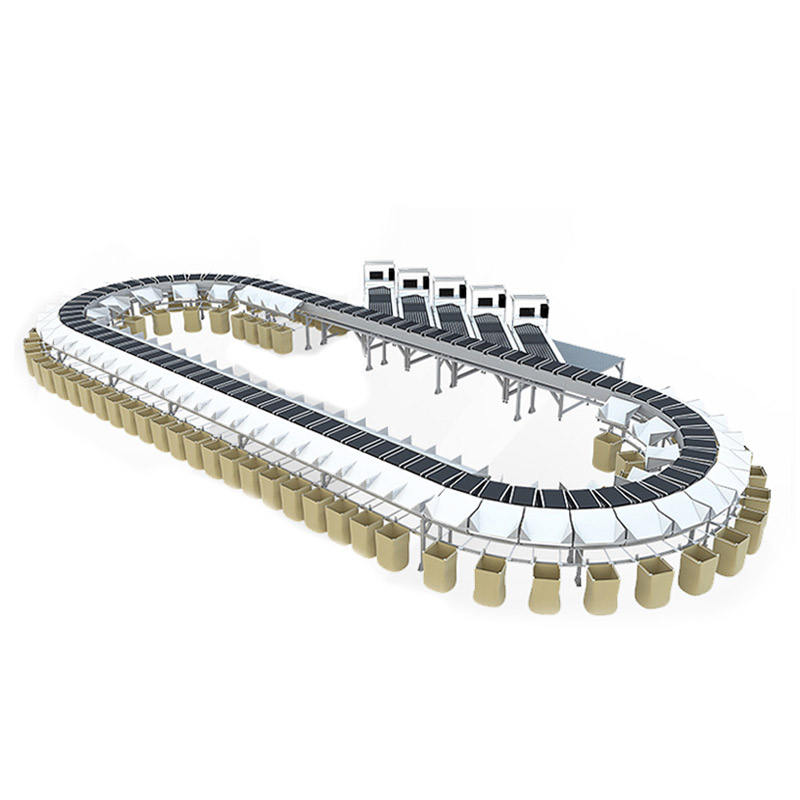
VAP stands for Variable Angle Platform — a sorting technology that uses individually controlled platform units, each capable of tilting at variable angles to divert parcels to designated chutes or lanes.
How VAP Sorting Works
- Induction — parcels are fed onto the sorter via a conveyor induction system, either manually or automatically
- Scanning — barcode, QR code, or RFID readers identify each parcel and look up its routing destination in the WMS/sorting software
- Tracking — the system tracks each parcel’s position on the sorter in real time
- Diversion — when a parcel reaches its designated divert point, the platform unit tilts to the correct angle, sliding the parcel into the correct chute or lane
- Collection — parcels accumulate in destination chutes for collection, bagging, or onward conveying
VAP vs. Other Sorting Technologies
| Technology | Parcel Types | Speed | Gentleness | Cost | Best For |
|---|---|---|---|---|---|
| VAP (Variable Angle Platform) | Wide range | High | Good | Medium | Mixed parcel operations |
| Crossbelt sorter | All types | Very high | Excellent | High | High-volume, fragile goods |
| Sliding shoe sorter | Flat, rigid | High | Good | Medium-High | Boxes, flat items |
| Pop-up wheel sorter | Rigid boxes | Medium | Good | Medium | Carton sorting |
| Manual sorting | All types | Low | Variable | Low (labor) | Very low volume |
| Tilt tray sorter | Small items | Very high | Good | High | Small parcel, e-commerce |
VAP technology occupies a strong middle ground — handling a wide variety of parcel types at high speed with good handling gentleness, at a capital cost significantly below crossbelt and tilt tray systems.
Key Components of the VAP Sorting System
Induction System
The entry point where parcels enter the sorter:
Manual induction stations
- Operators place parcels onto the induction conveyor one at a time
- Suitable for lower-volume operations or mixed parcel types requiring human judgment
- Lower cost, simpler installation
Automated induction
- Conveyor-fed induction with automatic singulation (separating parcels from bulk flow)
- Suitable for high-volume operations with consistent parcel types
- Higher throughput, lower labor dependency
Induction scanning
- Fixed barcode/QR code scanners at induction point
- Multi-face scanning tunnels for automatic label reading regardless of orientation
- OCR (Optical Character Recognition) for handwritten or damaged labels
- Dimensioning and weighing systems for parcel data capture
The VAP Sorting Deck
The heart of the system — the conveying and diverting mechanism:
- Individual platform units, each independently controlled
- Variable tilt angle — adjustable to match parcel weight, size, and destination chute position
- High-speed operation — platform units cycle rapidly for continuous parcel flow
- Robust construction — designed for continuous 24/7 operation
- Low maintenance — minimal moving parts per unit, standardized replacement components
Destination Chutes & Collection
Where sorted parcels accumulate:
- Fixed chutes — parcels slide into collection bins or bags
- Telescoping chutes — adjustable length for different facility layouts
- Chute sensors — detect full chutes and alert operators for collection
- Automated collection conveyors — on high-volume systems, chutes feed directly to outbound conveyors
Control System & Software
The intelligence layer:
- Sorting management software — manages routing rules, destination assignments, and exception handling
- WMS integration — bidirectional data exchange with warehouse management system
- Real-time monitoring — dashboard showing system status, throughput, and chute fill levels
- Exception handling — automatic diversion of unreadable or unrecognized parcels to manual exception lanes
- Reporting — throughput statistics, error rates, and productivity metrics
Applications: Who Needs a VAP Parcel Sorter?
E-Commerce Fulfillment Centers
The fastest-growing application. E-commerce fulfillment requires:
- Outbound sorting — routing picked orders to the correct carrier, service level, or delivery zone
- Returns processing — sorting returned items by SKU, condition, or disposition
- Cross-docking — sorting inbound supplier shipments directly to outbound orders
A VAP sorter in an e-commerce fulfillment center can process thousands of parcels per hour with minimal labor — enabling same-day and next-day fulfillment at scale.
Express Courier Hubs
Express courier networks (DHL, FedEx, UPS, local carriers) operate sorting hubs that process millions of parcels per day. Smaller regional hubs and last-mile delivery depots use compact sorters like the VAP system to:
- Sort inbound parcels by delivery route or postcode
- Sequence parcels for optimal delivery order
- Process returns and failed deliveries
Cross-Docking Facilities
Cross-docking operations receive mixed inbound shipments and immediately sort them for outbound delivery without storage. Speed is critical — the VAP sorter enables rapid, accurate sorting that keeps cross-docking operations flowing.
Postal Processing Centers
National and regional postal services process enormous volumes of parcels and packets. Automated sorting reduces labor costs and improves accuracy — critical as postal volumes shift from letters to parcels.
Retail & Omnichannel Logistics
Retailers operating omnichannel fulfillment (ship from store, click and collect, home delivery) need flexible sorting capability to route orders across multiple fulfillment channels. The VAP system’s flexibility handles the mixed parcel types typical of retail operations.
3PL Operators
Third-party logistics providers serving multiple clients need sorting systems that can handle diverse parcel types and routing requirements. The VAP system’s software-driven routing makes it easy to configure different sorting rules for different clients.
Performance Metrics: What to Expect
Throughput
VAP sorting systems are typically rated by parcels per hour (PPH). The $10,000 price point suggests a compact or entry-level system — typical throughput for systems in this range:
- Small/compact VAP systems: 1,000–3,000 PPH
- Mid-range VAP systems: 3,000–8,000 PPH
- Large VAP systems: 8,000–20,000+ PPH
Confirm the specific throughput rating with the supplier for your volume requirements.
Parcel Specifications
- Weight range: Typically 0.1 kg to 30 kg per parcel
- Size range: Minimum and maximum dimensions (length × width × height)
- Parcel types: Rigid boxes, polybags, padded envelopes, irregular shapes
Accuracy
Modern automated sorting systems achieve sorting accuracy of 99.5–99.9% — significantly better than manual sorting (typically 97–99%). Confirm the accuracy specification with the supplier.
Availability
Well-maintained sorting systems achieve system availability of 98–99.5%. Confirm MTBF (Mean Time Between Failures) and MTTR (Mean Time To Repair) specifications.
ROI Analysis: The Business Case at $10,000
Labor Cost Comparison
Manual sorting (equivalent throughput):
- 2,000 parcels/hour manual sorting requires approximately 4–6 sorters
- Labor cost: $8–$15/hour per worker = $32–$90/hour
- Annual labor cost (16-hour operation, 300 days): $154,000–$432,000
VAP automated sorter:
- Capital cost: $10,000
- Annual operating cost (maintenance, power): $1,000–$3,000
- Labor: 1 operator for monitoring and exception handling
- Annual saving vs. manual: $100,000–$400,000+
Payback period: 2–6 weeks based on labor savings alone for a 2-shift operation.
Additional Value Drivers
Error reduction
- Sorting errors cost $5–$25 per misrouted parcel (re-delivery, customer service, returns)
- At 99.9% accuracy vs. 98% manual: saves 19 errors per 1,000 parcels
- On 10,000 parcels/day: 190 fewer errors/day × $10 average cost = $1,900/day saved
Throughput increase
- Automated sorting enables higher peak throughput without proportional labor increase
- Critical for handling peak season volumes (Singles Day, Black Friday, Christmas)
Space efficiency
- Automated sorting uses vertical space more efficiently than manual sorting tables
- Reduces floor space required for sorting operations
System Design & Installation
Site Requirements
- Floor space: Depends on system size and number of destination chutes — confirm with supplier
- Floor loading: Sorter systems require adequate floor load capacity
- Power supply: 3-phase electrical supply (380V/50Hz or 220V/60Hz — confirm for your market)
- Network: Ethernet or WiFi for WMS integration and system monitoring
- Ceiling height: Sufficient for sorter deck height plus operator access
Installation Process
- Site survey — supplier reviews facility layout and confirms installation requirements
- System design — sorter layout, chute configuration, and induction design
- Manufacturing — typically 4–8 weeks for compact systems
- Installation — mechanical installation, electrical connection, software configuration
- Testing & commissioning — system testing with actual parcels
- Training — operator and maintenance training
- Go-live — phased startup with parallel manual operation
Total timeline: 8–16 weeks from order to full operation for compact systems.
WMS Integration
The VAP sorter connects to your WMS via standard API (REST or SOAP). The WMS provides routing rules (which parcel goes to which chute) and receives sorting confirmation data. Confirm your WMS platform compatibility with the supplier before ordering.
Featured Product: VAP Intelligent Warehouse Sorter on MEGA BDM
MEGA BDM has sourced and verified the Intelligent Warehouse Sorter: VAP Automated Parcel Handling System — an accessible, high-performance automated sorting solution for e-commerce fulfillment centers, courier hubs, and distribution operations of all sizes.
👉 View the VAP Intelligent Warehouse Sorter on MEGA BDM
Frequently Asked Questions
What parcel types can the VAP sorter handle?
VAP sorters handle a wide range of parcel types including rigid cardboard boxes, polybag mailers, padded envelopes, and many irregular shapes. Confirm the specific parcel size and weight range with the supplier for your application.
How many destination chutes does the system support?
The number of destination chutes depends on the system configuration and physical length of the sorter. Compact systems typically support 10–50 destinations; larger systems support 100+ destinations. Confirm the chute count for your routing requirements.
What scanning technology is used for parcel identification?
Standard systems use 1D/2D barcode scanners. Advanced configurations include multi-face scanning tunnels, OCR for handwritten labels, and RFID reading. Confirm the scanning technology matches your parcel labeling standards.
Can the system handle polybags and soft parcels?
VAP technology generally handles polybags better than sliding shoe or crossbelt sorters because the tilting platform mechanism is gentler on soft parcels. Confirm polybag handling capability with the supplier for your specific bag dimensions and weights.
What happens to parcels that cannot be read?
Unreadable parcels are automatically diverted to a manual exception lane where an operator resolves the routing manually. The exception rate depends on label quality and scanning technology — modern multi-face scanning systems achieve read rates of 99%+.
What maintenance does the system require?
Preventive maintenance includes daily inspection of conveyor belts and platform units, weekly lubrication of drive components, and monthly calibration checks. The supplier provides a maintenance manual and can offer a maintenance contract for ongoing support.
Conclusion
The VAP Intelligent Warehouse Sorter makes automated parcel sorting accessible to operations that previously could not justify the capital cost of large-scale sorting systems. At $10,000, this system delivers genuine automated sorting capability — high throughput, high accuracy, and significant labor savings — at a price point that delivers payback in weeks rather than years.
For e-commerce operators, courier hubs, and logistics providers facing growing parcel volumes and rising labor costs, the VAP sorter is not a luxury — it is the foundation of a scalable, profitable sorting operation.
👉 View the full product details on MEGA BDM