
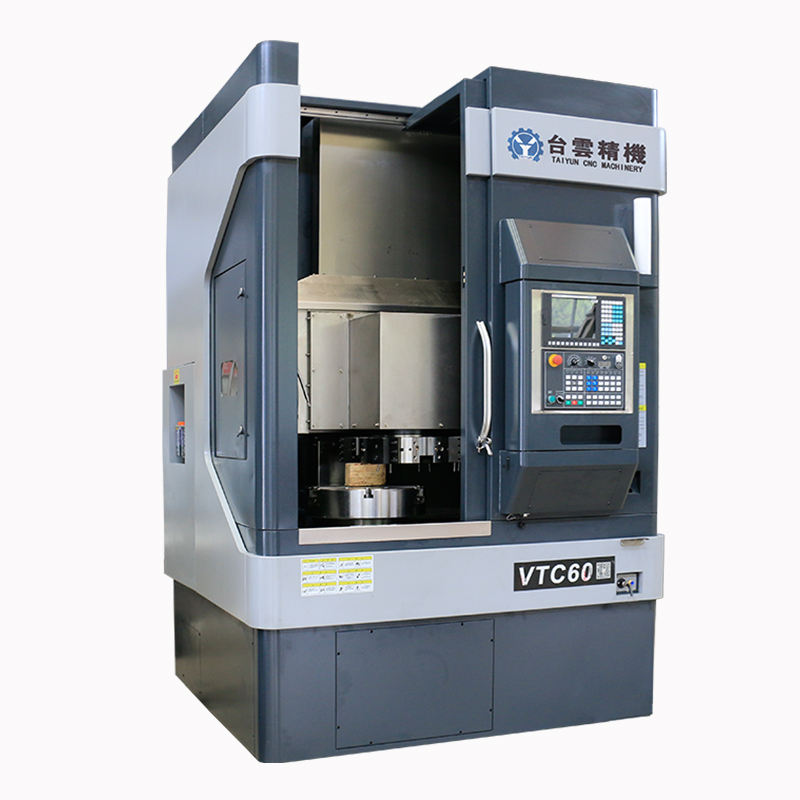
Introduction: The Workpiece That Cannot Lie on Its Side
Every machinist understands the horizontal lathe — the workpiece spins between centers or in a chuck, and the cutting tool moves along the axis to turn, face, bore, and thread. It is the most fundamental machine tool in any workshop, and for the vast majority of turned components — shafts, pins, bushings, and cylinders — it is the right machine.
But there is a class of workpiece that the horizontal lathe cannot efficiently handle: large-diameter, heavy, disc-shaped components. A 1,200mm diameter bearing ring weighing 800kg. A wind turbine hub flange 2,000mm in diameter. A brake drum 600mm across. A gear blank 900mm in diameter and 400mm tall.
These components share a common characteristic: they are wide relative to their height, and they are heavy. Mounting them in a horizontal lathe chuck requires enormous chucking force to overcome gravity — and even then, the workpiece deflects under its own weight, compromising roundness and surface finish. The chuck jaws must grip with enough force to prevent the workpiece from falling, which can distort thin-walled components.
The solution — developed over a century of heavy machining practice — is the vertical lathe (also called a vertical turning center or VTL): a machine where the workpiece sits on a horizontal rotary table, supported by gravity rather than fighting it, and the cutting tool moves vertically and horizontally above the workpiece.
The CNC Vertical Lathe Machine with Fanuc or Siemens CNC Control available through MEGA BDM at $36,986 — with free delivery and customizable configuration — brings this essential heavy machining capability to precision engineering workshops, bearing manufacturers, gear producers, and heavy component machinists at a globally competitive price.
The Vertical Lathe: Architecture and Fundamental Advantages
Why Vertical? The Physics of Heavy Workpiece Machining
The vertical lathe’s design is driven by a simple physical reality: gravity acts downward, and large, heavy workpieces are most stable when supported from below.
The horizontal lathe’s limitations for large, heavy workpieces:
Gravity-induced deflection: When a large, heavy workpiece is mounted horizontally in a chuck, gravity pulls the unsupported end downward. This deflection:
- Causes the workpiece axis to deviate from the spindle axis
- Produces taper on turned diameters (the diameter varies along the length)
- Reduces roundness (the workpiece is not truly circular in the cutting plane)
- Requires steady rests to support the workpiece — adding setup complexity
Chucking force requirements: To prevent a heavy workpiece from falling out of a horizontal chuck, the chuck jaws must apply enormous clamping force. This force:
- Can distort thin-walled workpieces (rings, flanges, casings)
- Requires a very large, heavy chuck — adding to spindle load
- Limits the maximum workpiece weight that can be safely machined
Spindle bearing load: In a horizontal lathe, the workpiece weight is supported by the spindle bearings as a radial load. For very heavy workpieces, this radial load reduces bearing life and limits the maximum workpiece weight.
The vertical lathe’s solutions:
Gravity support: The workpiece sits on the horizontal rotary table — gravity holds it down, not the chuck jaws. The table supports the full workpiece weight as a thrust load (axial load on the table bearing) — which the table bearing is designed to handle.
No deflection: With the workpiece axis vertical and gravity acting along the axis, there is no gravity-induced deflection. The workpiece is perfectly supported regardless of its diameter or weight.
Minimal clamping force: The chuck jaws (or clamps) only need to prevent the workpiece from rotating relative to the table — not from falling. Much lower clamping force is required, eliminating distortion of thin-walled components.
Operator ergonomics: Loading and unloading large, heavy workpieces onto a horizontal table is much easier than mounting them in a horizontal chuck — crane loading is straightforward, and the workpiece can be positioned and clamped without fighting gravity.
Vertical Lathe vs. Horizontal Lathe: When to Choose Each
Choose a horizontal lathe for:
- Long, slender workpieces (shafts, bars, cylinders) where length >> diameter
- Workpieces that can be supported between centers
- High-speed turning of small to medium diameter parts
- Thread cutting and taper turning over long lengths
- Parts where the L/D ratio > 1
Choose a vertical lathe for:
- Large-diameter, disc-shaped workpieces where diameter >> height
- Heavy workpieces that are difficult to mount horizontally
- Thin-walled rings and flanges that would distort under horizontal chucking force
- Parts where the D/H ratio > 1 (diameter greater than height)
- Workpieces too large for horizontal lathe swing
The rule of thumb: If the workpiece diameter exceeds 600–800mm, or if the workpiece weight exceeds 500–1,000kg, a vertical lathe is almost always the better choice.
CNC Control: Fanuc or Siemens — Your Choice
Why Control System Choice Matters
The CNC control system is the brain of the vertical lathe — it determines how the machine is programmed, how operators interact with it, what cycles and functions are available, and what support ecosystem surrounds it. The choice between Fanuc and Siemens is one of the most important decisions when purchasing a CNC machine tool.
This vertical lathe offers both options — a significant advantage that allows buyers to select the control system that best fits their existing operations.
Fanuc: The Global Market Leader
Fanuc (Fujitsu Automatic Numerical Control) is the world’s largest CNC control manufacturer by installed base — with an estimated 4+ million CNC systems installed globally.
Fanuc advantages:
Widest global installed base: More machine tools run Fanuc than any other control — which means:
- The largest pool of Fanuc-trained operators and programmers globally
- The widest availability of Fanuc-compatible CAM post-processors
- The most extensive global spare parts network
- The most Fanuc service engineers available in any country
Reliability reputation: Fanuc controls are renowned for reliability — the “set it and forget it” reputation that has made Fanuc the default choice for high-volume production environments where uptime is paramount.
Ease of programming: Fanuc’s G-code programming is the closest thing to a universal standard in CNC — operators trained on any Fanuc control can work on any other Fanuc control with minimal retraining.
Conversational programming (Manual Guide i): Fanuc’s Manual Guide i provides conversational (graphical) programming capability — operators can program complex turning cycles without G-code expertise.
Dominant in Asia and Americas: Fanuc is the preferred control in Japan, China, South Korea, Taiwan, Southeast Asia, and the Americas — the dominant choice in the world’s largest manufacturing regions.
Choose Fanuc when:
- Your operators are trained on Fanuc
- You need the widest CAM software compatibility
- You prioritize maximum reliability and global support
- You are in Asia, Americas, or any market where Fanuc dominates
Siemens: The European Premium Standard
Siemens SINUMERIK is the leading CNC control in Europe and a strong competitor globally — particularly for high-performance, multi-axis, and complex machining applications.
Siemens advantages:
ShopTurn conversational programming: Siemens’ ShopTurn graphical programming system is widely regarded as the most intuitive conversational turning programming interface available — enabling operators to program complex turning cycles, contours, and multi-axis operations without G-code expertise.
Advanced surface quality: Siemens’ Advanced Surface Quality (ASQ) function optimizes the machine’s dynamic behavior for surface finish — critical for bearing races, gear blanks, and other precision components where surface finish directly affects performance.
Superior for complex turning: For complex contour turning, multi-axis turning, and turning with live tooling, Siemens’ programming environment and interpolation algorithms are widely considered superior to Fanuc.
Preferred in Europe and Middle East: Siemens is the dominant control in Germany, Italy, France, and the broader European market — and strongly preferred in the Middle East, India, and South Asia.
Choose Siemens when:
- Your operators are trained on Siemens
- You need ShopTurn conversational programming
- Surface finish quality is critical
- You are in Europe, Middle East, or South Asia
- You need advanced multi-axis turning capability
The Flexibility Advantage
The ability to choose between Fanuc and Siemens on the same machine platform is a significant commercial advantage — it means this vertical lathe can be specified to match any operator training background, any CAM software ecosystem, and any regional support infrastructure. Most machine tool buyers have a strong preference for one control system; this machine accommodates both.
Vertical Lathe Specifications: What to Evaluate
Table Diameter (Swing)
The table diameter is the most fundamental specification of a vertical lathe — it determines the maximum workpiece diameter that can be machined:
Common table diameter ranges:
- 800–1,000mm: Small vertical lathes — bearing rings, brake drums, small flanges
- 1,000–1,600mm: Medium vertical lathes — gear blanks, pump casings, medium flanges
- 1,600–2,500mm: Large vertical lathes — wind turbine components, large gear housings
- 2,500mm+: Heavy-duty vertical lathes — large industrial components
Confirm the table diameter of this configuration with the supplier for your largest workpiece diameter.
Maximum Workpiece Height and Weight
Maximum workpiece height: Determines the tallest workpiece that fits under the crossrail — confirm for your tallest component
Maximum workpiece weight: Determined by the table bearing capacity — confirm for your heaviest component
Spindle Power and Speed
Spindle power (kW): Determines the maximum cutting force and material removal rate — higher power for harder materials and heavier cuts
Spindle speed range (RPM): Determines the cutting speed range — lower speeds for large diameters, higher speeds for small diameters and finishing
Constant surface speed (CSS): CNC function that automatically adjusts spindle speed as the tool moves to different diameters — maintains constant cutting speed for consistent surface finish
Tool System
Single-column vs. double-column:
- Single-column: One vertical column with one ram/crossrail — simpler, lower cost, suitable for smaller machines
- Double-column (bridge type): Two columns with a crossrail spanning between them — higher rigidity, suitable for larger machines
Tool turret:
- Automatic tool turret with 8–12 tool positions
- Rapid tool indexing — reduces non-cutting time
- Live tooling option: Driven tools for milling, drilling, and tapping in a single setup
Ram vs. crossrail:
- Ram: Vertical slide that moves the tool up and down (Z-axis)
- Crossrail: Horizontal beam that moves the ram left and right (X-axis)
- Crossrail height adjustment: Allows accommodation of different workpiece heights
Accuracy Specifications
Positioning accuracy: ±0.005–0.01mm — confirm for your tolerance requirements
Repeatability: ±0.003–0.005mm
Roundness: The roundness of turned diameters — critical for bearing races and gear blanks
Surface finish: Ra 1.6–3.2 μm (turning), Ra 0.8–1.6 μm (fine turning) — confirm for your surface finish requirements
Applications: What the CNC Vertical Lathe Machines
Bearing Manufacturing
Bearing manufacturing is one of the primary applications for vertical lathes — and one of the most demanding:
Bearing ring turning:
- Inner rings (bore, inner raceway, shoulders)
- Outer rings (outer diameter, outer raceway, shoulders)
- Material: 52100 bearing steel (hardened to 60–64 HRC after turning), stainless steel, ceramic
- Tolerances: IT5–IT6 on bore and OD (±0.005–0.015mm)
- Surface finish: Ra 0.4–0.8 μm on raceways (before grinding)
- Roundness: <0.005mm
The vertical lathe’s role in bearing production: Bearing rings are turned to near-net shape on the vertical lathe, leaving grinding allowance (0.2–0.5mm) for the subsequent grinding operation that achieves final tolerances and surface finish. The vertical lathe’s ability to hold tight tolerances and good surface finish minimizes grinding time and grinding wheel wear.
Gear Manufacturing
Gear blank turning:
- Turning the gear blank to the correct OD, bore, face dimensions, and hub features before gear cutting (hobbing, shaping, or grinding)
- Material: Alloy steel (42CrMo4, 20CrMnTi), cast iron, bronze
- Tolerances: ±0.01–0.05mm on critical dimensions
- Surface finish: Ra 1.6–3.2 μm
Gear housing turning:
- Turning the bore, face, and mounting features of gear housings and gearbox casings
- Material: Cast iron (GG25, GGG40), aluminum alloy
- Large diameter, complex geometry — ideal for vertical lathe
Wind Energy Components
The global wind energy industry is one of the fastest-growing markets for large vertical lathes:
Wind turbine hub:
- Diameter: 2,000–4,000mm
- Weight: 5,000–30,000 kg
- Material: Nodular cast iron (GGG40, GGG70)
- Features: Blade pitch bearing bores, main shaft bore, mounting faces
Main shaft flange:
- Diameter: 800–2,000mm
- Material: Forged steel (42CrMo4)
- Features: Flange face, bolt hole circle, shaft bore
Nacelle bedplate:
- Large structural casting — multiple machined faces and bores
- Material: Nodular cast iron
- Requires large vertical lathe or horizontal boring mill
Automotive and Heavy Equipment
Brake drums and discs:
- Diameter: 200–600mm
- Material: Gray cast iron (GG25)
- High-volume production — requires fast cycle time and consistent quality
Wheel hubs:
- Diameter: 200–500mm
- Material: Ductile iron, forged steel
- Features: Wheel bolt circle, bearing bore, brake mounting face
Differential housings:
- Complex geometry with multiple bores and faces
- Material: Ductile iron, aluminum alloy
Pump and Valve Manufacturing
Pump casings:
- Large-diameter, complex internal geometry
- Material: Cast iron, stainless steel, bronze
- Features: Impeller bore, volute, inlet/outlet flanges
Valve bodies:
- Large flanged valves for oil and gas, power generation
- Material: Carbon steel, stainless steel, duplex stainless
- Features: Bore, seat faces, flange faces
Aerospace and Defense
Jet engine components:
- Compressor and turbine discs
- Material: Titanium alloy (Ti-6Al-4V), nickel superalloy (Inconel 718)
- Tight tolerances: ±0.005–0.01mm
- Requires high-rigidity machine and premium tooling
Structural rings and frames:
- Large-diameter aluminum and titanium structural rings
- Aerospace tolerances and surface finish requirements
ROI Analysis: The Economics of Vertical Lathe Investment
Investment: $36,986
Revenue Generation
Contract machining (job shop):
- Vertical lathe utilization: 16 hours/day, 300 days/year = 4,800 hours/year
- Hourly machine rate for vertical lathe: $80–$150/hour
- Annual revenue: $384,000–$720,000
In-house production (replacing outsourced turning):
- Outsourced vertical lathe turning: $100–$200/hour
- In-house cost (amortization + labor + overhead): $30–$55/hour
- Saving per hour: $45–$145
- Annual saving (4,800 hours): $216,000–$696,000
Payback Period
Job shop scenario:
- Annual revenue: $500,000 (conservative)
- Operating cost: $150,000
- Annual profit: $350,000
- Payback: 38 days
In-house production scenario:
- Annual saving: $300,000
- Payback: 45 days
Comparison: CNC Vertical Lathe vs. Alternatives
| Factor | Manual Vertical Lathe | This CNC VTL | Japanese/European CNC VTL |
|---|---|---|---|
| Price | $8,000–$15,000 | $36,986 | $150,000–$400,000 |
| Control | Manual/DRO | Fanuc or Siemens | Fanuc/Siemens |
| Accuracy | ±0.05–0.1mm | ±0.005–0.01mm | ±0.003–0.005mm |
| Cycle time | Long | Short | Shortest |
| Operator skill | High | Medium | Medium |
| Repeatability | Low | High | Highest |
| ROI | Moderate | Excellent | Good |
The CNC vertical lathe at $36,986 delivers 85–90% of the capability of a Japanese or European equivalent at 10–25% of the price — the rational choice for manufacturers who need CNC vertical turning capability without the premium brand price tag.
Featured Product: CNC Vertical Lathe on MEGA BDM
MEGA BDM has sourced and verified the CNC Vertical Lathe Machine with Fanuc or Siemens Custom CNC System for Precision Engineering from a verified global CNC machine tool manufacturer with proven vertical lathe design, manufacturing, and international export experience across bearing, gear, automotive, energy, and general precision engineering applications.
👉 View the CNC Vertical Lathe on MEGA BDM
Frequently Asked Questions
What table diameter (swing) does this machine have?
Confirm the table diameter with the supplier. Provide your largest workpiece diameter for confirmation that the machine can accommodate it.
What is the maximum workpiece weight the table can support?
Confirm the maximum workpiece weight with the supplier. Provide your heaviest workpiece weight for confirmation.
What does “free delivery” include — FOB, CIF, or door delivery?
Confirm the delivery terms with the supplier. “Free delivery” may mean FOB (port of origin), CIF (cost, insurance, freight to destination port), or door delivery — confirm what is included and what destination is covered.
What is the spindle power and speed range?
Confirm spindle power (kW) and speed range (RPM) with the supplier for your material and cutting requirements. Heavy steel cutting requires high torque at low speed; aluminum finishing requires high speed.
Does the machine include a tool turret? How many tool positions?
Confirm the tool turret configuration (number of positions, live tooling option) with the supplier for your machining requirements.
What is the lead time and installation support?
Confirm lead time (typically 2–4 months for CNC vertical lathes) and installation support (supplier technicians for commissioning and operator training) with the supplier.
Conclusion
The CNC Vertical Lathe Machine with Fanuc or Siemens Control solves the fundamental challenge of large-diameter, heavy workpiece machining — delivering the gravity-supported stability, minimal clamping distortion, and CNC precision that bearing manufacturers, gear producers, wind energy component machinists, and heavy engineering job shops require.
At $36,986 — with payback periods of 38–45 days and annual profit potential of $300,000–$350,000 — this machine is one of the highest-ROI capital investments available in precision heavy machining. The choice of Fanuc or Siemens control ensures compatibility with any operator training background and any CAM software ecosystem, while the free delivery and customizable configuration make it accessible to manufacturers at every scale.
For any precision engineering operation that regularly machines large-diameter flanges, rings, gear blanks, bearing races, or disc-shaped components, the CNC vertical lathe is not optional equipment — it is the machine that makes these parts possible to produce accurately, efficiently, and profitably.
👉 View the full product details on MEGA BDM