
Introduction: The Cold Heart of Every Ice Rink
Walk into any ice rink — whether it’s a world-class NHL arena, a community recreational facility, or a shopping mall skating attraction — and you experience the same thing: crisp, cold air, the sound of blades on ice, and the unmistakable atmosphere of a frozen surface maintained at precise temperature in any weather, any season.
What you don’t see is the mechanical system that makes it all possible. Beneath the ice surface, a network of pipes carries refrigerant or brine at temperatures of -8°C to -12°C, absorbing heat from the ice and maintaining the frozen surface that skaters glide on. Above or beside the rink building, a refrigeration plant — the chiller — continuously removes that heat and rejects it to the atmosphere, running 24 hours a day, 365 days a year, in all weather conditions.
The refrigeration system is the most critical and most expensive component of any ice rink. It is the system that determines whether the ice is good or poor, whether the operating cost is manageable or ruinous, and whether the facility can operate reliably year-round or suffers frequent breakdowns. Getting the refrigeration system right is the single most important decision in ice rink engineering.
The 100 Ton High Efficiency Energy-Saving Air Cooled Chiller — purpose-engineered for ice rink construction and operation at $22,290 — represents a complete, factory-assembled refrigeration solution that simplifies ice rink construction, reduces operating cost, and delivers reliable ice surface performance.
Ice Rink Refrigeration: The Physics of Making Ice
Why Ice Rinks Need Refrigeration
Water freezes at 0°C under standard atmospheric pressure. But maintaining a skating surface at the right temperature — typically -3°C to -5°C at the ice surface, with brine or refrigerant at -8°C to -12°C in the floor pipes — requires continuous removal of heat from multiple sources:
Heat sources in an ice rink:
- Solar radiation: Through roof and walls (significant in outdoor or poorly insulated rinks)
- Lighting: Arena lighting generates substantial heat — LED lighting has reduced this significantly
- Skaters: Each skater generates approximately 300–500W of body heat
- Resurfacing: The Zamboni floods the ice with warm water (40–60°C) — each resurfacing adds significant heat load
- Ambient air: Heat transfer through the building envelope
- Ground heat: Heat conducted from the ground beneath the ice floor
Total heat load for a standard recreational rink (30m × 60m):
- Base heat load: 150–250 kW
- Peak load (full session, resurfacing): 300–450 kW
- Annual energy consumption: 800,000–1,500,000 kWh
The refrigeration system must remove all of this heat continuously to maintain the ice surface at the required temperature.
The Refrigeration Cycle
The vapor compression refrigeration cycle is the technology used in virtually all ice rink refrigeration systems:
Step 1: Compression The compressor draws in low-pressure refrigerant vapor and compresses it to high pressure. Compression raises the refrigerant temperature significantly — the compressed vapor is hot.
Step 2: Condensation (heat rejection) The hot, high-pressure refrigerant vapor flows to the condenser — in an air-cooled system, a heat exchanger with fans that blow ambient air across the refrigerant coils. The refrigerant condenses from vapor to liquid, rejecting heat to the ambient air.
Step 3: Expansion The high-pressure liquid refrigerant passes through an expansion valve, which reduces its pressure rapidly. The pressure drop causes the refrigerant temperature to drop dramatically — the liquid becomes very cold.
Step 4: Evaporation (heat absorption) The cold, low-pressure refrigerant flows through the evaporator — in an ice rink system, this is either the ice floor pipes directly (direct expansion system) or a brine/glycol chiller (indirect system). The refrigerant absorbs heat from the ice floor, evaporating from liquid back to vapor. This heat absorption is what cools the ice.
The cycle then repeats continuously, with the compressor drawing in the vapor and starting the cycle again.
Direct vs. Indirect Refrigeration Systems
Direct expansion (DX) system:
- Refrigerant flows directly through the ice floor pipes
- More efficient — no intermediate heat exchanger
- Requires more refrigerant charge (larger system)
- Refrigerant leak in floor pipes is a significant risk
- Common in smaller rinks and older installations
Indirect (brine/glycol) system:
- Chiller cools a secondary fluid (brine or propylene glycol solution)
- Secondary fluid circulates through the ice floor pipes
- Less efficient — intermediate heat exchanger adds temperature penalty
- Refrigerant contained in chiller — no risk of floor pipe refrigerant leak
- Easier to control ice temperature uniformly
- Most common for new ice rink construction
The 100 Ton Air Cooled Chiller is designed for indirect system operation — chilling brine or glycol solution that circulates through the ice floor.
Air Cooled vs. Water Cooled: The Critical Design Choice
Water-Cooled Chillers
Water-cooled chillers use a cooling tower to reject heat to the atmosphere via evaporative cooling:
Advantages:
- Higher efficiency (lower COP) — evaporative cooling is more effective than air cooling
- Better performance in high ambient temperatures
- Smaller physical footprint (chiller unit only — cooling tower is separate)
Disadvantages:
- Cooling tower required: Additional capital cost ($15,000–$50,000+)
- Water consumption: Cooling towers evaporate significant water — 2–4 liters per kWh of heat rejected
- Water treatment: Cooling tower water requires chemical treatment to prevent scale, corrosion, and Legionella growth — ongoing chemical cost and management
- Legionella risk: Cooling towers are a known Legionella risk — regulatory compliance and testing required
- Maintenance: Cooling tower requires regular cleaning, inspection, and maintenance
- Freeze risk: Cooling tower must be winterized or protected from freezing in cold climates
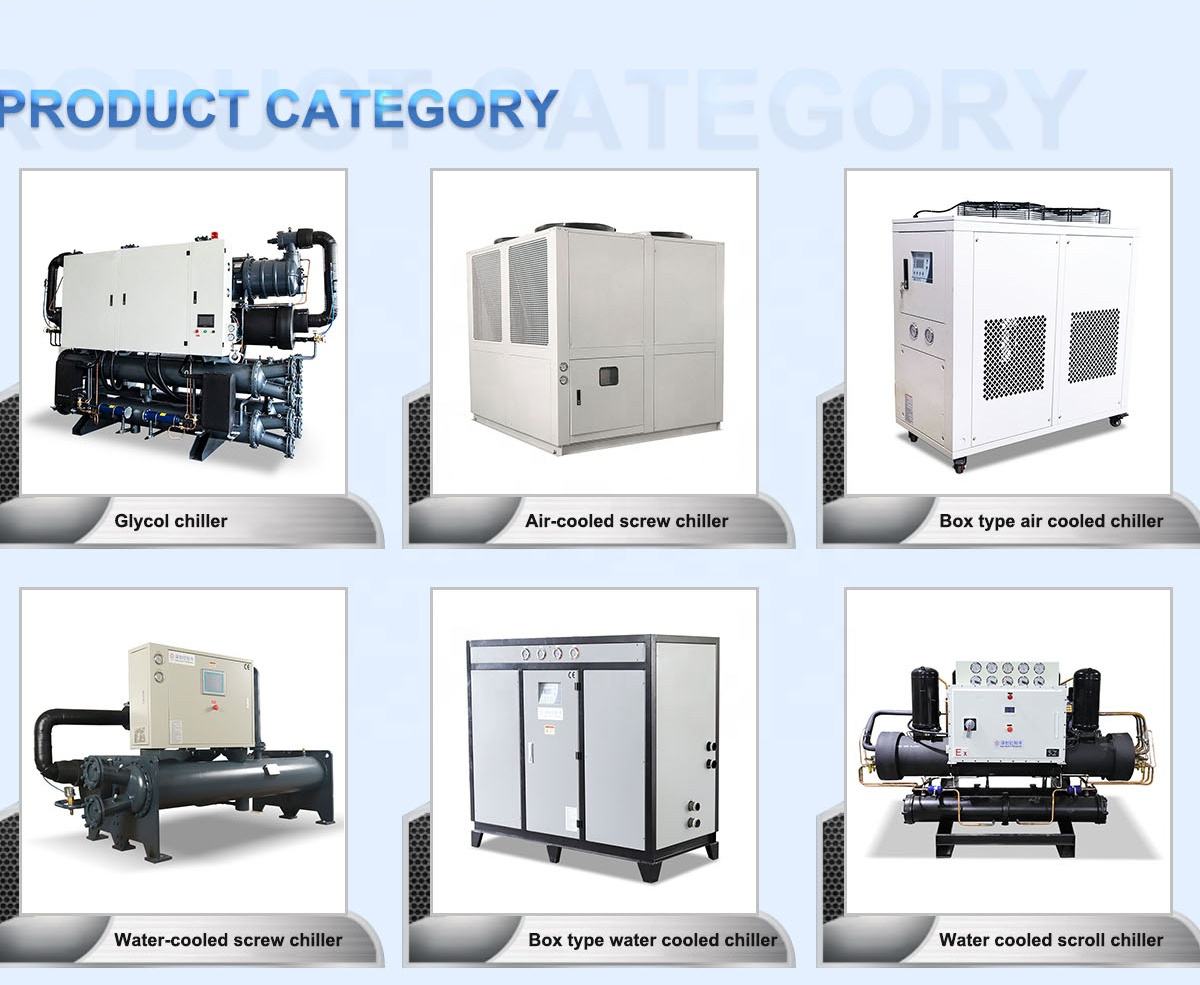
Air-Cooled Chillers ← This product
Air-cooled chillers reject heat directly to the ambient air using fans and air-cooled condenser coils:
Advantages:
- No cooling tower: Eliminates cooling tower capital cost, water consumption, water treatment, and Legionella risk
- Simpler installation: Single package unit — no cooling tower, no condenser water piping
- Lower maintenance: No cooling tower to clean, inspect, and treat
- No water consumption: Zero condenser water use — important in water-scarce regions
- No Legionella risk: Eliminates a significant health and regulatory compliance burden
- Faster commissioning: Simpler system commissions faster
Disadvantages:
- Lower efficiency: Air cooling is less effective than evaporative cooling — higher energy consumption per unit of cooling
- Ambient temperature sensitivity: Performance degrades at high ambient temperatures — must be sized for worst-case ambient conditions
- Larger footprint: Air-cooled condenser coils require more space than a cooling tower
For ice rink applications, air-cooled chillers are increasingly preferred because the elimination of cooling tower complexity, water treatment, and Legionella risk outweighs the efficiency penalty — particularly for smaller and medium-sized rinks where simplicity and reliability are paramount.
Sizing the Refrigeration System: 100 Tons for Ice Rinks
Understanding Refrigeration Tons
A “ton of refrigeration” is a unit of cooling capacity equal to 3.517 kW (or 12,000 BTU/hour) — the rate of heat absorption required to melt one short ton (2,000 lbs) of ice in 24 hours.
100 tons of refrigeration = 351.7 kW ≈ 352 kW of cooling capacity
Ice Rink Sizing Guidelines
The required refrigeration capacity depends on:
- Rink dimensions: Larger ice surface = more heat load
- Building insulation: Better insulation = lower heat load
- Climate: Warmer climate = higher heat load
- Usage intensity: More skaters and more resurfacing = higher peak load
- Ambient temperature: Higher ambient = lower chiller efficiency, higher required capacity
Approximate refrigeration requirements by rink size:
| Rink Type | Dimensions | Required Capacity |
|---|---|---|
| Small recreational | 20m × 40m | 60–100 tons |
| Standard recreational | 26m × 56m | 100–150 tons |
| NHL/Olympic size | 26m × 61m | 120–180 tons |
| Large arena | 30m × 65m | 150–250 tons |
| Multiple rinks | — | Sum of individual requirements |
The 100-ton chiller is well-suited for:
- Small to medium recreational rinks (20m × 40m to 26m × 56m) as the primary refrigeration unit
- Smaller rinks in cooler climates where ambient temperatures reduce heat load
- Secondary/backup unit for larger rinks
- Multiple small rinks (e.g., two 50-ton equivalent rinks)
For larger rinks or warmer climates, multiple units can be installed in parallel to achieve the required total capacity.
Ambient Temperature Derating
Air-cooled chiller capacity decreases as ambient temperature increases — the condenser becomes less effective at rejecting heat when the temperature difference between refrigerant and ambient air is smaller.
Typical derating for air-cooled chillers:
- At 25°C ambient: 100% rated capacity
- At 35°C ambient: 85–90% rated capacity
- At 40°C ambient: 75–85% rated capacity
- At 45°C ambient: 65–75% rated capacity
For ice rinks in warm climates (Southeast Asia, Middle East, tropical regions), the chiller must be sized for the maximum ambient temperature — not the average. A 100-ton chiller rated at 25°C ambient may deliver only 75–80 tons at 40°C ambient.
Confirm the chiller’s capacity at your maximum ambient temperature with the supplier before ordering.
Ice Rink Floor System: What the Chiller Connects To
The Ice Floor Construction
The ice rink floor is a carefully engineered system that distributes refrigerant or brine uniformly across the entire ice surface:
Layer structure (from bottom to top):
- Subgrade: Compacted soil or gravel base
- Insulation: Rigid foam insulation (100–200mm) — prevents ground heat from entering the ice floor
- Heating pipes (optional): Glycol heating pipes prevent ground freezing and frost heave
- Concrete slab: Structural concrete (150–200mm thick)
- Brine/refrigerant pipes: Embedded in or below the concrete — typically HDPE or steel pipes at 75–100mm spacing
- Concrete topping: Thin concrete layer over pipes
- Ice: 25–50mm of ice built up by flooding
Pipe spacing and layout:
- Pipes typically spaced 75–100mm apart
- Serpentine or header-and-branch layout
- Multiple circuits for uniform temperature distribution
- Total pipe length for a standard rink: 5,000–15,000 meters
Brine/Glycol System
The indirect refrigeration system uses a secondary fluid to transfer heat between the chiller and the ice floor:
Calcium chloride brine:
- Traditional secondary fluid
- Effective to -30°C
- Corrosive — requires corrosion inhibitors and compatible pipe materials
- Lower cost than glycol
Propylene glycol solution:
- Modern preferred secondary fluid
- Food-safe (important for ice used in food production)
- Less corrosive than calcium chloride
- Higher viscosity — requires more pumping energy
- Concentration adjusted for required freeze point
Brine temperature:
- Supply temperature: -8°C to -12°C (from chiller)
- Return temperature: -4°C to -8°C (from ice floor)
- Temperature differential: 3–5°C
Brine pumps:
- Circulate brine between chiller and ice floor
- Pump capacity: 50–200 m³/hour for a standard rink
- Pump head: 20–40m (depending on pipe length and diameter)
Energy Efficiency: The Dominant Operating Cost
Why Energy Efficiency Is Critical for Ice Rinks
Energy is the largest operating cost for most ice rinks — typically representing 30–50% of total operating expenses. For a standard recreational rink:
- Annual energy consumption: 800,000–1,500,000 kWh
- Energy cost at $0.10/kWh: $80,000–$150,000/year
- Energy cost at $0.15/kWh: $120,000–$225,000/year
Over a 20-year facility life, energy cost represents $1.6–$4.5 million — dwarfing the initial equipment investment. A 10% improvement in chiller efficiency saves $160,000–$450,000 over the facility’s life.
COP and EER: Measuring Chiller Efficiency
COP (Coefficient of Performance): COP = Cooling capacity (kW) / Power input (kW)
A chiller with COP of 3.0 delivers 3 kW of cooling for every 1 kW of electrical power consumed.
Typical COP values for air-cooled chillers:
- Standard efficiency: COP 2.5–3.0
- High efficiency: COP 3.0–3.8
- Premium efficiency: COP 3.8–4.5+
EER (Energy Efficiency Ratio): EER = Cooling capacity (BTU/hr) / Power input (W) EER = COP × 3.412
For ice rink chillers, the relevant efficiency metric is the COP at the actual operating conditions — brine supply temperature of -10°C and maximum ambient temperature for your location. Confirm the COP at these conditions with the supplier.
Energy-Saving Features
The “high efficiency and energy-saving” designation indicates the chiller incorporates features that reduce energy consumption:
Variable speed compressors:
- Inverter-driven compressors adjust speed to match actual cooling load
- At part load (common during off-peak hours), variable speed reduces energy consumption by 20–40% vs. fixed-speed compressors
- Eliminates on/off cycling — smoother operation, less wear
Variable speed condenser fans:
- Fan speed adjusted to ambient temperature and cooling load
- At low ambient temperatures, fans slow down — reducing fan energy consumption
- Significant savings during winter operation
Electronic expansion valves:
- Precise refrigerant flow control for optimal evaporator performance
- Maintains optimal superheat across all operating conditions
- Improves efficiency at part load
Economizer cycle:
- At low ambient temperatures, uses ambient air to pre-cool refrigerant
- Reduces compressor work — significant energy saving in cold weather
Demand-based control:
- Chiller capacity modulated based on actual ice temperature feedback
- Prevents over-cooling — maintains ice at target temperature without excess refrigeration
Energy Optimization Strategies for Ice Rinks
Ice temperature management:
- Maintain ice at the warmest acceptable temperature for the activity
- Hockey: -3°C to -5°C surface temperature
- Figure skating: -2°C to -4°C surface temperature
- Recreational skating: -2°C to -3°C surface temperature
- Each 1°C warmer ice surface reduces refrigeration load by approximately 5–8%
Off-peak operation:
- Pre-cool ice during off-peak electricity tariff periods
- Allow ice temperature to rise slightly during peak tariff periods
- Thermal mass of ice provides buffer — temperature changes slowly
Resurfacing optimization:
- Use hot water (not cold) for resurfacing — hot water produces clearer, harder ice
- Minimize resurfacing frequency during low-usage periods
- Schedule resurfacing during off-peak electricity periods
Building envelope:
- Insulate roof and walls to minimize solar and ambient heat gain
- LED lighting reduces heat load vs. metal halide or fluorescent
- Dehumidification reduces condensation on ice surface
Applications: Ice Rink Markets Worldwide
Commercial Recreational Ice Rinks
The largest market for ice rink refrigeration — public skating facilities operated as commercial businesses or community amenities:
Business models:
- Public skating sessions (admission fee)
- Ice hockey league rentals (team and league fees)
- Figure skating club rentals
- Learn-to-skate programs
- Birthday parties and private events
- Curling clubs
Revenue potential (standard recreational rink):
- Ice rental: $150–$300/hour
- Operating hours: 16–18 hours/day
- Annual revenue: $875,000–$1,971,000
Key markets:
- North America (Canada, USA) — mature market, replacement and upgrade demand
- Europe — established market, growing in Eastern Europe
- Asia (China, South Korea, Japan) — rapidly growing with Olympic legacy
- Middle East — indoor ice rinks in hot climates (Dubai, Riyadh, Doha)
- Southeast Asia — emerging market (Singapore, Malaysia, Thailand, Vietnam)
Hotel and Resort Ice Rinks
Luxury hotels and resorts increasingly offer ice skating as a premium amenity:
- Seasonal outdoor rinks (winter season)
- Year-round indoor rinks in resort facilities
- Rooftop ice rinks (architectural showcase)
- Ice skating as part of winter sports resort offering
Market: Middle East, Asia-Pacific luxury hotels, European ski resorts, North American resort destinations
Shopping Mall Ice Rinks
Ice skating rinks in shopping malls serve as anchor attractions that drive foot traffic:
- Typically 20m × 40m to 26m × 56m
- Open year-round
- Revenue from admission, skate rental, and food & beverage
- Anchor tenant status — favorable lease terms from mall operators
Market: Asia (China, Southeast Asia, Middle East) — rapidly growing as mall developers seek differentiated attractions
Sports Training Facilities
Dedicated ice hockey and figure skating training facilities:
- Multiple ice surfaces for different training groups
- NHL-size or Olympic-size ice
- Year-round operation
- Revenue from team training, individual coaching, and league play
Curling Facilities
Curling rinks have specific refrigeration requirements:
- Ice temperature: -3°C to -5°C (similar to skating)
- Ice surface: Pebbled texture (different from skating ice)
- Sheet dimensions: 42.07m × 4.75m per sheet
- Typical facility: 4–8 sheets
Ice Rink Construction: The Complete System
The 100-ton chiller is one component of a complete ice rink refrigeration system. Understanding the full system helps plan the project:
Complete Ice Rink Refrigeration System
1. Chiller (this product): $22,290
- Produces chilled brine at -10°C
- Air-cooled — no cooling tower required
2. Brine storage tank: $3,000–$8,000
- Buffer tank for brine volume
- Allows chiller to operate at steady state
3. Brine circulation pumps: $5,000–$15,000
- Circulate brine between chiller and ice floor
- Typically 2 pumps (duty + standby)
4. Ice floor piping system: $30,000–$80,000
- HDPE or steel pipes embedded in concrete
- Headers, manifolds, and connections
- Insulation beneath floor
5. Concrete ice floor: $20,000–$50,000
- Structural concrete with embedded pipes
- Insulation layer beneath
6. Control system: $5,000–$15,000
- PLC-based control of chiller, pumps, and ice temperature
- Remote monitoring capability
7. Refrigerant piping and fittings: $5,000–$15,000
- Connecting chiller to brine system
8. Electrical installation: $10,000–$25,000
- Power supply, switchgear, and wiring
Total refrigeration system cost: $100,000–$208,000
The chiller at $22,290 represents approximately 10–22% of the total refrigeration system cost — the largest single equipment item but far from the only cost in a complete ice rink refrigeration installation.
Project Timeline
Design phase (4–8 weeks):
- Ice floor layout design
- Refrigeration system sizing and specification
- Electrical and structural design
- Permitting
Construction phase (12–24 weeks):
- Site preparation and subgrade
- Insulation installation
- Ice floor pipe installation
- Concrete pour and curing
- Chiller installation
- Piping and electrical installation
Commissioning phase (2–4 weeks):
- System pressure testing
- Refrigerant charging
- Brine filling and circulation testing
- Ice making (first ice build: 3–7 days)
- Performance verification
Total project timeline: 18–36 weeks from design start to first ice
Featured Product: 100 Ton Ice Rink Air Cooled Chiller on MEGA BDM
MEGA BDM has sourced and verified the Ice Rink Engineering Construction 100 Ton High Efficiency Energy-Saving Air Cooled Chiller from a verified global refrigeration equipment manufacturer with proven ice rink system design, manufacturing, and international project experience.
👉 View the Ice Rink 100 Ton Chiller on MEGA BDM
Frequently Asked Questions
What refrigerant does the chiller use?
Confirm the refrigerant type with the supplier. Modern high-efficiency chillers typically use R410A, R32, R134a, or low-GWP alternatives (R1234ze, R513A). Confirm compliance with refrigerant regulations in your country — F-Gas regulations in the EU restrict high-GWP refrigerants.
What is the COP at ice rink operating conditions?
Request the COP at your specific operating conditions — brine supply temperature (-10°C typical) and maximum ambient temperature for your location. This is the most important efficiency specification for ice rink applications.
Can multiple units be paralleled for larger rinks?
Yes — multiple chillers can be installed in parallel to achieve higher total capacity. Parallel operation also provides redundancy — if one chiller fails, the others maintain partial ice surface temperature. Confirm parallel operation capability and control integration with the supplier.
What power supply is required?
Confirm the electrical specifications — voltage (380V/400V/415V 3-phase typical), frequency (50Hz or 60Hz), and maximum power demand (kW). Ensure your electrical supply can accommodate the chiller’s starting current (typically 3–5× running current for fixed-speed compressors; much lower for variable speed).
What maintenance does the chiller require?
Air-cooled chillers require: regular condenser coil cleaning (quarterly to annually depending on environment), refrigerant leak checks, compressor oil analysis, filter replacement, and annual performance verification. Confirm the maintenance schedule and requirements with the supplier.
Is the chiller suitable for outdoor installation?
Air-cooled chillers are designed for outdoor installation — confirm the IP rating of electrical components and the operating ambient temperature range with the supplier for your climate.
Conclusion
The 100 Ton High Efficiency Energy-Saving Air Cooled Chiller for ice rink engineering represents a complete, factory-assembled refrigeration solution that simplifies ice rink construction, eliminates cooling tower complexity, and delivers reliable ice surface performance at a capital cost of $22,290.
For ice rink developers, operators, and engineers evaluating refrigeration options, the air-cooled chiller’s combination of simplified installation, zero water consumption, eliminated Legionella risk, and competitive efficiency makes it the preferred choice for small to medium recreational rinks, hotel and resort ice attractions, and shopping mall skating facilities worldwide.
As ice skating continues its global expansion — driven by Olympic legacy, growing middle-class leisure spending in Asia and the Middle East, and the enduring appeal of ice as a premium entertainment experience — the demand for reliable, efficient, and cost-effective ice rink refrigeration systems has never been stronger.
👉 View the full product details on MEGA BDM