
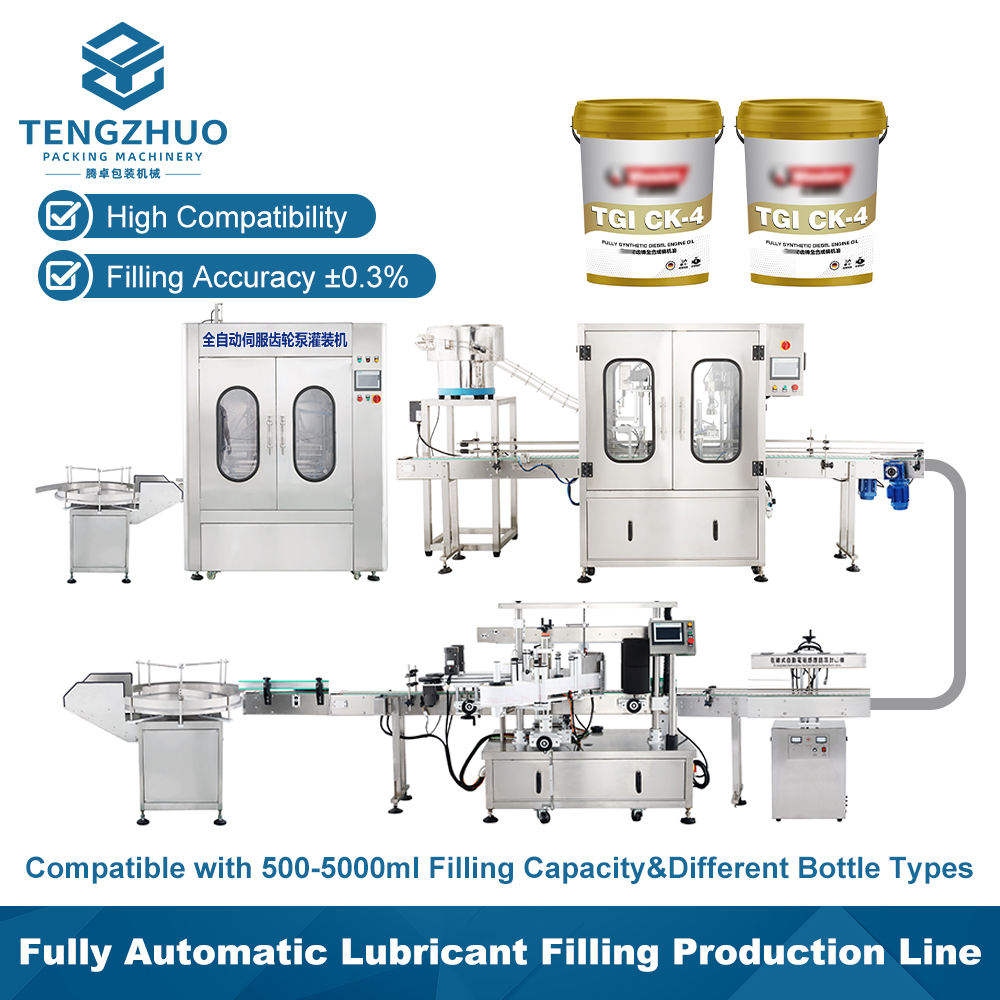
Introduction: The Filling Line — Where Product Becomes Profit
Every lubricant blender, chemical manufacturer, and industrial fluid producer faces the same bottleneck: the filling line. You can source the best base oils, blend the most advanced additive packages, and develop the most competitive product formulations — but if your filling operation is slow, inaccurate, or labor-intensive, your cost per unit is too high and your production capacity is too low to compete.
The global lubricant market alone exceeds $150 billion annually. The industrial chemical packaging market adds hundreds of billions more. And across all of these categories, the manufacturers who win on margin are the ones who have automated their filling operations — replacing manual or semi-automatic filling with fully automatic, smart filling lines that deliver consistent accuracy, high throughput, and minimal labor cost per unit.
The Customizable High Productivity Fully Automatic Chemical Lubricant Filling Production Line available through MEGA BDM at $12,000 represents exactly this automation opportunity — a complete, smart filling system for chemical, lubricant, oil, and industrial fluid products, configurable for your specific containers, fill volumes, and production requirements.
At $12,000, this is one of the most accessible entry points to fully automatic liquid filling in the industrial chemical and lubricant sector — and one of the highest-ROI capital investments available in liquid product manufacturing.
The Lubricant and Chemical Filling Market: Why Automation Is Non-Negotiable
The Scale of the Opportunity
Global lubricant market:
- Market size: $150+ billion annually
- Volume: 35+ million metric tons per year
- Key segments: Automotive engine oils, industrial lubricants, marine lubricants, metalworking fluids
- Growth: 2–4% annually, driven by automotive production and industrial activity
Industrial chemical packaging:
- Solvents, cleaners, degreasers: $50+ billion market
- Agricultural chemicals: $250+ billion market
- Household chemicals: $200+ billion market
- Automotive fluids (brake fluid, coolant, transmission fluid): $30+ billion market
The packaging opportunity: Every liter of lubricant or chemical that reaches the end user passes through a filling line. The filling operation is the final value-adding step before the product reaches the customer — and it is the step where cost control has the most direct impact on margin.
The Cost of Manual and Semi-Automatic Filling
Many small and medium lubricant blenders and chemical manufacturers still rely on manual or semi-automatic filling:
Manual filling:
- Operator fills each container individually using a gravity or pump-fed nozzle
- Speed: 100–300 containers/hour (1L containers)
- Fill accuracy: ±2–5% (operator-dependent)
- Labor cost: 1–2 operators per filling station
- Spillage and waste: 2–5% of product
Semi-automatic filling:
- Operator positions container, machine fills to preset volume, operator removes container
- Speed: 300–800 containers/hour
- Fill accuracy: ±1–2%
- Labor cost: 1 operator per machine
- Spillage: 1–2%
Fully automatic filling (this product):
- Automated container feeding, filling, capping, and discharge
- Speed: 800–3,000+ containers/hour (depending on configuration)
- Fill accuracy: ±0.5%
- Labor cost: 0.5 operators per line (supervision only)
- Spillage: <0.5%
The economics of automation are compelling. At 1,000 containers/hour with a $0.50 labor saving per container vs. manual filling, a fully automatic line saves $500/hour — paying back a $12,000 investment in 24 hours of operation.
Understanding the Filling Line: Core Components and Technology
Container Feeding System
The filling line begins with automated container feeding — delivering empty containers to the filling station in a continuous, controlled flow:
Unscrambler:
- Bulk containers (bottles, cans, jerricans) loaded into a hopper
- Unscrambler orients containers upright and feeds them onto the conveyor
- Handles round, square, and rectangular containers
- Speed: Matched to filling line throughput
Conveyor system:
- Stainless steel or plastic chain conveyor
- Variable speed drive — adjustable to match filling speed
- Container guides and rails for different container widths
- Accumulation zones to buffer between stations
Container detection:
- Sensors detect container presence at each station
- Missing container detection prevents filling without a container
- Jam detection stops the line if containers back up
Filling System: The Heart of the Line
The filling system is the most critical component — it determines fill accuracy, speed, and product compatibility:
Filling technologies for chemical and lubricant products:
Flow meter filling:
- Electromagnetic or Coriolis flow meter measures the volume of liquid dispensed
- Accuracy: ±0.5% of fill volume
- Suitable for: Low to medium viscosity liquids (water-thin to light oil viscosity)
- Speed: High — flow meter responds quickly, enabling fast fill cycles
- Advantages: No moving parts in contact with product, easy cleaning, handles foamy products
Weighing (gravimetric) filling:
- Load cell weighs the container during filling, stops when target weight is reached
- Accuracy: ±0.1–0.3% of fill weight
- Suitable for: Any viscosity — thin liquids to thick greases
- Speed: Moderate — weighing requires settling time
- Advantages: Highest accuracy, handles viscous products, compensates for density variation
Piston filling:
- Piston displaces a fixed volume of liquid per stroke
- Accuracy: ±0.5–1.0%
- Suitable for: Medium to high viscosity products (gear oils, greases, pastes)
- Speed: Moderate
- Advantages: Handles viscous products, simple mechanism, easy maintenance
Peristaltic pump filling:
- Peristaltic pump meters liquid by tube compression
- Accuracy: ±0.5–1.0%
- Suitable for: Corrosive chemicals, shear-sensitive products
- Speed: Moderate
- Advantages: No product contact with pump mechanism, easy to clean, handles aggressive chemicals
For chemical and lubricant filling, flow meter or weighing filling is most common — confirm the filling technology with the supplier for your specific product viscosity and accuracy requirements.
Multi-Head Filling
High-productivity filling lines use multiple filling heads operating simultaneously:
2-head filling: 2 containers filled simultaneously — doubles throughput vs. single head 4-head filling: 4 containers filled simultaneously — quadruples throughput 6-head or 8-head filling: For very high-speed production lines
The number of filling heads determines the line’s maximum throughput. Confirm the number of heads with the supplier for your required production rate.
Capping System
After filling, containers must be sealed immediately to prevent spillage, contamination, and evaporation:
Screw capping:
- Rotary screw capper applies and torques screw caps
- Torque control ensures consistent seal without over-tightening
- Handles: HDPE caps, PP caps, metal caps with plastic liners
- Speed: 20–100 caps/minute per head
Snap capping:
- Press-on caps applied by downward pressure
- Suitable for: Snap-fit HDPE and PP caps
- Speed: 30–120 caps/minute
Induction sealing:
- Electromagnetic induction heats a foil liner inside the cap, sealing it to the container neck
- Provides tamper-evident seal
- Suitable for: Products requiring hermetic seal (chemicals, pharmaceuticals)
Trigger sprayer and pump dispenser application:
- Automated application of trigger sprayers and pump dispensers
- Suitable for: Household chemical products, cleaning products
Labeling System
Labeling is the final step before the filled and capped container is ready for shipment:
Self-adhesive labeling:
- Roll-fed self-adhesive labels applied by a labeling head
- Wrap-around labeling for round containers
- Front and back labeling for flat containers
- Speed: 20–150 containers/minute
Sleeve labeling:
- Heat-shrink sleeve labels applied over the container
- Full-body coverage for complex label designs
- Tamper-evident capability
Batch coding:
- Inkjet or laser coding of production date, batch number, and expiry date
- Applied to the container or label
- Required for regulatory compliance in most markets
Control System
The smart filling line’s intelligence resides in its control system:
PLC (Programmable Logic Controller):
- Controls all machine functions — conveyor speed, filling volume, capping torque, labeling position
- Recipe management — stores parameters for different products and container sizes
- Alarm management — detects and alerts on faults, missing containers, low product level
HMI (Human Machine Interface):
- Touchscreen display for operator control and monitoring
- Recipe selection — operator selects product/container combination, machine automatically sets parameters
- Production data — containers filled, fill accuracy, line speed, downtime tracking
- Fault diagnostics — identifies fault location and suggests corrective action
Fill accuracy monitoring:
- Real-time monitoring of fill weight or volume
- Statistical process control — alerts when fill accuracy drifts outside specification
- Automatic adjustment of fill parameters to maintain accuracy
Chemical and Lubricant Compatibility: Material Selection
The Corrosion Challenge
Chemical and lubricant products present significant material compatibility challenges for filling equipment:
Petroleum-based lubricants (engine oils, gear oils, hydraulic fluids):
- Compatible with: Stainless steel, carbon steel, most plastics
- Incompatible with: Natural rubber (swells and degrades)
- Seals: Nitrile (NBR) or Viton (FKM) recommended
Synthetic lubricants (PAO, ester-based):
- Compatible with: Stainless steel, most metals
- Incompatible with: Some plastics and elastomers — confirm compatibility
- Seals: Viton (FKM) recommended
Solvents (acetone, MEK, toluene, xylene):
- Compatible with: Stainless steel, PTFE
- Incompatible with: Most plastics, natural rubber, many elastomers
- Seals: PTFE or Viton (FKM) required
Acids (hydrochloric, sulfuric, phosphoric):
- Compatible with: 316L stainless steel, HDPE, PP, PTFE
- Incompatible with: Carbon steel, aluminum, most metals
- Seals: PTFE or EPDM required
Alkalis (sodium hydroxide, potassium hydroxide):
- Compatible with: 316L stainless steel, HDPE, PP
- Incompatible with: Aluminum, zinc
- Seals: EPDM or Viton (FKM) recommended
Agricultural chemicals (pesticides, herbicides):
- Highly variable — confirm specific chemical compatibility with supplier
- Generally: 316L stainless steel + PTFE seals for broad compatibility
Confirm the specific materials of construction and seal materials with the supplier for your product chemistry. Incorrect material selection can result in rapid corrosion, seal failure, and product contamination.
Container Formats: What This Line Can Fill
Container Types
HDPE bottles (1L, 2L, 4L, 5L):
- Most common format for automotive engine oils and lubricants
- Round or rectangular cross-section
- Screw cap closure
HDPE jerricans (10L, 20L, 25L):
- Industrial lubricant and chemical packaging
- Rectangular with handle
- Screw cap or UN-approved closure
Metal cans (1L, 4L, 5L, 20L):
- Traditional format for premium lubricants and paints
- Lever-lid or screw cap closure
- Requires can-compatible filling nozzle
PET bottles (250mL, 500mL, 1L):
- Household chemical products, automotive fluids
- Transparent — product visibility
- Screw cap or trigger sprayer closure
Drums (200L):
- Industrial bulk lubricant and chemical packaging
- Typically filled by separate drum filling station
- Confirm drum filling capability with supplier
Container Size Changeover
A key advantage of the customizable filling line is the ability to handle multiple container sizes on the same line:
Quick-change format parts:
- Container guides, filling nozzle height, capping head, and labeling position adjusted for each container size
- Changeover time: 15–45 minutes with quick-change tooling
- Recipe-based changeover — operator selects new container size, machine automatically adjusts parameters
Confirm the range of container sizes and changeover time with the supplier for your product range.
Applications: Who Needs This Filling Line
Lubricant Blenders and Distributors
Independent lubricant blenders:
- Blend base oils and additives to produce finished lubricants
- Fill into branded or private-label containers
- Market: Automotive workshops, industrial maintenance, fleet operators
Lubricant distributors with private label:
- Source finished lubricants from major producers
- Fill into own-brand containers for retail or industrial sale
- Market: Automotive parts retailers, industrial distributors
OEM lubricant suppliers:
- Supply lubricants under automotive OEM brands (Ford, Toyota, Caterpillar)
- Strict fill accuracy and quality requirements
- High-volume production
Chemical Manufacturers and Distributors
Industrial chemical manufacturers:
- Produce solvents, cleaners, degreasers, and specialty chemicals
- Fill into containers for industrial and commercial sale
- Market: Manufacturing plants, maintenance contractors, cleaning companies
Agricultural chemical distributors:
- Distribute pesticides, herbicides, and fertilizer solutions
- Fill into containers for agricultural retail
- Market: Farmers, agricultural cooperatives, garden centers
Household chemical manufacturers:
- Produce detergents, disinfectants, and cleaning products
- Fill into consumer packaging for retail sale
- Market: Supermarkets, hardware stores, online retail
Automotive Fluid Manufacturers
Brake fluid, coolant, and transmission fluid:
- Automotive OEM and aftermarket fluid manufacturers
- Fill into 250mL, 500mL, 1L, and 5L containers
- Market: Automotive parts retailers, service stations, workshops
Windshield washer fluid:
- High-volume, low-margin product — automation essential for profitability
- Fill into 1L, 2L, and 5L containers
- Market: Automotive retailers, supermarkets, petrol stations
ROI Analysis: The Economics of Automatic Filling
Investment: $12,000
Labor Cost Savings
Manual filling baseline:
- 2 operators × $8/hour = $16/hour labor cost
- Output: 400 containers/hour (1L containers)
- Labor cost per container: $0.040
Automatic filling line:
- 0.5 operators × $8/hour = $4/hour labor cost (supervision only)
- Output: 1,200 containers/hour
- Labor cost per container: $0.003
Labor saving per container: $0.037 Annual labor saving (8,000 hours/year): $296/hour × 8,000 = $296,000
Wait — let’s be more conservative:
Conservative scenario:
- Labor saving: $8/hour (replacing 1 operator)
- Operating hours: 2,000 hours/year (single shift, 250 days)
- Annual labor saving: $16,000
- Payback: 9 months
Moderate scenario:
- Labor saving: $20/hour (replacing 2.5 operators)
- Operating hours: 4,000 hours/year (double shift)
- Annual labor saving: $80,000
- Payback: 1.8 months
High-volume scenario:
- Labor saving: $30/hour
- Operating hours: 6,000 hours/year
- Annual labor saving: $180,000
- Payback: 3 weeks
Fill Accuracy Savings
Manual filling waste (±3% overfill average):
- 1,000 containers/day × 1L × $2/L product cost × 3% overfill = $60/day waste
- Annual waste: $15,000–$20,000
Automatic filling waste (±0.5% overfill):
- Same scenario: $10/day waste
- Annual waste: $2,500–$3,500
Annual fill accuracy saving: $12,000–$17,000 — nearly the entire cost of the machine, recovered in the first year from fill accuracy alone.
Throughput Increase
Manual filling capacity: 400 containers/hour × 2,000 hours = 800,000 containers/year Automatic filling capacity: 1,200 containers/hour × 2,000 hours = 2,400,000 containers/year
3× throughput increase without additional labor — enabling revenue growth without proportional cost increase.
Customization: Configuring the Line for Your Application
What “Customizable” Means
The filling line’s customizability is one of its most important commercial features — it means the line can be configured for your specific products, containers, and production requirements rather than forcing you to adapt your products to the machine’s limitations.
Customizable parameters:
Fill volume range:
- Minimum fill: 100mL (confirm with supplier)
- Maximum fill: 20L+ (confirm with supplier)
- Fill volume adjustment: Via HMI recipe — no mechanical adjustment required
Container size range:
- Minimum container diameter: 50mm (confirm with supplier)
- Maximum container diameter: 300mm+ (confirm with supplier)
- Container height range: 100–500mm (confirm with supplier)
Filling speed:
- Adjustable via HMI — match filling speed to downstream capping and labeling capacity
- Slower speed for viscous products, faster for thin liquids
Number of filling heads:
- 2, 4, 6, or 8 heads depending on required throughput
- More heads = higher throughput, higher cost
Filling technology:
- Flow meter, weighing, piston, or peristaltic — selected based on product viscosity and accuracy requirements
Capping type:
- Screw cap, snap cap, induction seal, or trigger sprayer — selected based on container closure type
Labeling:
- Self-adhesive wrap-around, front/back, or sleeve labeling — selected based on label design
Confirm all customization options and their impact on price with the supplier before ordering.
Featured Product: Automatic Chemical Lubricant Filling Line on MEGA BDM
MEGA BDM has sourced and verified the Customizable High Productivity Fully Automatic Chemical Lubricant Filling Production Line with Smart Filling Equipment from a verified global filling machinery manufacturer with proven automatic filling line design, manufacturing, and international export experience across chemical, lubricant, oil, and industrial fluid applications.
👉 View the Automatic Chemical Lubricant Filling Line on MEGA BDM
Frequently Asked Questions
What filling speed (containers per hour) does this line achieve?
Confirm the filling speed with the supplier for your specific container size and fill volume. Speed varies significantly by container size — a 1L container fills faster than a 20L jerrican. Provide your container size and required output for an accurate specification.
What viscosity range can this line handle?
Confirm the viscosity range with the supplier. Most automatic filling lines handle thin liquids (water viscosity) to medium-viscosity oils (SAE 40–50 engine oil). Very high viscosity products (greases, bitumen) may require specialized equipment.
What container sizes does the line accommodate?
Confirm the minimum and maximum container size (diameter, height, volume) with the supplier. Provide your full range of container sizes to confirm all can be handled on a single line.
What fill accuracy does the line achieve?
Confirm the fill accuracy specification (±%) with the supplier for your filling technology (flow meter, weighing, piston). Request fill accuracy test data for your specific product and container.
What is the changeover time between container sizes?
Confirm the changeover time and procedure with the supplier. Quick-change tooling can reduce changeover to 15–30 minutes — important if you run multiple container sizes on the same line.
What after-sales support and spare parts are available?
Confirm the supplier’s after-sales support, spare parts availability, and remote troubleshooting capability. Request a recommended spare parts list and confirm availability in your region.
Conclusion
The Fully Automatic Chemical Lubricant Filling Production Line with Smart Filling Equipment delivers what every lubricant blender, chemical manufacturer, and industrial fluid producer ultimately needs: a complete, automated filling system that produces consistently filled, accurately sealed, and properly labeled containers — at the throughput and cost per unit that competitive manufacturing demands.
At $12,000 — with payback periods measured in weeks to months and annual savings of $16,000–$180,000 depending on production volume — this filling line is one of the most accessible and highest-ROI automation investments available in liquid product manufacturing. For lubricant blenders replacing manual filling, chemical distributors scaling up private-label production, and automotive fluid manufacturers reducing labor cost, the fully automatic filling line is the investment that transforms a labor-intensive bottleneck into a competitive advantage.
👉 View the full product details on MEGA BDM