
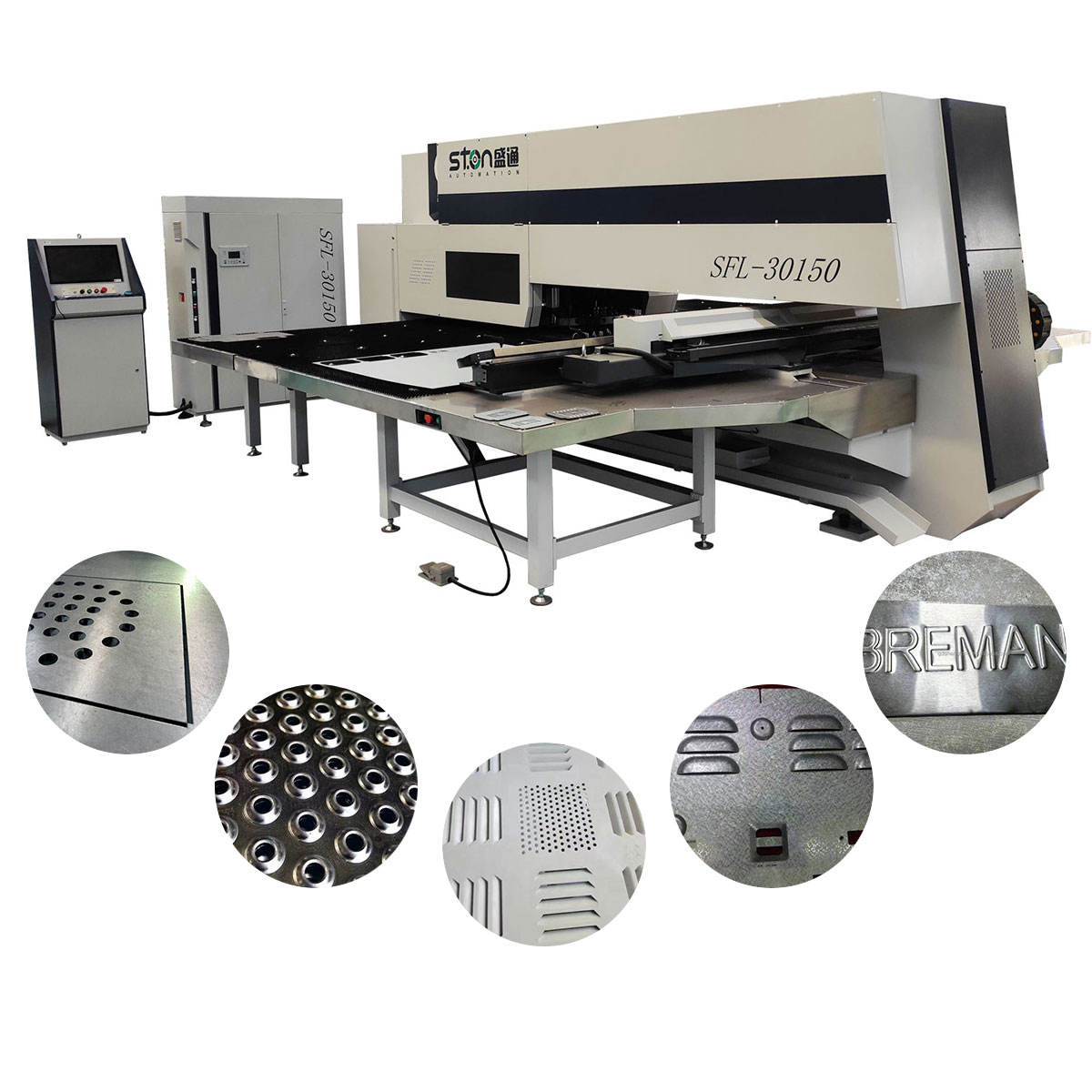
Introduction: The Turret Punch — The Swiss Army Knife of Sheet Metal Fabrication
In sheet metal fabrication, there is one machine that stands apart for its versatility, speed, and ability to transform a flat sheet of metal into a complex, multi-feature component in a single automated operation: the CNC turret punching machine.
While laser cutters get the headlines and press brakes shape the final form, the turret punch is the workhorse that punches hundreds of holes, forms embossed features, creates louvers, countersinks, and taps threads — all in one setup, at speeds that no other sheet metal process can match for high-volume, multi-feature parts.
The global sheet metal fabrication market exceeds $300 billion annually. Electrical enclosures, HVAC panels, elevator cabs, server racks, automotive brackets, telecommunications equipment — virtually every metal product with holes, slots, and formed features passes through a turret punch at some point in its production journey.
The FANUC CNC Turret Punching Machine with High Precision Control System available through MEGA BDM at $126,000 brings the world’s most trusted CNC control platform to a professional-grade turret punch — delivering the accuracy, speed, and reliability that competitive sheet metal fabrication demands.
The Turret Punching Machine: Architecture and Operating Principle
How a Turret Punch Works
The CNC turret punching machine is a deceptively elegant machine — its operating principle is straightforward, but the engineering required to execute it at high speed and precision is sophisticated:
The turret: A rotating disc (the turret) holds multiple punch and die sets in indexed stations around its circumference. The turret rotates under CNC control to position the required tool at the punching station. A typical turret holds 20–72 tool stations, each loaded with a different punch and die combination.
The sheet positioning system: The sheet metal workpiece is held by pneumatic clamps on a CNC-controlled X-Y positioning table. The table moves the sheet under the punching station with servo-driven precision — positioning the sheet so that the correct location is under the selected tool.
The punch stroke: When the sheet is positioned and the correct tool is indexed, the punch ram drives the punch through the sheet into the die below — creating a hole, slot, or formed feature. The punch stroke is typically hydraulic or servo-electric.
The cycle:
- Sheet loaded onto table, clamped
- CNC program selects tool (turret indexes)
- CNC program positions sheet (X-Y table moves)
- Punch stroke executed
- Steps 2–4 repeat for each feature
- Sheet unloaded
The speed advantage: A modern CNC turret punch can execute 300–1,000+ punch strokes per minute. A sheet with 200 holes can be completely punched in 30–60 seconds — a task that would take a manual punch press operator 30–60 minutes.
Turret Tool Stations: The Versatility Engine
The turret’s multiple tool stations are what make the turret punch so versatile. Each station can hold a different tool:
Round punches: The most common — for circular holes of various diameters
Oblong/slot punches: For elongated holes and slots
Square/rectangular punches: For square and rectangular cutouts
Special shape punches: D-shapes, triangles, hexagons, and custom profiles
Forming tools:
- Emboss tools: Create raised or recessed features (stiffening ribs, logos, identification marks)
- Louver tools: Create ventilation louvers in a single stroke
- Countersink tools: Create countersunk holes for flush fasteners
- Lance and form tools: Create tabs, bridges, and formed features
- Extrusion tools: Create extruded holes for thread tapping
Tapping tools: Some turret punches include tapping stations — creating threaded holes without a separate tapping operation
Marking tools: Stamp part numbers, revision levels, and identification marks directly on the sheet
The combination of these tools in a single turret means a complex sheet metal part with round holes, slots, louvers, embosses, and countersinks can be completely processed in one setup — eliminating the multiple machine setups and material handling that would otherwise be required.
FANUC Control: Why It Defines This Machine
FANUC — The World’s CNC Standard
FANUC (Fujitsu Automatic Numerical Control) is the world’s largest manufacturer of CNC systems by installed base — with over 4 million CNC systems installed globally across machine tools, robots, and factory automation equipment.
In sheet metal fabrication specifically, FANUC is the dominant CNC platform — found on turret punches, press brakes, laser cutters, and panel benders from virtually every major machine tool manufacturer. This dominance is not accidental — it reflects decades of proven performance in demanding production environments.
Why FANUC is the preferred control for turret punching:
Processing speed: FANUC’s high-speed processing capability handles the complex, multi-axis coordinated motion required for turret punching — simultaneous X-Y sheet positioning, turret indexing, and punch stroke timing — at maximum machine speed without hesitation or lag.
Positioning accuracy: FANUC servo systems deliver positioning accuracy of ±0.01mm or better — critical for hole patterns that must align with mating components, PCB mounting holes, and precision assemblies.
Program capacity: FANUC controls store thousands of part programs — enabling rapid changeover between different parts without re-programming at the machine.
CAM software compatibility: Every major sheet metal CAM software (Radan, Metalix, Lantek, SigmaNEST, Alma) has proven FANUC post-processors — programs generated offline run on the machine without modification.
Operator familiarity: FANUC is the most widely trained CNC platform globally — operators who have worked on any FANUC-controlled machine can work on this turret punch with minimal retraining.
Global support: FANUC has service centers and certified engineers in 100+ countries — spare parts are available globally, and technical support is accessible 24/7 for critical production situations.
FANUC Features Specific to Turret Punching
High-speed look-ahead: FANUC’s look-ahead function pre-reads upcoming program blocks and optimizes the motion profile — maintaining maximum speed through complex punch sequences without unnecessary deceleration.
Turret indexing optimization: FANUC’s control optimizes turret rotation direction (clockwise or counterclockwise) to minimize indexing time — always taking the shortest path to the next tool station.
Nibbling cycles: Built-in nibbling cycles enable the creation of large cutouts by overlapping punch strokes — the FANUC control manages the overlap and step distance automatically.
Forming cycles: Dedicated forming cycles for louvers, embosses, and countersinks — the operator specifies the feature parameters, the control generates the required punch sequence.
Sheet repositioning: When a sheet is too large for a single clamp position, FANUC’s repositioning function automatically moves the clamps and repositions the sheet — enabling processing of sheets larger than the standard table travel.
Turret Punch vs. Laser Cutter: Choosing the Right Technology
The Technology Decision
Sheet metal fabricators frequently face the choice between turret punching and laser cutting for hole-making and profile cutting. Understanding the strengths of each technology is essential for making the right investment decision.
Turret punch advantages:
Speed for hole-intensive parts: For parts with many holes (>20 holes per sheet), turret punching is significantly faster than laser cutting. A turret punch creates each hole in a single stroke (0.1–0.3 seconds); a laser must trace the entire hole perimeter (0.5–2 seconds per hole for small holes).
Forming capability: Laser cutters cannot form — they can only cut. Turret punches create louvers, embosses, countersinks, and extruded holes that laser cutters cannot produce. Parts requiring formed features must go through a turret punch regardless of whether a laser is also used.
Lower operating cost: Turret punch operating cost (tooling wear, electricity) is significantly lower than laser cutting (laser gas, laser source maintenance, electricity). For high-volume production of standard parts, turret punching is more economical.
Edge quality for punched holes: Punched holes have a clean, consistent edge quality that is ideal for fastener holes — no heat-affected zone, no dross, no oxidation.
Laser cutter advantages:
Complex profiles: Laser cutters excel at cutting complex external profiles, curves, and intricate shapes that turret punches cannot produce (or can only approximate by nibbling).
No tooling required: Laser cutters require no tooling — any shape can be cut without a corresponding punch and die. Turret punches require a punch and die for each hole shape and size.
Thin material advantage: For very thin materials (<0.5mm), laser cutting is more practical — thin materials can be difficult to punch without distortion.
The practical conclusion: Most competitive sheet metal fabrication shops have both technologies — turret punches for hole-intensive, forming-required parts, and laser cutters for complex profiles and thin materials. The FANUC CNC Turret Punch at $126,000 is the essential complement to a laser cutter, not a replacement for it.
Turret Punch vs. Punch Press
Single-station punch press:
- One tool at a time — manual tool change between operations
- Suitable for: Simple parts with few hole types, very high volume of identical parts
- Limitations: Slow for multi-feature parts, labor-intensive tool changes
CNC turret punch:
- 20–72 tools available without manual change
- Suitable for: Complex parts with multiple hole types and formed features, medium to high volume
- Advantages: Dramatically faster for multi-feature parts, minimal operator intervention
For any sheet metal fabricator producing parts with more than 3–4 different hole types or formed features, the CNC turret punch is the correct investment.
Sheet Metal Materials: What the Turret Punch Processes
Mild Steel (Low Carbon Steel)
Grades: S235, S275, S355 (European); A36, A572 (US); Q235, Q345 (Chinese)
Thickness range: 0.5–6.0mm (typical for turret punching)
Applications: Electrical enclosures, HVAC panels, structural brackets, general fabrication
Punching characteristics:
- Excellent punchability — clean shear, minimal burr
- Punching force: Moderate — standard tooling handles all standard thicknesses
- Tool life: Good — mild steel is not abrasive
Stainless Steel
Grades: 304, 316, 430 (most common for sheet metal)
Thickness range: 0.5–4.0mm (turret punching)
Applications: Food processing equipment, pharmaceutical equipment, architectural panels, marine applications
Punching characteristics:
- Work-hardening tendency — stainless steel hardens as it is punched, increasing punching force
- Requires higher punching force than mild steel of the same thickness
- Tool life: Shorter than mild steel — stainless is more abrasive
- Burr: Tendency to produce larger burr — may require deburring
Confirm maximum stainless steel thickness with the supplier for this specific machine configuration.
Aluminum
Grades: 1050, 3003, 5052, 6061 (most common for sheet metal)
Thickness range: 0.5–6.0mm (turret punching)
Applications: Aerospace panels, electronics enclosures, automotive trim, architectural cladding
Punching characteristics:
- Soft and ductile — low punching force
- Tendency to stick to punch face — requires punch with special coating or geometry
- Tool life: Excellent — aluminum is not abrasive
- Burr: Minimal with correct tooling
Copper and Brass
Applications: Electrical busbars, decorative panels, heat exchanger components
Punching characteristics:
- Soft and ductile — low punching force
- Excellent punchability
- Tool life: Good
Applications: Industries and Products That Rely on Turret Punching
Electrical Enclosures and Control Panels
The electrical enclosure industry is the largest single market for CNC turret punching — virtually every electrical enclosure, distribution board, and control panel is manufactured using a turret punch:
Typical features:
- Cable entry knockouts (round holes, various diameters)
- Ventilation holes and louvers
- Mounting holes for DIN rails, cable trays, and equipment
- Gland plate holes for cable glands
- Earthing stud holes
- Nameplate and label mounting holes
Volume: A single electrical enclosure may have 50–500 punched features — the turret punch’s speed advantage is decisive.
Materials: Mild steel (1.0–2.0mm), stainless steel (1.0–2.0mm), aluminum (1.5–3.0mm)
Key customers: Schneider Electric, ABB, Rittal, Legrand, and thousands of regional enclosure manufacturers
HVAC and Ventilation
Ductwork components:
- Rectangular and round duct sections with mounting holes
- Damper blades with pivot holes
- Diffuser and grille panels with ventilation patterns
Air handling units:
- Panel sections with ventilation louvers
- Mounting hole patterns for fans, coils, and filters
- Access panel cutouts
Volume: HVAC panels are typically high-volume, repetitive parts — ideal for turret punching
Telecommunications Equipment
Server racks and cabinets:
- Rack unit mounting holes (standard 19″ rack pattern)
- Cable management holes and slots
- Ventilation patterns (perforated panels)
- Equipment mounting cutouts
Base station enclosures:
- Weatherproof enclosures for outdoor telecom equipment
- Cable entry holes, ventilation louvers, mounting features
The 19″ rack mounting hole pattern — 10-32 or M6 holes at 1U (44.45mm) spacing — is one of the most common turret punch programs in the world.
Automotive Components
Body and structural:
- Bracket mounting holes
- Wiring harness routing holes
- Heat shield ventilation patterns
- Reinforcement panel features
Interior:
- Seat frame mounting holes
- Dashboard bracket features
- Door panel mounting holes
Elevator and Escalator
Cab panels:
- Decorative perforated panels (complex hole patterns)
- Mounting holes for lighting, buttons, and displays
- Ventilation panels
Structural components:
- Guide rail mounting brackets
- Safety device mounting plates
Furniture and Shelving
Office furniture:
- Desk frame mounting holes
- Cable management slots
- Bracket mounting features
Industrial shelving:
- Upright post mounting holes (standard shelf pin patterns)
- Beam connection holes
- Brace mounting features
Tooling System: The Heart of the Turret Punch
Turret Tool Stations
The turret’s tool stations are classified by size — larger stations hold larger tools:
Station sizes (typical):
- Size A (1.25″ / 31.75mm): Small round punches up to ~25mm diameter
- Size B (2″ / 50.8mm): Medium punches up to ~44mm diameter
- Size C (3.5″ / 88.9mm): Large punches up to ~76mm diameter
- Size D (4.5″ / 114.3mm): Extra-large punches and forming tools
- Auto-index stations: Stations that rotate the tool under CNC control — enabling oblong and special-shape punches to be oriented at any angle
Confirm the turret configuration (number of stations, station sizes, auto-index stations) with the supplier for your tooling requirements.
Punch and Die Materials
Punch materials:
- High-speed steel (HSS): Standard for most applications — good wear resistance, re-sharpenable
- Powder metallurgy HSS (PM-HSS): Higher wear resistance than standard HSS — for stainless steel and high-volume applications
- Carbide: Highest wear resistance — for very high-volume production or abrasive materials
Die materials:
- Tool steel: Standard for most applications
- Carbide: For high-volume and abrasive material applications
Tool coatings:
- TiN (Titanium Nitride): Gold-colored coating — reduces friction, extends tool life
- TiCN (Titanium Carbonitride): Higher hardness than TiN — for stainless steel
- DLC (Diamond-Like Carbon): For aluminum — prevents material adhesion to punch face
Tool Life and Maintenance
Punch life (number of strokes before resharpening):
- Mild steel (2mm): 50,000–200,000 strokes
- Stainless steel (2mm): 20,000–80,000 strokes
- Aluminum (2mm): 100,000–500,000 strokes
Resharpening: Punches are resharpened by grinding the punch face — restoring the cutting edge. Each resharpening removes 0.1–0.3mm from the punch length. Punches can typically be resharpened 10–20 times before replacement.
Die clearance: The clearance between punch and die (typically 10–15% of material thickness per side) is critical for cut quality and tool life. Incorrect clearance causes excessive burr, tool breakage, and poor hole quality.
ROI Analysis: The Economics of CNC Turret Punching
Investment: $126,000
Revenue Generation
Contract sheet metal fabrication:
- Turret punch utilization: 16 hours/day, 300 days/year = 4,800 hours/year
- Hourly machine rate: $60–$120/hour
- Annual revenue: $288,000–$576,000
In-house production (replacing outsourced punching):
- Outsourced turret punching: $80–$150/hour
- In-house cost (amortization + labor + tooling + overhead): $35–$60/hour
- Annual saving (4,800 hours): $192,000–$432,000
Payback Period
Job shop scenario:
- Annual revenue: $400,000
- Operating cost: $120,000
- Annual profit: $280,000
- Payback: 5.4 months
In-house production scenario:
- Annual saving: $300,000
- Payback: 5 months
Comparison: FANUC CNC Turret Punch vs. Alternatives
| Factor | Manual Punch Press | This FANUC CNC Turret | Japanese/European Premium |
|---|---|---|---|
| Price | $5,000–$20,000 | $126,000 | $300,000–$600,000 |
| Throughput | 50–100 holes/hour | 5,000–20,000 holes/hour | 10,000–30,000 holes/hour |
| Tool stations | 1 | 20–72 | 20–72 |
| Forming capability | Limited | Full | Full |
| CNC control | None/basic | FANUC | FANUC/Siemens |
| Accuracy | ±0.5mm | ±0.1mm | ±0.05mm |
| ROI | Poor | Excellent | Good |
The FANUC CNC Turret Punch at $126,000 delivers 85–90% of the capability of a Japanese or European equivalent at 20–40% of the price — the rational choice for sheet metal fabricators who need professional-grade CNC turret punching without the premium brand price tag.
Featured Product: FANUC CNC Turret Punching Machine on MEGA BDM
MEGA BDM has sourced and verified the FANUC CNC Turret Punching Machine with High Precision Control System from a verified global sheet metal fabrication equipment manufacturer with proven CNC turret punch design, manufacturing, and international export experience across electrical enclosure, HVAC, automotive, telecommunications, and general sheet metal fabrication applications.
👉 View the FANUC CNC Turret Punching Machine on MEGA BDM
Frequently Asked Questions
What is the maximum sheet size and thickness?
Confirm the maximum sheet size (L × W) and maximum material thickness (mild steel, stainless steel, aluminum) with the supplier. Provide your largest sheet size and thickest material for confirmation.
How many tool stations does the turret have?
Confirm the number of turret stations and station sizes (A, B, C, D) with the supplier. More stations = more tools available without manual change = greater part complexity capability.
What is the maximum punching force?
Confirm the maximum punching force (tonnes or kN) with the supplier. Higher punching force enables thicker materials and larger punch sizes. Provide your thickest material and largest punch diameter for confirmation.
Does the machine include auto-index stations?
Confirm the number of auto-index stations with the supplier. Auto-index stations rotate the tool under CNC control — enabling oblong and special-shape punches to be oriented at any angle without manual tool repositioning.
What CAM software is compatible?
Confirm compatible CAM software with the supplier. FANUC-controlled turret punches are compatible with all major sheet metal CAM packages (Radan, Metalix, Lantek, SigmaNEST) — confirm your specific CAM software for post-processor availability.
What is the lead time and installation support?
Confirm lead time (typically 2–4 months) and installation support (supplier technicians for commissioning and operator training) with the supplier.
Conclusion
The FANUC CNC Turret Punching Machine with High Precision Control System delivers what competitive sheet metal fabrication demands: the speed to process hundreds of features per minute, the versatility to punch, form, louver, countersink, and tap in a single setup, and the FANUC precision and reliability that production environments require.
At $126,000 — with payback periods of 5 months and annual profit potential of $280,000+ — this machine is one of the highest-ROI capital investments available in sheet metal fabrication. For electrical enclosure manufacturers, HVAC fabricators, telecommunications equipment producers, and general sheet metal job shops, the FANUC CNC Turret Punch is the machine that transforms complex, multi-feature sheet metal parts from a labor-intensive challenge into a fast, automated, profitable production operation.
👉 View the full product details on MEGA BDM