
Introduction: The Energy Storage Inflection Point
The global energy landscape is undergoing its most significant transformation in a century. Solar and wind power — once expensive novelties — are now the cheapest sources of new electricity generation in most of the world. But they have a fundamental limitation: the sun doesn’t always shine, and the wind doesn’t always blow.
Energy storage is the technology that bridges this gap — storing electricity when generation exceeds demand and releasing it when demand exceeds generation. And for commercial and industrial energy users, energy storage offers something even more immediately valuable than grid balancing: dramatic reductions in electricity costs through peak shaving, demand charge reduction, and solar self-consumption maximization.
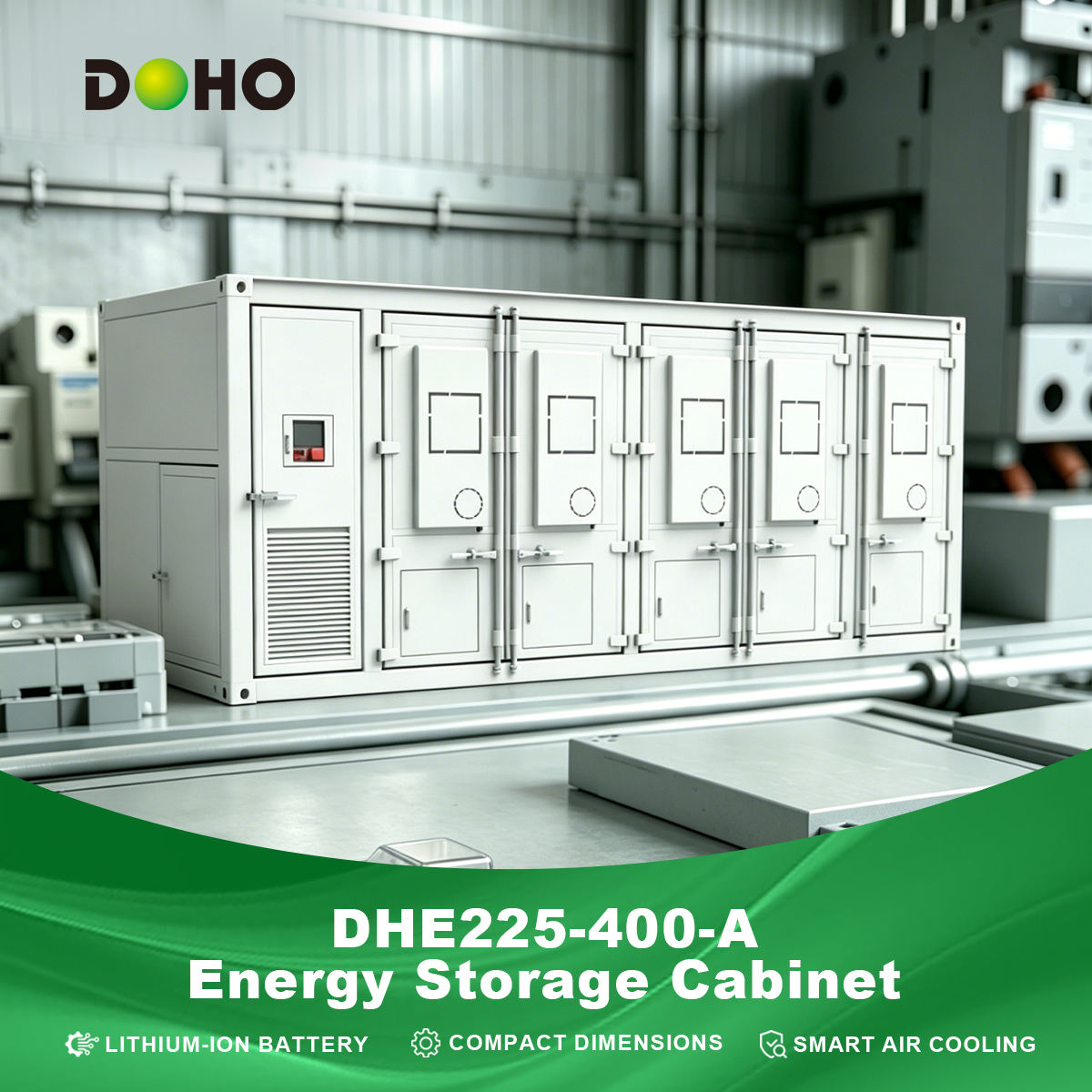
The DOHO E2570-400-A — a 100kW/200kWh lithium iron phosphate hybrid energy storage system with IP54 protection, Smart CAN communication, and true on/off-grid capability — represents one of the most capable and cost-effective commercial-scale ESS solutions available through global sourcing channels at $12,050.
At $60.25/kWh of storage capacity, this system is priced at the frontier of what’s achievable for commercial LFP storage — making the economics of energy storage compelling for a wide range of commercial and industrial applications.
Why LFP? The Chemistry That Changed Energy Storage
Not all lithium batteries are equal. The battery chemistry determines safety, cycle life, temperature performance, and ultimately the total cost of ownership over the system’s operational life.
The Four Main Lithium Battery Chemistries
NMC (Nickel Manganese Cobalt)
- Higher energy density (more kWh per kg)
- Higher cost (cobalt is expensive and supply-constrained)
- Less thermally stable — thermal runaway risk at high temperatures
- Shorter cycle life: 1,000–2,000 cycles
- Common in: EVs, consumer electronics
NCA (Nickel Cobalt Aluminum)
- Very high energy density
- High cost, cobalt-dependent
- Thermal stability concerns
- Common in: Tesla vehicles
LTO (Lithium Titanate)
- Extremely long cycle life: 10,000–20,000 cycles
- Very fast charging
- Very low energy density — heavy and bulky
- Very high cost
- Common in: Specialized industrial applications
LFP (Lithium Iron Phosphate) ← This product
- Lower energy density than NMC (acceptable for stationary storage)
- No cobalt — lower cost, more stable supply chain
- Thermally stable — no thermal runaway — the safest lithium chemistry
- Long cycle life: 4,000–6,000+ cycles
- Excellent performance at high temperatures
- Common in: Stationary energy storage, commercial EVs, buses
Why LFP Wins for Stationary Energy Storage
For stationary applications — where weight and volume are less critical than safety, cycle life, and cost — LFP is the clear winner:
Safety: LFP’s iron-phosphate bond is extremely stable. Even under abuse conditions (overcharge, short circuit, physical damage), LFP does not catch fire or explode. This is not a minor advantage — it is the difference between a system that can be installed in occupied buildings and one that requires fire suppression systems and safety setbacks.
Cycle life: At 4,000–6,000 cycles to 80% capacity retention, an LFP system cycled once daily lasts 11–16 years. NMC systems at 1,500–2,000 cycles last 4–5 years under the same conditions. The LFP system’s longer life dramatically reduces the levelized cost of storage.
Temperature performance: LFP performs well at elevated temperatures — important for outdoor installations in tropical and subtropical climates (Southeast Asia, Middle East, Africa, South Asia) where ambient temperatures regularly exceed 35–40°C.
Cost trajectory: Without cobalt dependency, LFP costs have fallen faster than NMC. LFP is now the dominant chemistry for commercial and industrial stationary storage globally.
System Architecture: Understanding the E2570-400-A
100kW Power / 200kWh Energy — What This Means
Power (100kW): The maximum rate at which the system can charge or discharge electricity. 100kW is equivalent to powering approximately 100 average homes simultaneously, or running a medium-sized commercial facility’s peak load.
Energy (200kWh): The total amount of electricity stored. At 100kW discharge, the system runs for 2 hours at full power. At 50kW average discharge, it runs for 4 hours.
The 2-hour duration is optimal for the most common commercial ESS applications:
- Peak shaving: Most utility demand charges are based on the highest 15–30 minute demand in a billing period. A 2-hour ESS can cover the typical peak demand window.
- Solar self-consumption: Most commercial solar systems generate peak power for 4–6 hours per day. A 2-hour ESS captures the midday solar surplus for evening use.
- Backup power: 2 hours of backup at full load covers most short outages; at reduced load (critical systems only), backup duration extends to 4–8+ hours.
Hybrid ESS Architecture
“Hybrid” in the context of this system means it integrates multiple power sources and can operate in multiple modes:
Grid-connected mode (on-grid)
- System connected to utility grid
- Charges from grid during low-tariff periods
- Discharges during high-tariff or peak demand periods
- Exports excess solar to grid (where permitted)
- Grid provides backup if battery is depleted
Off-grid mode
- System operates as standalone power source
- Solar + battery provides all power
- No grid connection required
- Critical for remote sites, islands, and areas without reliable grid access
Hybrid mode (most common)
- Grid connected but with seamless islanding capability
- Operates normally on-grid
- Automatically switches to island mode on grid failure
- Provides uninterrupted power supply (UPS) functionality
- Returns to grid-connected mode when grid is restored
Automatic mode switching is a key feature — the system detects grid failure and switches to island mode within milliseconds, providing seamless backup power without interruption to connected loads.
IP54 Protection Rating
IP54 means:
- 5 (first digit — solid particle protection): Protected against dust ingress sufficient to prevent harmful deposits
- 4 (second digit — liquid ingress protection): Protected against water splashing from any direction
IP54 is suitable for:
- Outdoor installation without additional enclosure
- Industrial environments with dust and occasional water exposure
- Coastal environments (with appropriate corrosion protection on external surfaces)
- Rooftop installations exposed to rain
For installations in particularly harsh environments (heavy rain, salt spray, high humidity), confirm whether additional protection measures are recommended.
Smart CAN Communication
CAN (Controller Area Network) bus is an industrial communication protocol originally developed for automotive applications and now widely used in industrial electronics, battery management systems, and energy storage.
What Smart CAN enables:
- BMS communication: Battery Management System data (cell voltages, temperatures, state of charge, state of health) transmitted in real time
- Inverter integration: Seamless communication with compatible hybrid inverters for coordinated charge/discharge control
- SCADA integration: Connection to building energy management systems and SCADA platforms for centralized monitoring and control
- Remote monitoring: Cloud-based monitoring platforms receive real-time system data for performance tracking and fault diagnosis
- Demand response: Utility demand response programs can signal the ESS to discharge during grid stress events
Air-Cooled Design
The air-cooled thermal management system uses forced-air cooling (fans) rather than liquid cooling:
Advantages of air cooling:
- Simpler installation — no coolant plumbing, no coolant reservoir, no pump maintenance
- Lower maintenance — fan replacement is simpler and cheaper than liquid cooling system maintenance
- No leak risk — liquid cooling systems can leak coolant, potentially damaging battery cells
- Lower cost — air cooling systems are less expensive than liquid cooling
Considerations:
- Air cooling is slightly less efficient than liquid cooling at very high ambient temperatures
- Confirm the operating temperature range with the supplier for your installation environment
- Adequate airflow clearance around the unit is required for effective cooling
Applications: Where the DOHO E2570-400-A Delivers Maximum Value
Commercial & Industrial Peak Shaving
The demand charge problem: Commercial and industrial electricity customers in most markets pay two components on their electricity bill:
- Energy charge — cost per kWh consumed
- Demand charge — cost based on peak power demand (kW) in the billing period
Demand charges can represent 30–50% of a commercial electricity bill. A single 15-minute peak demand event — a large motor starting, HVAC compressors cycling simultaneously, production equipment at full load — sets the demand charge for the entire month.
How ESS solves it: The ESS monitors real-time power demand and automatically discharges when demand approaches the target threshold, “shaving” the peak and reducing the demand charge.
Example calculation:
- Facility peak demand: 150 kW
- Target demand with ESS: 100 kW (50 kW reduction)
- Demand charge rate: $15/kW/month
- Monthly demand charge saving: 50 kW × $15 = $750/month
- Annual saving: $9,000/year
- Payback on $12,050 system: 16 months
Solar Self-Consumption Maximization
The solar export problem: Commercial solar systems often generate more power than the facility consumes during midday hours. Without storage, this excess is exported to the grid — often at low feed-in tariff rates (or zero in markets without net metering).
How ESS solves it: The ESS stores excess solar generation during the day and discharges it in the evening when solar generation has stopped but facility demand continues.
Example calculation:
- Daily excess solar: 150 kWh (stored in ESS)
- Grid electricity rate: $0.15/kWh
- Daily saving: 150 kWh × $0.15 = $22.50/day
- Annual saving: $8,213/year
- Payback: 17 months
Time-of-Use (TOU) Arbitrage
Many utilities offer time-of-use tariffs with significant price differences between peak and off-peak periods:
- Off-peak rate (night): $0.05–$0.08/kWh
- Peak rate (day/evening): $0.15–$0.30/kWh
The ESS charges during off-peak hours and discharges during peak hours, capturing the price differential.
Example:
- Charge: 200 kWh at $0.06/kWh = $12.00
- Discharge: 180 kWh (accounting for round-trip efficiency) at $0.20/kWh = $36.00
- Daily arbitrage profit: $24.00
- Annual profit: $8,760/year
Backup Power for Critical Facilities
Applications requiring uninterrupted power:
- Data centers and server rooms
- Hospitals and medical facilities
- Telecommunications infrastructure
- Manufacturing processes sensitive to power interruption
- Cold storage and refrigeration
- Security systems and access control
DOHO E2570-400-A backup capability:
- At 100kW load: 2 hours backup
- At 50kW load (critical systems only): 4 hours backup
- At 25kW load (emergency systems): 8 hours backup
For longer backup requirements, multiple units can be paralleled to increase capacity.
Microgrid & Off-Grid Power Systems
Remote site applications:
- Telecom towers and base stations
- Mining and exploration camps
- Agricultural operations in areas without grid access
- Island communities
- Remote industrial facilities
Hybrid solar + ESS microgrid:
- Solar panels generate power during daylight hours
- ESS stores excess solar for nighttime use
- Diesel generator provides backup for extended cloudy periods
- ESS reduces generator runtime by 60–80%, dramatically reducing fuel costs
Telecom tower example:
- Tower load: 5 kW continuous
- Daily energy: 120 kWh
- Solar + 200kWh ESS covers 1–2 days of autonomy
- Generator runtime reduced from 24 hours/day to 2–4 hours/day
- Fuel saving: $15,000–$25,000/year per tower
EV Charging Station Energy Buffering
Fast EV chargers (50kW–350kW) create large, sudden demand spikes that trigger demand charges and may exceed grid connection capacity. An ESS buffers these spikes:
- ESS charges slowly from the grid during low-demand periods
- ESS discharges rapidly to power EV chargers during charging events
- Grid connection capacity requirement reduced
- Demand charges eliminated or reduced
- Enables fast charging at sites with limited grid capacity
Economic Analysis: Levelized Cost of Storage
The true cost of energy storage is not the purchase price — it is the levelized cost of storage (LCOS): the total cost per kWh of electricity stored and discharged over the system’s lifetime.
DOHO E2570-400-A LCOS Calculation
System cost: $12,050 Installation cost (estimated): $3,000–$5,000 Total installed cost: $15,050–$17,050 Capacity: 200 kWh Usable capacity (at 90% DoD): 180 kWh Cycle life (LFP at 80% DoD): 4,000–6,000 cycles Annual cycles: 365 (one cycle per day) System life: 11–16 years Total energy throughput: 180 kWh × 4,000 cycles = 720,000 kWh
LCOS = Total cost / Total energy throughput = $17,050 / 720,000 kWh = $0.024/kWh
At $0.024/kWh levelized cost, the DOHO ESS delivers stored electricity at a cost far below grid electricity rates in virtually every market — making the economics of energy storage compelling wherever grid electricity costs exceed $0.05/kWh.
Installation Requirements
Electrical Requirements
- AC input: 3-phase, 380V/400V/415V (confirm for your grid voltage)
- AC output: 3-phase, same as input
- DC bus: Internal (battery to inverter)
- Grid connection: Requires licensed electrician and utility interconnection approval
- Protection: AC circuit breaker, surge protection, earth leakage protection
Physical Installation
- Mounting: Floor-mounted or rack-mounted (confirm with supplier)
- Clearance: Minimum 500mm on all sides for airflow and maintenance access
- Foundation: Level, load-bearing surface capable of supporting system weight
- Ventilation: Adequate airflow for air-cooled thermal management
Environmental Requirements
- Operating temperature: Confirm range with supplier (typically -10°C to +45°C)
- Humidity: Typically 5–95% non-condensing
- Altitude: Derating may apply above 1,000m — confirm with supplier
- IP54: Suitable for outdoor installation; avoid direct water jet exposure
Regulatory & Grid Connection
- Grid interconnection approval: Required from utility before grid-connected operation
- Electrical permits: Required in most jurisdictions
- Safety certifications: Confirm CE, IEC 62619, UN38.3 certifications for your market
- Fire safety: Confirm local fire code requirements for battery storage installation
Featured Product: DOHO E2570-400-A on MEGA BDM
MEGA BDM has sourced and verified the DOHO E2570-400-A 100kW/200kWh Lithium Ion Hybrid ESS — IP54 rated, Smart CAN enabled, air-cooled LFP battery storage for on/off-grid applications — from DOHO, a verified commercial energy storage manufacturer with proven international deployment experience.
👉 View the DOHO E2570-400-A ESS on MEGA BDM
Frequently Asked Questions
How many cycles does the LFP battery last?
LFP batteries in commercial ESS applications typically achieve 4,000–6,000 cycles to 80% capacity retention at 80% depth of discharge. At one cycle per day, this corresponds to 11–16 years of operational life. Confirm the cycle life warranty with the supplier.
Can multiple units be paralleled for larger capacity?
Yes — most commercial ESS systems support parallel connection of multiple units to increase power and energy capacity. Confirm the maximum parallel configuration and communication requirements with the supplier.
What inverter is compatible with this system?
The Smart CAN interface enables communication with compatible hybrid inverters. Confirm inverter compatibility with the supplier — they can recommend compatible inverter brands and models for your application.
What certifications does the system carry?
Confirm certifications with the supplier for your target market. Common certifications for commercial ESS include CE (Europe), IEC 62619 (battery safety), UN38.3 (transport), and local grid interconnection standards.
What is the round-trip efficiency?
LFP-based ESS systems typically achieve round-trip efficiency of 90–95% (energy out / energy in). Confirm the specific efficiency specification with the supplier.
What warranty is provided?
Confirm warranty terms with the supplier. Commercial ESS systems typically carry 5–10 year warranties on battery capacity (e.g., guaranteed 80% capacity retention after 4,000 cycles) and 1–2 years on system components.
Conclusion
The DOHO E2570-400-A 100kW/200kWh LFP Hybrid ESS represents the convergence of three powerful trends: falling battery costs, rising grid electricity prices, and growing solar adoption. At $12,050 — just $60.25/kWh of storage capacity — this system makes commercial-scale energy storage economically compelling for a wide range of applications across commercial, industrial, and off-grid markets.
With LFP chemistry’s unmatched safety and cycle life, true hybrid on/off-grid capability, IP54 outdoor rating, and Smart CAN integration, the DOHO E2570-400-A is a complete, production-ready energy storage solution for the commercial and industrial market segment where energy storage ROI is most compelling.
👉 View the full product details on MEGA BDM