
Introduction: The Surface Finish Problem in Motor Manufacturing
In electric motor manufacturing, surface finish is not an aesthetic consideration — it is a functional requirement. The polished surfaces of rotor shafts, stator housings, commutator rings, and bearing seats directly affect motor performance, bearing life, vibration levels, and long-term reliability. A shaft with inadequate surface finish generates excessive bearing wear. A commutator with inconsistent polish produces electrical noise and accelerated brush wear. A housing with poor surface quality compromises seal integrity and thermal management.
For decades, motor polishing was a manual craft — skilled operators using hand-held polishing tools, abrasive belts, and buffing wheels to achieve the required surface finish on each component. This approach has three fundamental problems that become more acute as production volumes grow: it is slow, it is inconsistent, and it is expensive.
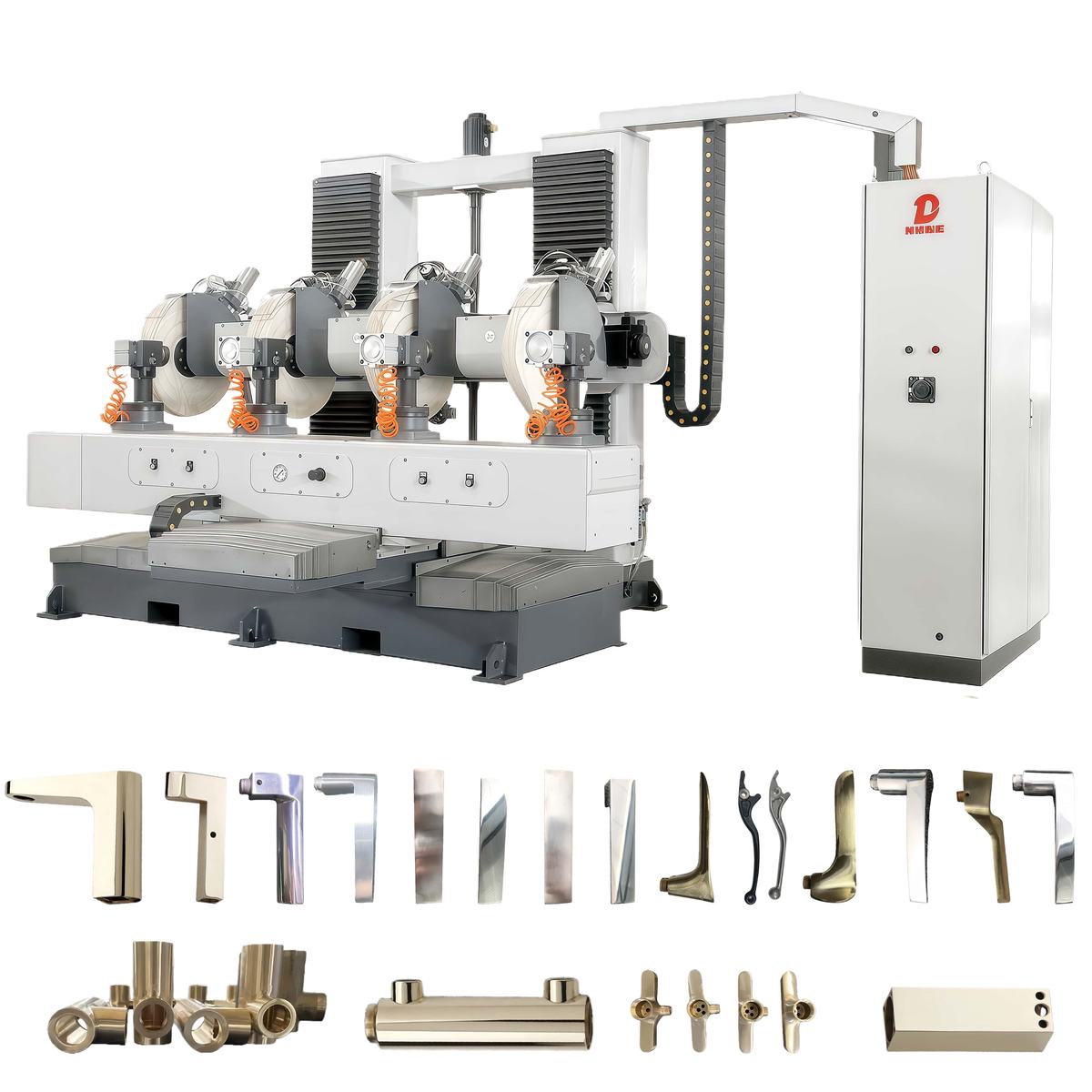
The Dingzhu Energy Saving 35KW Digital Intelligent Control System Fully Automatic CNC Polishing Machine addresses all three problems simultaneously — delivering automated, consistent, high-throughput polishing for motor workshops and precision surface finishing operations.
What Is a CNC Polishing Machine?
A CNC (Computer Numerical Control) polishing machine is an automated surface finishing system where the polishing tool path, pressure, speed, and dwell time are controlled by a computer program rather than a human operator. The workpiece and/or polishing head move along precisely controlled axes, applying the polishing medium to the workpiece surface according to a programmed recipe.
Key Differences: CNC Polishing vs. Manual Polishing
| Parameter | Manual Polishing | CNC Polishing |
|---|---|---|
| Consistency | Operator-dependent | Programmed, repeatable |
| Speed | Limited by operator fatigue | Continuous, constant |
| Surface finish quality | Variable | Consistent, measurable |
| Labor requirement | High | Minimal (load/unload) |
| Documentation | Difficult | Automatic data logging |
| Night shift operation | Requires additional staff | Unattended capable |
| Skill dependency | High | Low (after programming) |
For motor workshops producing hundreds or thousands of components per shift, CNC polishing is not a luxury — it is the only way to achieve consistent surface finish quality at production scale.
The Dingzhu Advantage: 35KW Energy Saving Design
Why Power Rating Matters in Polishing
The 35KW power rating of the Dingzhu machine is significant for two reasons: it provides sufficient power for heavy-duty polishing of large motor components, and the energy-saving design ensures this power is delivered efficiently — minimizing operating costs over the machine’s service life.
Energy Saving Technology in Industrial Polishing Machines
Traditional polishing machines run their drive motors at constant speed regardless of the actual polishing load — wasting energy during light-load phases and generating unnecessary heat. Energy-saving designs use variable frequency drives (VFDs) and intelligent power management to match motor output to actual load requirements:
- Variable frequency drive (VFD): Adjusts motor speed and torque in real time to match the polishing load — reducing energy consumption by 20–40% compared to fixed-speed drives
- Regenerative braking: Recovers energy during deceleration phases and feeds it back into the system
- Intelligent standby: Reduces power consumption during idle periods between workpieces
- Optimized spindle control: Maintains optimal polishing speed and pressure with minimum energy input
For a 35KW machine running two shifts per day, 300 days per year, a 30% energy saving represents approximately $3,000–$8,000 per year in reduced electricity costs depending on local power rates — a meaningful contribution to operating cost reduction over the machine’s service life.
Digital Intelligent Control System: The Brain of the Machine
What “Digital Intelligent Control” Means in Practice
The digital intelligent control system is the software and hardware architecture that manages all machine functions — from axis motion and spindle speed to polishing pressure, abrasive feed, and process monitoring. Key capabilities:
Recipe management Store and recall polishing programs for different workpiece types. Once a polishing recipe is developed and validated for a specific motor component, it can be recalled instantly for every subsequent production run — eliminating setup variability and reducing changeover time.
Real-time process monitoring The control system monitors key process parameters in real time:
- Spindle speed and torque
- Polishing pressure (force feedback)
- Abrasive belt or wheel wear
- Workpiece temperature (where applicable)
- Cycle time per piece
Deviations from programmed parameters trigger automatic alerts or machine stops — preventing out-of-specification parts from being produced.
Adaptive control Advanced intelligent control systems adjust polishing parameters in real time based on feedback from the process — compensating for abrasive wear, workpiece dimensional variation, and material hardness differences to maintain consistent surface finish output.
Data logging and traceability Every polishing cycle is logged with timestamp, recipe ID, process parameters, and outcome — providing full traceability for quality management systems and customer documentation requirements.
Operator interface The HMI (Human Machine Interface) provides an intuitive touchscreen interface for recipe selection, parameter adjustment, production monitoring, and alarm management — accessible to operators without specialized programming knowledge.
CNC Automation: Axis Configuration and Motion Control
Typical Axis Configuration for Motor Component Polishing
CNC polishing machines for motor applications typically use the following axis configurations depending on the workpiece geometry:
2-axis (X + C): Linear traverse (X) + workpiece rotation (C). Standard configuration for cylindrical components — rotor shafts, commutator rings, bearing seats. The workpiece rotates while the polishing head traverses along the axis, producing a helical polishing pattern.
3-axis (X + Y + C): Adds a cross-slide (Y) for polishing head positioning. Enables polishing of stepped shafts, shoulders, and features at different diameters without repositioning.
4-axis (X + Y + Z + C): Full 3D positioning plus workpiece rotation. Enables polishing of complex geometries including tapered surfaces, curved profiles, and non-cylindrical features.
Multi-spindle configurations: Some motor polishing machines use multiple polishing spindles operating simultaneously — polishing different zones of the workpiece in parallel to maximize throughput.
Motion Control Precision
CNC polishing machines use servo motor drives with encoder feedback for precise axis positioning and speed control. Typical positioning accuracy: ±0.01–0.05mm — sufficient for the surface finishing applications where polishing removes only a small amount of material and dimensional accuracy is maintained by the preceding machining operations.
Applications: Motor Component Polishing in Detail
Rotor Shaft Polishing
The rotor shaft is the most critical polished component in an electric motor. Bearing seats, seal journals, and commutator mounting surfaces all require specific surface finish specifications:
- Bearing seats: Ra 0.4–0.8 μm (mirror-smooth) — critical for bearing fit and life
- Seal journals: Ra 0.2–0.4 μm — critical for seal integrity and leakage prevention
- Commutator mounting: Ra 0.8–1.6 μm — for secure commutator press fit
Manual polishing of rotor shafts is time-consuming and produces variable results. CNC polishing achieves consistent Ra values across every shaft — eliminating bearing failures and seal leaks caused by inadequate surface finish.
Commutator Polishing
DC motor commutators require precise surface finish for optimal brush contact and electrical performance:
- Commutator surface: Ra 0.4–0.8 μm — smooth enough for low brush wear, rough enough for adequate contact
- Mica undercut slots: Must be clean and free of copper burrs after polishing
- Concentricity: Commutator must be concentric with the shaft axis to within 0.01–0.02mm
CNC polishing with in-process measurement ensures commutator surface finish and concentricity meet specification on every piece.
Stator Housing Polishing
Motor stator housings require polishing of:
- Bearing bore surfaces: Ra 0.8–1.6 μm for bearing outer race fit
- Sealing faces: Ra 0.4–0.8 μm for gasket or O-ring sealing
- Mating flanges: Ra 1.6–3.2 μm for assembly alignment
Slip Ring and Brush Ring Polishing
AC motors and generators with slip rings require polishing of:
- Slip ring surfaces: Ra 0.4–0.8 μm for brush contact
- Insulation surfaces: Clean, burr-free finish for electrical isolation integrity
Energy Saving in Context: The Full Operating Cost Picture
For a motor workshop evaluating the Dingzhu machine at $50,000, the total cost of ownership calculation should include:
Capital Cost
- Machine purchase: $50,000
- Installation and commissioning: $2,000–$5,000
- Tooling and abrasives (initial stock): $1,000–$3,000
- Total initial investment: ~$53,000–$58,000
Annual Operating Costs
- Energy (35KW × 16h/day × 300 days × $0.10/kWh × 0.7 energy saving factor): ~$11,760/year
- Abrasives and consumables: $3,000–$8,000/year
- Maintenance: $2,000–$5,000/year
- Total annual operating cost: ~$17,000–$25,000/year
Annual Labor Saving (vs. manual polishing)
- Manual polishing team equivalent: 3–5 operators × $15,000–$30,000/year = $45,000–$150,000/year
- CNC machine operator (load/unload): 1 operator × $15,000–$25,000/year
- Annual labor saving: $30,000–$125,000/year
Payback Period
- Annual net saving: $13,000–$100,000
- Payback: 6 months – 4 years depending on labor costs, shift pattern, and production volume
Sourcing and Implementation
Supplier Evaluation
When sourcing a CNC polishing machine for motor applications, evaluate:
- Application-specific configuration — confirm the machine is configured for your specific workpiece types (shaft diameter range, length, material)
- Abrasive system — belt, wheel, or compound — confirm compatibility with your surface finish requirements
- Control system capability — recipe management, data logging, and integration with your quality management system
- After-sales support — remote diagnostics, spare parts availability, and on-site service capability
- Reference installations — request references from motor manufacturers using the same machine model
Installation Requirements
- Floor space: Confirm machine footprint and required clearances
- Power supply: 3-phase industrial power, 35KW capacity (confirm voltage and frequency)
- Compressed air: For clamping, coolant, and pneumatic functions (confirm pressure and flow)
- Coolant/lubrication: Confirm coolant system requirements and waste disposal
- Foundation: Heavy CNC machines may require a reinforced concrete foundation — confirm with supplier
Commissioning and Training
Typical commissioning includes:
- Mechanical installation and leveling
- Electrical connection and safety checks
- Control system configuration and recipe setup
- Test runs with sample workpieces
- Operator training (machine operation, recipe management, maintenance)
- Process validation — confirming surface finish specifications are achieved on production workpieces
Frequently Asked Questions
What workpiece diameter and length range does the machine handle?
Confirm the minimum and maximum workpiece diameter and length with the supplier for your specific motor component range. The machine configuration (chuck size, between-centers distance, polishing head travel) must match your workpiece dimensions.
What surface finish (Ra) values can the machine achieve?
Typical CNC polishing machines achieve Ra 0.1–1.6 μm depending on abrasive selection, polishing speed, and workpiece material. Confirm the achievable Ra range for your specific application with the supplier.
What abrasive systems are compatible?
Confirm whether the machine uses abrasive belts, polishing wheels, lapping film, or compound-based polishing — and confirm abrasive availability and cost for your application.
Can the machine be integrated with our production line?
Confirm automation interface options — loading/unloading robot compatibility, conveyor integration, and data output to MES/ERP — with the supplier for your specific production line configuration.
What is the warranty and after-sales support?
Confirm warranty terms (typically 12 months) and after-sales support capability — including remote diagnostics, spare parts lead times, and on-site service availability in your country.
Conclusion
The Dingzhu Energy Saving 35KW Digital Intelligent Control System Fully Automatic CNC Polishing Machine addresses the core challenge of motor component surface finishing at production scale: delivering consistent, measurable surface finish quality on every workpiece, at throughput levels that manual polishing cannot match, with operating costs that make the investment economics compelling.
For motor manufacturers, contract polishing workshops, and precision engineering operations facing growing production volumes and tightening surface finish specifications, this machine represents the transition from craft-based manual polishing to data-driven, automated surface finishing — the foundation of a scalable, quality-controlled polishing operation.
👉 View the Dingzhu CNC Polishing Machine on MEGA BDM