Introduction: Why the Control System Defines the Machine
When manufacturers evaluate a CNC lathe, the conversation often starts with spindle speed, swing over bed, and between-centers distance. These are important specifications — but experienced machinists and production engineers know that the control system is the single most consequential choice in a CNC machine tool purchase.
The control system determines how the machine is programmed, how operators interact with it, which CAM software is compatible, where spare parts come from, and how quickly problems can be diagnosed and resolved. A machine with a premium control system and adequate mechanical specification will outperform a mechanically superior machine with a poor control system in almost every real-world production scenario.
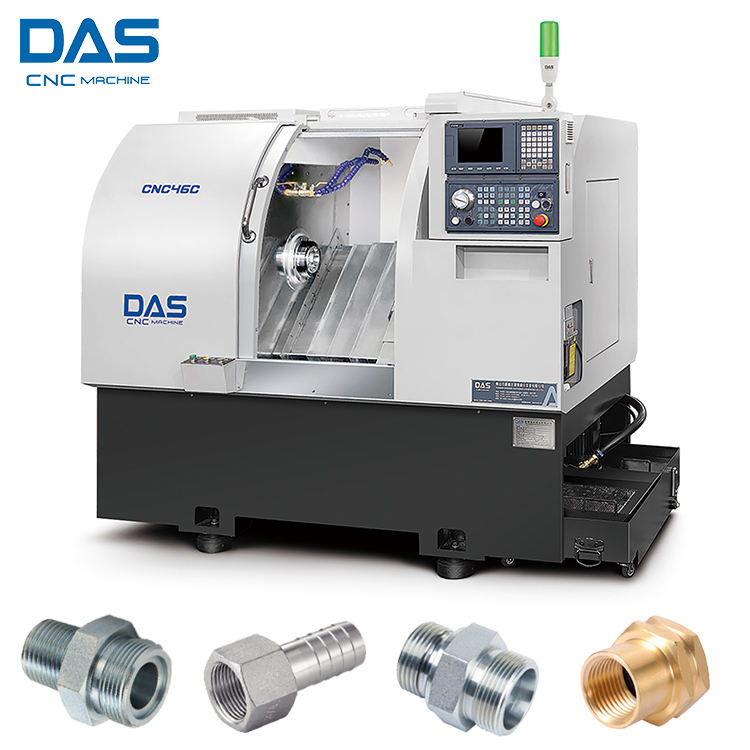
The DAS CNC Lathe Machine with FANUC Control makes a clear statement on this point: factory-direct pricing on the machine body, combined with the world’s most trusted CNC control system — FANUC — and new motor and gear core components that ensure full mechanical performance from day one.
FANUC: The Global Standard in CNC Control
Why FANUC Dominates Industrial CNC
FANUC Corporation, founded in Japan in 1956, is the world’s largest manufacturer of CNC systems, with an estimated 65–70% global market share in industrial CNC controls. This dominance is not accidental — it reflects decades of engineering excellence, reliability engineering, and global support infrastructure that no competitor has matched.
The numbers that matter:
- Over 4 million FANUC CNC systems installed worldwide
- Operations in over 100 countries
- Mean Time Between Failures (MTBF) measured in decades for many FANUC control components
- Global spare parts availability — FANUC components can be sourced in virtually every manufacturing country
FANUC vs. Siemens: The Two Control Giants
The CNC control market is effectively a two-horse race between FANUC and Siemens, with each dominant in different regions and applications:
| Factor | FANUC | Siemens |
|---|---|---|
| Global market share | ~65–70% | ~20–25% |
| Dominant regions | Asia, Americas, global | Europe, Middle East, India |
| Programming style | G-code, conversational | ShopMill/ShopTurn, G-code |
| Reliability reputation | Exceptional | Excellent |
| Spare parts availability | Widest global network | Strong in Europe |
| CAM compatibility | Widest | Very wide |
| Operator training resources | Most abundant globally | Abundant |
For manufacturers in Southeast Asia, the Americas, and global export markets, FANUC is the default choice — operators are trained on it, CAM post-processors are proven for it, and spare parts are available locally in virtually every manufacturing hub.
FANUC Series for CNC Lathes
FANUC produces several CNC series for turning applications. Common series found on production CNC lathes:
FANUC 0i-TF / 0i-TF Plus The most widely deployed FANUC series for production CNC lathes. Features:
- 2-axis turning (X + Z) standard; C-axis and Y-axis options
- Nano CNC interpolation for smooth surface finish
- FANUC Manual Guide i — conversational programming at the machine
- High-speed processing for complex programs
- Ethernet connectivity for DNC and remote monitoring
- Compact, reliable hardware with proven long-term reliability
FANUC 31i-B / 35i-B Higher-performance series for multi-axis turning centers and complex turning applications. Features full 5-axis capability, advanced surface quality functions, and AI-based servo tuning.
Confirm the specific FANUC series installed on the DAS machine with the supplier for your application requirements.
Core Components: New Motor and Gear — Why It Matters
The Significance of “New Core Components”
The specification of new motor and gear core components is a critical differentiator in the CNC machine tool market — particularly for machines sourced from China, where the market includes both new machines with new components and refurbished or rebuilt machines with used components.
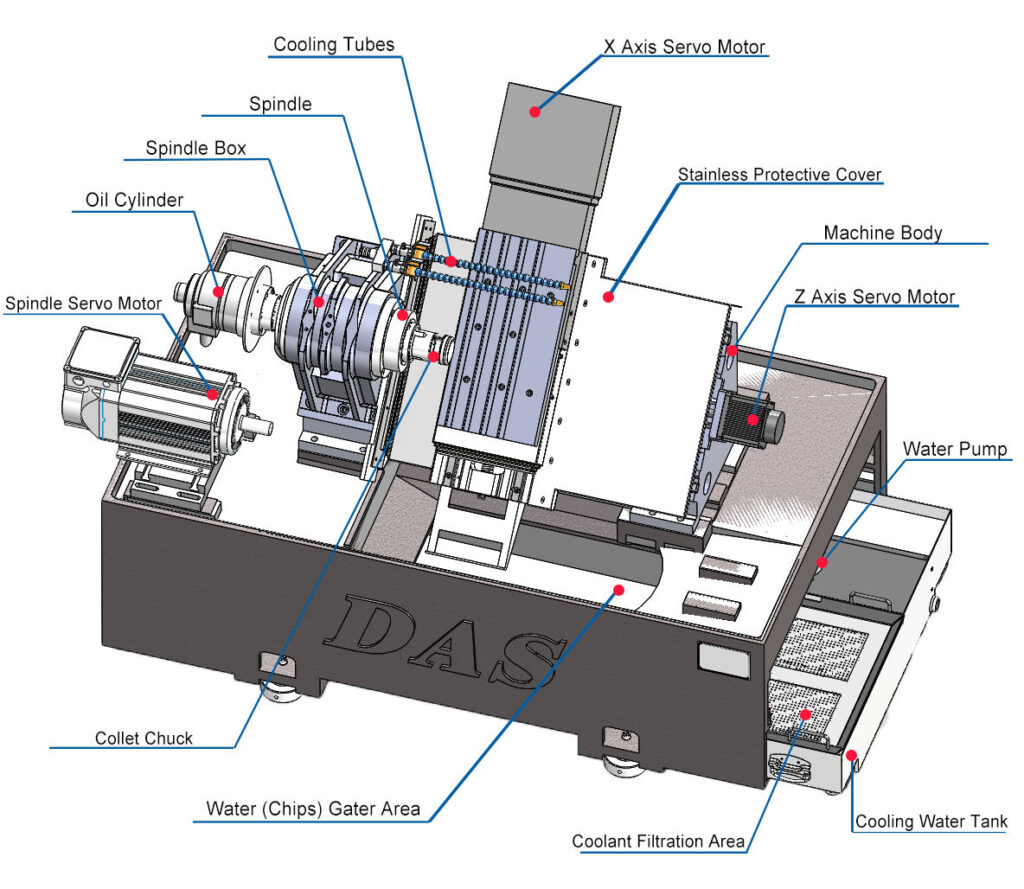
Spindle motor: The spindle motor drives the workpiece rotation. A new spindle motor provides:
- Full rated power and torque from day one
- Known service life — no accumulated wear hours
- Manufacturer warranty on the motor itself
- Consistent performance across the full speed range
Feed axis servo motors: The X and Z axis servo motors drive the cutting tool movement. New servo motors provide:
- Full positioning accuracy and repeatability
- No encoder wear or backlash from previous use
- Consistent dynamic response for smooth surface finish
- Full compatibility with the FANUC control system
Gearbox and transmission: The gear components transmit power from the spindle motor to the spindle. New gear components provide:
- No gear wear, pitting, or backlash from previous operation
- Full rated torque capacity at all speed ranges
- Quiet, vibration-free operation
- Known service life for maintenance planning
What to Verify with the Supplier
When confirming the “new motor and gear” specification:
- Request the motor brand and model number (FANUC servo motors are preferred for full system integration)
- Confirm the spindle motor power rating (kW) and maximum speed (RPM)
- Confirm the gearbox configuration (single-speed, two-speed, or variable)
- Request the machine’s factory test report showing spindle runout, axis positioning accuracy, and surface finish test results
CNC Lathe Architecture: Understanding the Machine
Key Mechanical Specifications to Evaluate
Swing over bed (maximum turning diameter) The maximum diameter workpiece the lathe can accommodate over the bed. Common sizes for production lathes: 320mm, 400mm, 500mm, 630mm. Confirm this matches your largest workpiece diameter.
Distance between centers (maximum turning length) The maximum length workpiece the lathe can turn between chuck and tailstock. Common sizes: 750mm, 1000mm, 1500mm, 2000mm. Confirm this matches your longest workpiece.
Spindle bore diameter The diameter of the hole through the spindle — determines the maximum bar stock diameter that can be fed through the spindle for bar work. Typical: 52mm, 65mm, 80mm, 105mm.
Spindle speed range The minimum and maximum spindle speed (RPM). Typical for production lathes: 50–4,000 RPM (two-speed gearbox) or 50–6,000 RPM (variable speed). Higher maximum speed enables better surface finish on small-diameter workpieces.
Spindle power The rated power of the spindle motor (kW). Typical for production lathes: 7.5–22kW. Higher power enables heavier cuts in harder materials.
Axis travel
- X-axis (cross slide): Determines maximum depth of cut and facing diameter
- Z-axis (carriage): Determines maximum turning length
Rapid traverse rate The maximum speed of axis movement during non-cutting moves. Typical: 15–30 m/min. Higher rapid traverse reduces non-cutting time and improves cycle time.
Turret The tool holding system. Common configurations:
- 8-station turret: Holds 8 tools, indexed automatically by the CNC
- 12-station turret: Holds 12 tools — more flexibility for complex parts
- VDI or BMT tooling interface: Determines tool holder compatibility
Tailstock Supports long workpieces during turning. Confirm hydraulic or manual tailstock, and quill travel.
Bed Construction
The machine bed is the foundation of accuracy and rigidity. Key considerations:
Cast iron bed: Traditional construction — excellent vibration damping, good thermal stability, proven long-term accuracy retention. Most production CNC lathes use cast iron beds.
Slant bed vs. flat bed:
- Slant bed (45° or 60°): Chip falls away from the work zone, better coolant drainage, more compact footprint, better operator ergonomics. Standard on modern CNC lathes.
- Flat bed: Traditional configuration, lower cost, suitable for heavy turning applications.
Confirm the bed configuration and material with the supplier.
Applications: What the DAS CNC Lathe Machines
Shaft Turning
Shafts are the most common CNC lathe application — from simple stepped shafts to complex multi-diameter components with threads, tapers, and undercuts:
- Automotive driveshafts and axles: High-volume production, tight tolerances on bearing seats and spline interfaces
- Motor and generator shafts: Precision bearing seats, keyways, and thread features
- Hydraulic cylinder rods: Chrome-plated, precision-ground finish — CNC turning provides the base geometry
- Pump shafts: Seal journals, impeller fits, and coupling interfaces
Bushing and Sleeve Production
Bushings and sleeves are high-volume turned components used across virtually every mechanical industry:
- Plain bearings and bushings: Bronze, brass, or polymer — precision bore and OD turning
- Hydraulic cylinder bushings: Tight bore tolerances for seal and piston fit
- Automotive bushings: Suspension, steering, and drivetrain components
- Industrial sleeves: Shaft protection, spacers, and adapter components
Threaded Components
CNC lathes excel at thread cutting — both external and internal threads:
- Fasteners and studs: High-volume thread production
- Hydraulic fittings: Precision threads for leak-free connections
- Valve bodies and stems: Fine threads for precise flow control
- Instrumentation components: Miniature threads for precision instruments
Automotive Components
The automotive industry is the largest consumer of CNC turned parts:
- Brake components: Brake drums, rotors, and caliper pistons
- Engine components: Crankshaft journals (finish turning), camshaft bearing journals, piston pins
- Transmission components: Gear blanks, synchronizer rings, shift forks
- Steering components: Rack and pinion components, tie rod ends
Medical and Instrumentation
High-precision CNC turning for medical devices and scientific instruments:
- Implant components: Orthopedic screws, bone plates, and joint components (titanium, stainless steel, PEEK)
- Surgical instruments: Precision handles, cannulas, and instrument bodies
- Instrumentation: Sensor housings, optical mounts, and precision mechanical components
FANUC Programming: Accessibility and Productivity
G-Code Programming
FANUC CNC systems use industry-standard G-code (ISO 6983) — the universal language of CNC machining. G-code programs are:
- Portable: Programs written for FANUC can be transferred to any FANUC machine with minimal modification
- CAM-generated: All major CAM software (Mastercam, SolidCAM, Fusion 360, hyperMILL) generates proven FANUC post-processors
- Manually programmable: Experienced operators can write and edit programs directly at the machine
FANUC Manual Guide i — Conversational Programming
For shops without CAM software, FANUC Manual Guide i provides conversational (menu-driven) programming directly at the machine control:
- Select operation type (turning, facing, threading, grooving, drilling)
- Enter workpiece dimensions and cutting parameters through guided menus
- The control generates the G-code automatically
- Simulate the program graphically before cutting
Manual Guide i makes CNC programming accessible to operators without formal CAM training — reducing the skill barrier for small shops and job shops.
CAM Integration
For complex parts and high-volume production, CAM software generates optimized CNC programs:
- Mastercam Lathe: Industry-leading turning CAM with proven FANUC post-processors
- SolidCAM: Integrated with SolidWorks, strong turning and mill-turn capability
- Autodesk Fusion 360: Cloud-based CAM with FANUC turning post-processors
- hyperMILL: High-performance CAM for complex turning and mill-turn applications
The FANUC control’s wide CAM compatibility means manufacturers can use their preferred CAM software without post-processor development costs.
ROI Analysis: The Business Case at $19,250
Investment: $19,250
Revenue Generation
Job shop / contract machining:
- CNC lathe utilization: 16 hours/day, 300 days/year = 4,800 hours/year
- Hourly machine rate for CNC lathe: $40–$80/hour
- Annual revenue: $192,000–$384,000
In-house production (replacing outsourced turning):
- Outsourced CNC turning cost: $50–$100/hour
- In-house cost (amortization + labor + overhead): $20–$35/hour
- Annual saving (4,800 hours): $144,000–$312,000
Payback Period
Job shop scenario:
- Annual revenue: $250,000 (conservative)
- Operating cost (labor, tooling, overhead): $80,000
- Annual profit: $170,000
- Payback: ~6 weeks
In-house production scenario:
- Annual machining cost saving: $200,000
- Payback: ~5 weeks
Comparison: DAS FANUC vs. Japanese/European Equivalent
| Specification | DAS FANUC (China) | Japanese/European Equivalent |
|---|---|---|
| Price | $19,250 | $60,000–$150,000 |
| CNC Control | FANUC | FANUC / Siemens |
| Core components | New motor & gear | New |
| Accuracy | ±0.005–0.01mm | ±0.002–0.005mm |
| Support | Supplier + FANUC global | OEM + FANUC/Siemens |
The DAS machine delivers 80–90% of the capability of a Japanese or European equivalent at 15–30% of the price — a compelling value proposition for manufacturers who need reliable FANUC-controlled turning capability without the capital cost of premium machines.
Sourcing and Implementation
What to Confirm with the Supplier
Before ordering, confirm:
- FANUC series (0i-TF, 31i-B, or other) — affects programming capability and spare parts
- Swing over bed and between-centers distance — must match your workpiece range
- Spindle power and speed range — must match your material and cutting requirements
- Turret configuration (8 or 12 station, VDI or BMT tooling)
- Spindle bore diameter — critical for bar work
- Accuracy test report — positioning accuracy, repeatability, and spindle runout
- Warranty terms — minimum 12 months on machine, 6 months on wear parts
- After-sales support — remote diagnostics, spare parts, and on-site service capability
Installation Requirements
- Floor space: Confirm machine footprint and required clearances (typically 3m × 2m minimum)
- Power supply: 3-phase industrial power (confirm voltage, frequency, and amperage)
- Compressed air: For chuck, tailstock, and coolant functions
- Coolant system: Confirm coolant type, tank capacity, and chip conveyor options
- Foundation: Heavy CNC lathes benefit from a leveled, vibration-isolated foundation
Tooling Setup
Initial tooling investment for a production CNC lathe:
- External turning tools: 4–6 tool holders with indexable inserts — $500–$2,000
- Boring bars: 2–4 internal turning tools — $300–$1,000
- Threading tools: External and internal threading inserts — $200–$500
- Grooving tools: Parting and grooving inserts — $200–$500
- Drill chuck and center drills: $100–$300
- Total initial tooling: $1,300–$4,300
Frequently Asked Questions
What FANUC series is installed on the DAS machine?
Confirm the specific FANUC series (0i-TF, 31i-B, etc.) with the supplier. The series determines programming capability, available functions, and spare parts compatibility.
What is the maximum workpiece diameter and length?
Confirm swing over bed (maximum turning diameter) and distance between centers (maximum turning length) with the supplier for your specific workpiece range.
What tooling system does the turret use?
Confirm the turret tooling interface (VDI 30, VDI 40, BMT 45, BMT 55, or other) to ensure compatibility with your existing tooling or planned tooling investment.
Can the machine run bar stock automatically?
Bar feeding requires a separate bar feeder attachment. Confirm bar feeder compatibility and spindle bore diameter with the supplier if bar work is required.
What is the positioning accuracy and repeatability?
Request the machine’s accuracy test report (ISO 230-2 or equivalent) from the supplier. Confirm positioning accuracy (typically ±0.005–0.01mm) and repeatability (typically ±0.003–0.005mm) over the full axis travel.
What is the lead time and shipping method?
Confirm lead time (typically 4–8 weeks for standard configurations), shipping method (sea freight in wooden crate), and installation support (supplier technicians for commissioning and operator training).
Conclusion
The DAS CNC Lathe Machine with FANUC Control delivers the combination that production machinists and manufacturing engineers have always wanted: the world’s most trusted CNC control system, new motor and gear core components for full mechanical performance, and factory-direct pricing that makes precision CNC turning accessible to operations that previously could not justify the capital cost of a FANUC-controlled lathe.
At $19,250, this machine offers a compelling entry point into FANUC-controlled precision turning — with the programming ecosystem, spare parts network, and operator training resources of the world’s dominant CNC platform behind every production run.
👉 View the DAS CNC Lathe Machine on MEGA BDM