Introduction: Steel Wire — The Invisible Infrastructure of Modern Industry
Steel wire is everywhere. It holds up suspension bridges. It reinforces concrete structures. It forms the springs in every vehicle seat and mattress. It becomes the cables that lift elevators and support cranes. It is drawn into nails, staples, and fasteners by the billion. It is woven into fencing that secures farms, borders, and construction sites across the world.
The global steel wire market exceeds $80 billion annually — and behind every meter of finished wire is a wire drawing machine: the industrial equipment that takes steel rod (typically 5.5–12mm diameter) and progressively reduces it through a series of hardened dies to the target wire diameter, whether that is 4mm construction wire, 2mm welding wire, 0.5mm spring wire, or 0.1mm fine wire for electronics.
Wire drawing is one of the most fundamental metalworking processes in industrial manufacturing — and the wire drawing machine is the core capital investment that determines a wire manufacturer’s productivity, wire quality, and cost per kilogram of finished wire.
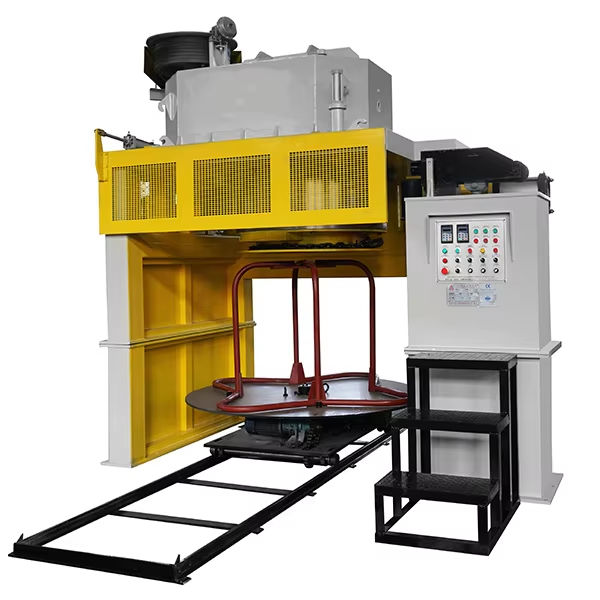
The AISEN Automatic Production Line Inverted Steel Wire Drawing Machine with High-Efficiency Motor at $14,000 brings professional-grade, production-line wire drawing capability to wire manufacturers at an accessible price point — with the inverted take-up design and high-efficiency motor that define modern, competitive wire production.
Wire Drawing: The Fundamental Process
What Wire Drawing Is and How It Works
Wire drawing is a metalworking process that reduces the diameter of a wire or rod by pulling it through a series of conical dies with progressively smaller apertures. Each die reduces the wire diameter by a specific amount (the reduction ratio), and the wire passes through multiple dies in sequence to achieve the target diameter from the starting rod diameter.
The physics of wire drawing:
Die geometry: A wire drawing die consists of:
- Entry angle (approach angle): The conical surface that guides the wire into the die — typically 6–15°
- Reduction zone: The conical surface where diameter reduction occurs
- Bearing (land): A short cylindrical section that sets the final wire diameter and improves surface finish
- Back relief: The exit cone that prevents wire damage as it leaves the die
Die materials:
- Tungsten carbide (WC-Co): Most common for steel wire — excellent wear resistance, good toughness, cost-effective
- Polycrystalline diamond (PCD): For fine wire and high-speed drawing — extremely hard, longest die life, highest cost
- Natural diamond: For ultra-fine wire (<0.1mm) — highest precision, highest cost
Reduction ratio: Each die reduces the wire cross-sectional area by a specific percentage — the area reduction ratio:
- Typical reduction per die: 15–25% area reduction
- Maximum reduction per die: 30–35% (beyond this, wire may break)
- Total reduction from rod to finished wire: Achieved through multiple dies in series
Example — 5.5mm rod to 2.0mm wire:
- Starting area: π × (2.75)² = 23.76 mm²
- Finished area: π × (1.0)² = 3.14 mm²
- Total area reduction: 86.8%
- Number of dies required (at 20% reduction per die): 9–10 dies
The Wire Drawing Machine: Core Components
Pay-off (uncoiler):
- Holds the input wire rod coil
- Feeds wire into the drawing machine at controlled tension
- Active pay-off (motorized) or passive pay-off (brake-controlled)
Drawing capstans (blocks):
- Rotating drums that pull the wire through each die
- Wire wraps around the capstan multiple times to generate pulling force
- Each capstan is driven by a motor — speed synchronized with the next capstan
- Capstan surface: Hardened steel or tungsten carbide coating for wear resistance
Dies:
- Mounted in die holders between capstans
- Lubricated by drawing lubricant (dry soap powder for steel wire, liquid lubricant for copper)
- Replaced when worn — die life depends on wire material, drawing speed, and lubrication
Drawing lubricant system:
- Dry drawing (steel wire): Soap powder lubricant applied to wire before each die
- Wet drawing (fine wire, copper): Liquid lubricant floods the die zone
- Lubricant reduces friction, extends die life, and improves wire surface finish
Take-up (coiler):
- Collects the finished wire onto a spool or coil
- Inverted take-up: Wire coils downward — the AISEN machine’s key design feature
- Horizontal take-up: Wire coils horizontally — conventional design
Control system:
- PLC-based speed control synchronizes all capstan motors
- Tension control maintains consistent wire tension throughout the drawing process
- Fault detection stops the machine on wire break, overload, or die failure
The Inverted Design: Why It Matters
Inverted vs. Conventional Wire Drawing
The “inverted” designation refers to the take-up configuration — how the finished wire is collected after drawing. This is not a minor detail; it is a fundamental design choice that affects wire quality, production efficiency, and downstream processing.
Conventional (horizontal) take-up:
- Wire exits the last drawing die horizontally and coils onto a horizontal spool
- Wire must change direction from horizontal to the coiling plane
- This direction change introduces wire twist — the wire rotates around its own axis as it coils
- Wire twist creates residual torsional stress in the finished wire
- Residual stress causes problems in downstream processing: springs that don’t hold their shape, wire that uncoils unpredictably, and reduced fatigue life
Inverted (vertical) take-up:
- Wire exits the last drawing die and coils downward onto a vertical spool (the spool is inverted — open end facing down)
- Wire coils naturally without direction change — no wire twist introduced
- Zero residual torsional stress in the finished wire
- Wire uncoils from the center of the coil (like a ball of yarn) — smooth, tangle-free pay-off for downstream processing
The inverted advantage in practice:
Spring wire: Springs require wire with zero residual torsional stress — any twist causes the spring to rotate when compressed, leading to inconsistent spring behavior. Inverted-drawn wire is the standard for spring wire production.
Rope wire: Wire rope strands must be laid without twist — inverted-drawn wire lays cleanly without the tendency to untwist that causes rope instability.
Welding wire: MIG/MAG welding wire must feed smoothly through the welding torch liner — twisted wire causes feeding problems and arc instability. Inverted-drawn welding wire feeds more reliably.
Fine wire: For fine wire applications (electronics, medical devices), residual stress causes wire breakage during subsequent processing. Inverted drawing minimizes residual stress and reduces breakage rates.
General wire: Even for commodity wire (nails, fencing, construction), inverted drawing produces tighter, more uniform coils that are easier to handle and process downstream.
The Inverted Machine’s Physical Configuration
The inverted wire drawing machine has a distinctive physical layout:
Vertical orientation:
- The take-up spool is mounted vertically with the open end facing downward
- The finished wire coils downward onto the spool
- The spool is typically located below the drawing section — the machine has a taller profile than conventional horizontal machines
Coil removal:
- When the spool is full, the coil is removed by lifting it off the spool (the open bottom allows the coil to slide off)
- Coil removal can be automated with a coil handling system for continuous production
Floor space:
- Inverted machines typically have a smaller floor footprint than equivalent horizontal machines
- The vertical orientation uses height rather than floor area — advantageous in facilities with limited floor space
High-Efficiency Motor: The Operating Cost Advantage
Why Motor Efficiency Matters in Wire Drawing
Wire drawing is an energy-intensive process — the motor must overcome the drawing force (the force required to pull the wire through the die) plus friction losses in the capstan bearings and drive system. For a production wire drawing machine running 16–24 hours per day, motor efficiency has a significant impact on operating cost.
Energy consumption of wire drawing:
- Typical energy consumption: 50–150 kWh per tonne of wire drawn (depending on reduction ratio, wire diameter, and drawing speed)
- Annual production: 500–2,000 tonnes/year for a single machine
- Annual energy consumption: 25,000–300,000 kWh/year
Impact of motor efficiency:
- IE2 (standard efficiency) motor: 90–93% efficiency
- IE3 (high efficiency) motor: 93–96% efficiency
- IE4 (premium efficiency) motor: 95–97% efficiency
Annual energy saving (IE3 vs. IE2, 100,000 kWh/year, $0.10/kWh):
- IE2 motor input: 100,000 kWh ÷ 0.91 = 109,890 kWh
- IE3 motor input: 100,000 kWh ÷ 0.94 = 106,383 kWh
- Annual saving: 3,507 kWh × $0.10 = $351/year
Over 10 years: $3,510 in electricity savings — meaningful for a $14,000 machine investment.
Additional Benefits of High-Efficiency Motors
Lower operating temperature: High-efficiency motors waste less energy as heat — they run cooler than standard motors. Lower operating temperature:
- Extends motor bearing life (bearing life doubles for every 10°C reduction in temperature)
- Extends winding insulation life
- Reduces cooling requirements
- Reduces thermal expansion effects on motor alignment
Better power factor: High-efficiency motors typically have better power factor (closer to 1.0) — reducing reactive power demand and potentially reducing electricity tariff charges in markets with power factor penalties.
Regulatory compliance: Many markets (EU, China, US) mandate minimum motor efficiency standards (IE3 or IE4) for industrial motors. High-efficiency motors ensure compliance with current and future regulations.
Confirm the specific motor efficiency class (IE2, IE3, IE4) and motor brand with the supplier for your energy cost calculation and regulatory compliance requirements.
Steel Wire Products: What the AISEN Machine Produces
Low Carbon Steel Wire
Construction wire (binding wire):
- Diameter: 0.7–4.0mm
- Carbon content: 0.06–0.12%
- Application: Tying rebar in concrete construction, general binding
- Market: Construction industry — massive global demand
Galvanized wire:
- Diameter: 0.5–4.0mm
- Process: Drawn to target diameter, then hot-dip or electro-galvanized
- Application: Fencing, agricultural wire, general outdoor use
- Market: Agriculture, construction, infrastructure
Nail wire:
- Diameter: 1.6–4.0mm
- Application: Nail manufacturing (cut nails, wire nails)
- Market: Construction, packaging, furniture
Mesh wire:
- Diameter: 0.5–3.0mm
- Application: Welded wire mesh, chain link fence, gabion mesh
- Market: Construction, security, agriculture
Barbed wire:
- Diameter: 1.6–2.5mm (line wire), 1.4–2.0mm (barb wire)
- Application: Security fencing, agricultural fencing
- Market: Agriculture, security, military
High Carbon Steel Wire
Spring wire:
- Diameter: 0.1–12mm
- Carbon content: 0.60–0.90%
- Application: Compression springs, tension springs, torsion springs
- Market: Automotive, industrial machinery, consumer products
Wire rope wire:
- Diameter: 0.1–5.0mm
- Carbon content: 0.60–0.85%
- Application: Wire rope strands for lifting, rigging, and structural cables
- Market: Construction, mining, marine, oil and gas
Prestressed concrete wire (PC wire):
- Diameter: 4–9mm
- Carbon content: 0.75–0.85%
- Application: Prestressed concrete structures (bridges, buildings, railway sleepers)
- Market: Infrastructure construction
Piano wire (music wire):
- Diameter: 0.1–6.0mm
- Carbon content: 0.80–0.95%
- Application: Musical instrument strings, precision springs, surgical instruments
- Market: Musical instruments, precision engineering, medical
Welding Wire
MIG/MAG welding wire (ER70S-6):
- Diameter: 0.6–1.6mm
- Carbon content: 0.06–0.15%
- Application: MIG/MAG welding of mild steel
- Market: Automotive, fabrication, construction — one of the largest wire markets globally
Submerged arc welding wire:
- Diameter: 2.0–6.0mm
- Application: SAW welding of heavy structural steel
- Market: Shipbuilding, pressure vessels, heavy fabrication
Flux-cored welding wire:
- Diameter: 0.9–3.2mm
- Application: FCAW welding — higher deposition rate than solid wire
- Market: Heavy fabrication, offshore, construction
Production Line Integration: Where the AISEN Machine Fits
The Wire Drawing Production Line
A complete wire drawing production line consists of multiple machines working in sequence:
Rod preparation:
- Descaling: Mechanical descaling (shot blasting or roller descaling) removes mill scale from the rod surface
- Pickling: Chemical descaling in acid bath (alternative to mechanical descaling)
- Coating: Phosphate or lime coating applied to rod surface to hold drawing lubricant
Rough drawing (rod breakdown):
- Input: 5.5–12mm rod
- Output: 2.5–5.0mm intermediate wire
- Machine: Heavy-duty multi-die drawing machine (10–20 dies)
- Speed: 5–15 m/s
Intermediate drawing:
- Input: 2.5–5.0mm intermediate wire
- Output: 1.0–2.5mm wire
- Machine: Medium-duty multi-die drawing machine
- Speed: 10–25 m/s
Fine drawing:
- Input: 1.0–2.5mm wire
- Output: 0.1–1.0mm fine wire
- Machine: Fine wire drawing machine (wet drawing)
- Speed: 20–50 m/s
The AISEN inverted machine is most commonly used in the intermediate and fine drawing stages — where the inverted take-up’s advantages (no wire twist, clean coiling) are most valuable.
Downstream processing:
- Annealing: Heat treatment to restore ductility after cold drawing
- Galvanizing: Zinc coating for corrosion protection
- Coating: PVC, nylon, or other polymer coating
- Stranding/rope making: Multiple wires twisted into rope or cable
- Nail making: Wire cut and formed into nails
Continuous vs. Batch Production
Batch production:
- Wire drawn in discrete coils (typically 500–2,000 kg per coil)
- Coil changed when full — brief production stop
- Suitable for: Multiple wire sizes, frequent changeovers, smaller production volumes
Continuous production:
- Wire joined (welded) at the pay-off — no production stop for coil changes
- Requires automatic coil joining (butt welder) and accumulator
- Suitable for: High-volume production of a single wire size
The AISEN machine supports both batch and continuous production — confirm the configuration with the supplier for your production requirements.
ROI Analysis: The Economics of Wire Drawing
Investment: $14,000
Revenue Generation
Wire drawing value-add:
- Steel rod price: $600–$800/tonne
- Drawn wire price (2mm construction wire): $800–$1,100/tonne
- Value-add per tonne: $200–$300
- Drawing cost (electricity, lubricant, dies, labor): $50–$100/tonne
- Gross profit per tonne: $100–$250
Production capacity:
- Drawing speed: 5–15 m/s (typical for intermediate drawing)
- Wire weight per meter (2mm wire): 0.025 kg/m
- Production rate at 10 m/s: 10 × 0.025 × 3,600 = 900 kg/hour
- Daily production (16 hours): 14,400 kg = 14.4 tonnes/day
- Annual production (300 days): 4,320 tonnes/year
Annual gross profit:
- 4,320 tonnes × $150 average gross profit = $648,000/year
- Payback on $14,000 investment: less than 1 week
Conservative scenario (small operation, 2 tonnes/day):
- Annual production: 600 tonnes/year
- Annual gross profit: 600 × $150 = $90,000/year
- Payback: 7 weeks
Comparison: In-House Drawing vs. Buying Drawn Wire
Buying drawn wire:
- Price: $800–$1,100/tonne
- No capital investment required
- No production control
In-house drawing:
- Rod cost: $600–$800/tonne
- Drawing cost: $50–$100/tonne
- Total cost: $650–$900/tonne
- Saving vs. buying: $100–$200/tonne
Annual saving (1,000 tonnes/year): $100,000–$200,000 Payback on $14,000 machine: 3–7 weeks
Featured Product: AISEN Inverted Steel Wire Drawing Machine on MEGA BDM
MEGA BDM has sourced and verified the AISEN Automatic Production Line Inverted Steel Wire Drawing Machine with High-Efficiency Motor from AISEN — a verified global wire drawing machine manufacturer with proven inverted wire drawing machine design, manufacturing, and international export experience across steel wire, copper wire, and specialty wire production applications.
👉 View the AISEN Wire Drawing Machine on MEGA BDM
Frequently Asked Questions
What input rod diameter and output wire diameter does this machine handle?
Confirm the input rod diameter range and minimum output wire diameter with the supplier. Provide your specific rod-to-wire reduction requirement for an accurate specification.
How many drawing dies does the machine have?
Confirm the number of drawing dies (passes) with the supplier. More dies = greater total reduction in a single pass = fewer machines required for a given rod-to-wire reduction.
What is the maximum drawing speed?
Confirm the maximum drawing speed (m/s or m/min) with the supplier for your target wire diameter. Drawing speed determines production rate and annual output capacity.
What motor power and efficiency class is used?
Confirm the total motor power (kW) and efficiency class (IE2, IE3, IE4) with the supplier for your energy cost calculation. Provide your electricity tariff for an accurate operating cost estimate.
What drawing lubricant system is included?
Confirm the lubricant system type (dry soap powder for steel wire, liquid for fine wire) and lubricant application method with the supplier for your wire material and diameter.
What after-sales support and spare parts are available?
Confirm spare parts availability (dies, capstan liners, motor components) and after-sales support from AISEN or local agents in your region. Dies are wear items — confirm availability and cost for your wire diameter range.
Conclusion
The AISEN Automatic Production Line Inverted Steel Wire Drawing Machine with High-Efficiency Motor delivers the combination that wire manufacturers need: the inverted take-up design that produces twist-free, stress-free wire for demanding downstream applications, the high-efficiency motor that minimizes operating cost over the machine’s lifetime, and the automatic production line capability that enables consistent, high-throughput wire production with minimal operator intervention.
At $14,000 — with payback periods of weeks from the value-add of in-house wire drawing — this machine is one of the most compelling capital investments available in wire manufacturing. For steel wire producers, welding wire manufacturers, spring wire producers, and general wire drawing operations, the AISEN inverted machine delivers professional-grade wire drawing capability at an accessible price that makes the investment decision straightforward.
👉 View the full product details on MEGA BDM