
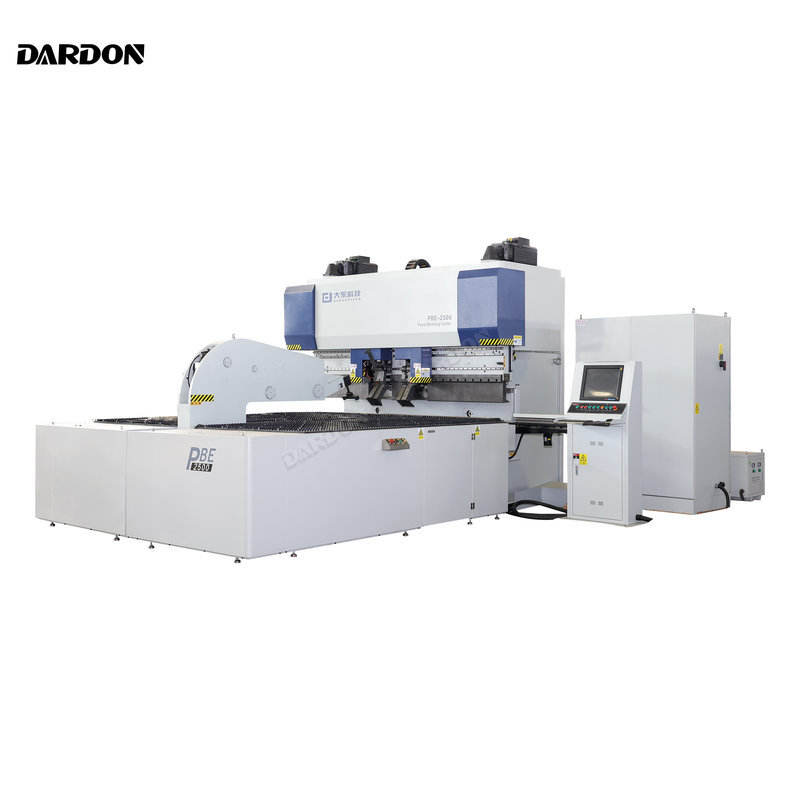
Introduction: The Panel Bender — The Machine That Changed Sheet Metal Fabrication Forever
For decades, the press brake was the undisputed king of sheet metal bending. Skilled operators loaded sheets, positioned them against the back gauge, activated the ram, repositioned, and repeated — bend by bend, part by part. The press brake is a capable machine, but it has fundamental limitations: it requires skilled operators, it is slow for multi-bend parts, and it produces results that vary with operator skill and fatigue.
The panel bender changed everything. By automating the sheet manipulation and bending sequence, the panel bender transformed sheet metal bending from a skilled-labor-intensive operation into a fast, automated, repeatable process — producing complex multi-bend panels in a fraction of the time a press brake requires, with consistency that no human operator can match.
The global sheet metal fabrication market exceeds $300 billion annually, and panel bending is one of its fastest-growing segments — driven by the demand for electrical enclosures, HVAC panels, elevator cabs, architectural cladding, and stainless steel equipment that requires complex, precise bending at high volume.
The DARDONTECH PBE2500 CNC Electric Fully Automatic Synchronized Panel Bender at $80,000 — with 2,500mm bending length, automatic tooling change, and all-electric servo drive — represents the state of the art in accessible panel bending technology, bringing capabilities previously reserved for premium European machines to fabricators at a globally competitive price.
Panel Bender vs. Press Brake: Understanding the Fundamental Difference
The Press Brake: Powerful but Limited
The press brake is the most widely used sheet metal bending machine in the world — and for good reason. It is versatile, capable of bending virtually any profile, and available in a wide range of sizes and capacities. But for panel bending applications — large, flat panels with multiple parallel bends — the press brake has significant limitations:
Manual sheet handling: The operator must manually position the sheet against the back gauge for each bend, flip the sheet between bends, and support the sheet weight throughout the bending sequence. For large panels (1,000mm × 2,000mm+), this is physically demanding and time-consuming.
Operator skill dependency: Consistent bend angles require an experienced operator who understands springback, material variation, and tooling wear. Results vary between operators and between shifts.
Slow cycle time for multi-bend parts: A panel with 8 bends requires 8 separate press brake operations — each requiring sheet positioning, bending, and repositioning. Cycle time: 5–15 minutes per panel.
Tooling setup time: Changing from one bend profile to another requires manual tool change — removing and installing punch and die sets. Setup time: 15–60 minutes per changeover.
Marking and scratching: The sheet slides against the press brake tooling during bending — causing surface marks that are unacceptable for stainless steel and pre-painted panels.
The Panel Bender: Automation Transforms the Process
The panel bender addresses every limitation of the press brake for panel bending applications:
Automatic sheet manipulation: The panel bender’s manipulator arm grips the sheet and automatically positions it for each bend — no operator handling required. The sheet moves precisely to the correct position for every bend in the sequence.
CNC consistency: Every bend is executed by the CNC-controlled bending blades — angle, position, and sequence are programmed, not operator-dependent. Every panel in a batch is identical.
Fast cycle time: A panel with 8 bends is completed in 60–120 seconds on a panel bender vs. 5–15 minutes on a press brake. Throughput improvement: 5–10× for typical panel parts.
Automatic tooling change: The DARDONTECH PBE2500’s automatic tooling change system switches between bending profiles without manual intervention — changeover time measured in seconds, not minutes.
No surface marking: The panel bender’s bending blades contact only the bend zone — the panel surface is never dragged against tooling. Stainless steel and pre-painted panels emerge scratch-free.
Single operator: A panel bender requires one operator to load and unload sheets — the machine handles all manipulation and bending automatically. A press brake requires one skilled operator per machine.
The DARDONTECH PBE2500: Technical Architecture
All-Electric Servo Drive: The Modern Standard
The PBE2500’s all-electric servo drive system is one of its most important technical features — and one that distinguishes it from older hydraulic panel benders:
How electric servo drive works: Servo motors drive the bending blades, manipulator arm, and tooling change system through precision ball screws and linear guides. The CNC control commands each axis independently — with position feedback from encoders ensuring precise, repeatable motion.
Electric vs. hydraulic — the comparison:
Energy efficiency:
- Hydraulic: Hydraulic pump runs continuously — consuming energy even when the machine is idle
- Electric servo: Motors only consume energy when moving — 30–50% lower energy consumption than equivalent hydraulic machines
Speed and response:
- Hydraulic: Hydraulic fluid compressibility and valve response time limit acceleration and deceleration
- Electric servo: Instant response — servo motors accelerate and decelerate at maximum rate, limited only by mechanical inertia
Precision:
- Hydraulic: Pressure variation, temperature effects on fluid viscosity, and valve hysteresis affect positioning accuracy
- Electric servo: Encoder feedback provides direct position measurement — positioning accuracy of ±0.01mm or better
Maintenance:
- Hydraulic: Hydraulic oil changes, filter replacement, pump maintenance, seal replacement, leak management
- Electric servo: No hydraulic system — maintenance limited to mechanical components (bearings, ball screws, guides) and electrical components
Cleanliness:
- Hydraulic: Hydraulic oil leaks are a constant risk — contaminating the workshop floor and workpieces
- Electric servo: No oil — clean operation suitable for food processing, pharmaceutical, and precision environments
Environmental:
- Hydraulic: Hydraulic oil disposal is an environmental concern
- Electric servo: No hydraulic oil — lower environmental impact
The all-electric advantage is decisive for modern fabrication environments — lower operating cost, higher precision, faster cycle time, and cleaner operation.
Synchronized Bending Blades
The “synchronized” designation refers to the coordinated operation of the upper and lower bending blades — the core mechanism that creates bends in the panel bender:
Upper bending blade:
- Positioned above the sheet
- Bends the sheet upward (positive bends)
- CNC-controlled position and angle
Lower bending blade:
- Positioned below the sheet
- Bends the sheet downward (negative bends)
- CNC-controlled position and angle
Synchronization: The upper and lower blades operate in coordinated sequences — enabling both positive and negative bends without flipping the sheet. A panel with alternating up and down bends (a common profile for enclosure panels) is completed in a single continuous sequence.
The synchronization advantage: Without synchronized upper and lower blades, the sheet must be flipped between positive and negative bends — adding handling time and the risk of surface damage. Synchronized blades eliminate flipping entirely for most panel profiles.
Automatic Tooling Change System
The automatic tooling change system is the feature that transforms the PBE2500 from a fast bending machine into a flexible production system:
What automatic tooling change does: Different bend profiles require different tooling — different blade radii, different blade lengths, different blade profiles for hemming, seaming, and special forms. The automatic tooling change system stores multiple tooling sets and switches between them under CNC control.
The production impact:
- Without automatic tooling change: Operator manually removes and installs tooling for each new profile — 15–45 minutes per changeover
- With automatic tooling change: CNC program selects the required tooling — changeover in 30–120 seconds
For job shops and fabricators running multiple part families, automatic tooling change is the difference between a machine that is productive and one that spends half its time in setup.
2,500mm Bending Length
The PBE2500’s 2,500mm bending length covers the full range of standard panel sizes:
Electrical enclosures:
- Standard enclosure widths: 400mm, 600mm, 800mm, 1,000mm, 1,200mm
- All within the 2,500mm capacity
HVAC panels:
- Standard duct sections: Up to 2,000mm wide
- Air handling unit panels: Up to 2,400mm wide
Architectural cladding:
- Standard facade panel widths: 600mm–2,000mm
- All within the 2,500mm capacity
Elevator cab panels:
- Standard cab widths: 1,000mm–2,000mm
- All within the 2,500mm capacity
The 2,500mm capacity means the PBE2500 can handle virtually any standard panel size in a single machine — no need for a larger, more expensive machine for occasional oversized panels.
Stainless Steel Bending: The PBE2500’s Critical Capability
Why Stainless Steel Bending Is Demanding
Stainless steel is one of the most challenging sheet metal materials to bend — and one of the most valuable. Understanding its bending characteristics explains why the PBE2500’s stainless steel capability is a significant commercial advantage.
Work hardening: Stainless steel (particularly austenitic grades 304 and 316) work-hardens rapidly during bending — the material becomes harder and stronger as it is deformed. This increases the bending force required and affects springback behavior.
Springback: Stainless steel has higher springback than mild steel — the material springs back more after the bending force is removed. The CNC control must overbend to compensate for springback — and the overbend amount varies with material grade, thickness, and temper.
Surface sensitivity: Stainless steel surfaces scratch easily — any contact between the sheet surface and tooling or handling equipment leaves visible marks. The panel bender’s non-contact bending approach (blades contact only the bend zone) is ideal for stainless steel.
Higher bending force: Stainless steel requires 50–70% more bending force than mild steel of the same thickness — the machine must have sufficient capacity for the stainless steel thicknesses required.
Stainless Steel Applications That Drive Demand
Food processing equipment:
- Stainless steel 304 or 316 is mandatory for food contact surfaces
- Equipment panels, machine guards, conveyor covers, hoppers
- Hygiene requirements demand scratch-free, smooth surfaces — panel bending is ideal
Pharmaceutical and laboratory equipment:
- Stainless steel 316L for pharmaceutical contact surfaces
- Equipment enclosures, clean room panels, laboratory furniture
- GMP requirements demand smooth, cleanable surfaces
Commercial kitchen equipment:
- Stainless steel 304 for all food service equipment
- Oven panels, refrigeration panels, prep table surfaces, hood panels
- High-volume production — panel bender throughput advantage is decisive
Architectural and interior design:
- Stainless steel cladding panels for elevator interiors, lobby walls, column covers
- Decorative panels with complex profiles
- Surface finish preservation is critical — panel bending eliminates press brake marking
Medical equipment:
- Stainless steel enclosures for medical devices and hospital equipment
- Strict surface finish requirements
- Panel bending’s scratch-free operation is essential
Applications: What the PBE2500 Produces
Electrical Enclosures and Control Cabinets
The electrical enclosure industry is the largest single market for panel benders — and the application that most clearly demonstrates the panel bender’s advantages:
Typical enclosure panel:
- Material: Mild steel (1.0–2.0mm) or stainless steel (1.0–2.0mm)
- Bends: 4–12 bends per panel (sides, flanges, mounting lips, cable entry lips)
- Profile: Multiple parallel bends, often with alternating up/down direction
Press brake cycle time: 8–15 minutes per panel (including handling and repositioning) PBE2500 cycle time: 60–120 seconds per panel
Throughput improvement: 6–10×
Annual production comparison (single shift, 8 hours/day, 300 days/year):
- Press brake: 8 hours × 60 min/hour ÷ 10 min/panel = 48 panels/day × 300 = 14,400 panels/year
- PBE2500: 8 hours × 3,600 sec/hour ÷ 90 sec/panel = 320 panels/day × 300 = 96,000 panels/year
The PBE2500 produces 6.7× more panels per year than a press brake — with one operator instead of one skilled operator.
HVAC Ductwork and Air Handling Units
Rectangular duct sections:
- Material: Galvanized steel (0.5–1.2mm), stainless steel (0.8–1.5mm)
- Profile: 4-bend rectangular cross-section with seam flanges
- Volume: High — HVAC contractors produce thousands of duct sections per project
Air handling unit panels:
- Material: Galvanized steel (0.8–1.5mm), aluminum (1.0–2.0mm)
- Profile: Complex panels with multiple bends, stiffening ribs, and mounting flanges
- Size: Up to 2,400mm wide — within PBE2500 capacity
Elevator and Escalator Panels
Elevator cab panels:
- Material: Stainless steel (1.0–1.5mm), mild steel (1.0–2.0mm)
- Profile: Flat panels with perimeter flanges and mounting features
- Surface finish: Critical — stainless steel panels must be scratch-free
Escalator side panels:
- Material: Stainless steel (1.5–2.0mm)
- Profile: Complex curved and flat sections
- Volume: Moderate — elevator manufacturers produce panels in batches
Architectural Cladding and Facade Panels
Facade cladding panels:
- Material: Aluminum (1.5–3.0mm), stainless steel (1.0–2.0mm), mild steel (1.5–2.5mm)
- Profile: Flat panels with perimeter returns and mounting flanges
- Size: Up to 2,400mm wide — within PBE2500 capacity
- Surface finish: Critical — architectural panels must be scratch-free
Column covers and wall panels:
- Material: Stainless steel (1.0–1.5mm), aluminum (1.5–2.5mm)
- Profile: Wrap-around panels with complex multi-bend profiles
Commercial Kitchen and Food Service Equipment
Oven and refrigeration panels:
- Material: Stainless steel 304 (0.8–1.5mm)
- Profile: Flat panels with perimeter flanges and mounting features
- Volume: High — commercial kitchen equipment manufacturers produce panels in large batches
Prep tables and work surfaces:
- Material: Stainless steel 304 (1.0–1.5mm)
- Profile: Flat top with turned-down edges and backsplash
Programming: From Design to Bent Part
Offline Programming (CAM Software)
Modern panel benders are programmed offline using CAM (Computer-Aided Manufacturing) software — the operator programs the part on a computer, and the program is transferred to the machine:
Programming process:
- Import 3D CAD model or 2D DXF drawing of the part
- CAM software automatically unfolds the part to flat blank dimensions
- CAM software generates the bending sequence — determining the optimal order of bends to avoid collisions
- CAM software generates the CNC program — including blade positions, angles, and tooling selection
- Program transferred to machine via network or USB
- First part bent and inspected — program adjusted if required
- Production run begins
Programming time:
- Simple panel (4–6 bends): 5–15 minutes
- Complex panel (8–16 bends): 15–45 minutes
- Repeat part (previously programmed): <1 minute (recall stored program)
The offline programming advantage: Programming is done on a computer while the machine is producing — no machine downtime for programming. New parts are ready to run as soon as the current batch is complete.
On-Machine Programming
For simple parts or urgent jobs, the PBE2500 can be programmed directly at the machine control:
Conversational programming: The operator enters bend parameters (angle, position, tooling) through the machine’s touchscreen interface — the control generates the bending sequence automatically.
Suitable for: Simple parts with few bends, urgent jobs where offline programming time is not available.
ROI Analysis: The Economics of Panel Bending
Investment: $80,000
Labor Savings
Press brake baseline (equivalent production):
- Skilled press brake operator: $25/hour
- Output: 48 panels/day (8-bend panels)
- Labor cost per panel: $25/hour × 8 hours ÷ 48 panels = $4.17/panel
PBE2500 panel bender:
- Semi-skilled operator (loading/unloading): $15/hour
- Output: 320 panels/day
- Labor cost per panel: $15/hour × 8 hours ÷ 320 panels = $0.375/panel
Labor saving per panel: $3.79 Annual labor saving (300 days × 320 panels/day × $3.79): $363,840/year
Revenue Generation
Contract sheet metal fabrication:
- Panel bender utilization: 16 hours/day, 300 days/year = 4,800 hours/year
- Hourly machine rate: $60–$100/hour
- Annual revenue: $288,000–$480,000
Payback Period
Labor saving scenario:
- Annual saving: $363,840
- Payback: 2.6 months
Job shop revenue scenario:
- Annual revenue: $380,000
- Operating cost: $100,000
- Annual profit: $280,000
- Payback: 3.4 months
Comparison: DARDONTECH PBE2500 vs. Alternatives
| Factor | Press Brake | DARDONTECH PBE2500 | Italian/German Premium Panel Bender |
|---|---|---|---|
| Price | $30,000–$80,000 | $80,000 | $300,000–$600,000 |
| Throughput (8-bend panel) | 48/day | 320/day | 400–500/day |
| Operator skill required | High | Low | Low |
| Automatic tooling change | No | Yes | Yes |
| Electric drive | Some | Yes | Yes |
| Stainless steel capable | Yes | Yes | Yes |
| Surface marking risk | High | None | None |
| ROI | Poor for panels | Excellent | Good |
The DARDONTECH PBE2500 delivers 80–85% of the throughput of a premium Italian or German panel bender at 13–27% of the price — the rational choice for fabricators who need panel bending automation without the premium brand investment.
Featured Product: DARDONTECH PBE2500 on MEGA BDM
MEGA BDM has sourced and verified the DARDONTECH PBE2500 CNC Electric Fully Automatic Synchronized Panel Bender with Automatic Tooling Change from DARDONTECH — a verified global sheet metal fabrication equipment manufacturer with proven CNC panel bender design, manufacturing, and international export experience across electrical enclosure, HVAC, architectural, food processing, and general sheet metal fabrication applications.
👉 View the DARDONTECH PBE2500 Panel Bender on MEGA BDM
Frequently Asked Questions
What is the maximum material thickness for mild steel and stainless steel?
Confirm the maximum bending thickness for mild steel and stainless steel with the supplier. Provide your thickest material for confirmation that the machine’s bending force is sufficient.
How many tooling sets does the automatic tooling change system hold?
Confirm the number of tooling sets in the automatic tooling change magazine with the supplier. More tooling sets = more bend profiles available without manual intervention.
What bend angle accuracy does the machine achieve?
Confirm the bend angle accuracy (±°) with the supplier for your tolerance requirements. Typical panel benders achieve ±0.3° or better with angle compensation.
What CAM software is compatible with the PBE2500?
Confirm compatible CAM software with the supplier. Provide your existing CAD/CAM software for confirmation of compatibility and post-processor availability.
What is the minimum flange length the machine can bend?
Confirm the minimum flange length with the supplier for your smallest bend features. Panel benders have a minimum flange length determined by the blade geometry — typically 6–12mm.
What is the lead time and installation support?
Confirm lead time (typically 2–4 months) and installation support (DARDONTECH technicians for commissioning and operator training) with the supplier.
Conclusion
The DARDONTECH PBE2500 CNC Electric Fully Automatic Synchronized Panel Bender delivers the automation, speed, and precision that competitive sheet metal fabrication demands — transforming panel bending from a skilled-labor-intensive press brake operation into a fast, consistent, one-operator automated process that produces 6–10× more panels per shift with zero surface marking and automatic tooling change.
At $80,000 — with payback periods of 2.6–3.4 months from labor savings and revenue generation — this machine is one of the highest-ROI capital investments available in sheet metal fabrication. For electrical enclosure manufacturers, HVAC fabricators, stainless steel equipment producers, architectural panel fabricators, and general sheet metal job shops, the DARDONTECH PBE2500 is the machine that makes panel bending profitable at any production volume.
👉 View the full product details on MEGA BDM