
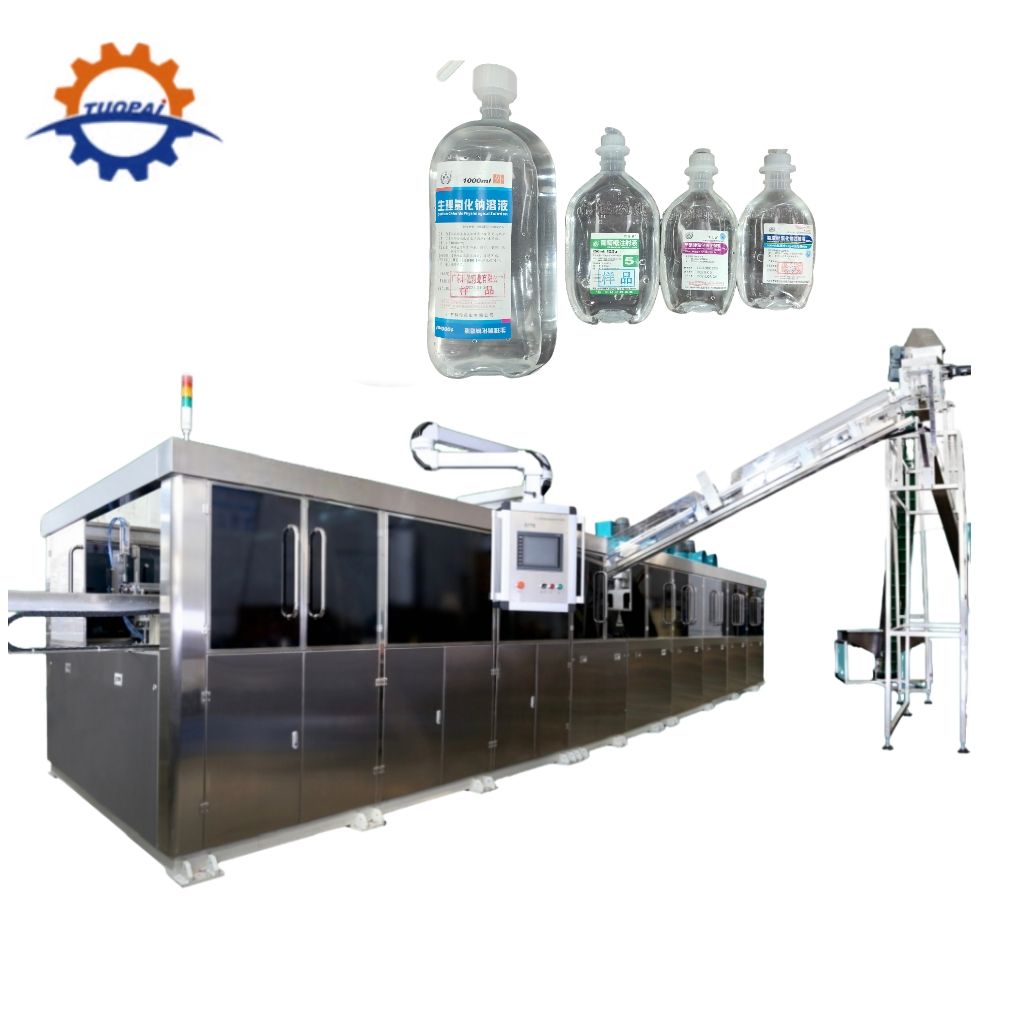
Introduction: IV Fluids — The Most Critical Pharmaceutical Product in the World
There is no pharmaceutical product more essential to modern medicine than intravenous (IV) fluid. Every hospital, every surgical suite, every emergency room, every intensive care unit depends on a continuous, reliable supply of IV solutions — normal saline, glucose, Ringer’s lactate, and other large-volume parenterals (LVPs) — to keep patients alive.
Normal saline (0.9% sodium chloride in water for injection) is the single most widely used IV fluid globally. It is used for:
- Fluid resuscitation in trauma, shock, and dehydration
- Medication dilution and delivery (antibiotics, chemotherapy, electrolytes)
- Surgical irrigation and intraoperative fluid replacement
- Maintenance fluid therapy for hospitalized patients
- Dialysis and renal replacement therapy
A 500-bed hospital uses 1,000–3,000 bags or bottles of IV fluid per day. A country of 10 million people requires tens of millions of IV fluid units per year. And in most developing markets — across Africa, Southeast Asia, South Asia, and the Middle East — the majority of this IV fluid is imported, creating supply chain vulnerability, foreign exchange drain, and price dependence on global manufacturers.
The 0.9% Normal Saline IV Fluid Factory Plant — PP Bottle Production Line at 2,000 BPH available through MEGA BDM at $1,758,920–$2,635,500 is the solution: a complete, GMP-compliant, turnkey IV solution manufacturing plant that enables any country, hospital group, or pharmaceutical manufacturer to produce IV fluids domestically — at the quality, scale, and cost that national health security demands.
The Global IV Fluid Market: Scale, Growth, and the Supply Security Imperative
Market Size and Growth
Global IV fluid market:
- Market size: $12+ billion annually (2024)
- Volume: 15+ billion units per year
- Growth rate: 6–8% annually
- Key drivers: Aging population, rising surgical volumes, expanding healthcare access in developing markets, pandemic preparedness
Large-volume parenterals (LVP) — the core market:
- Normal saline (0.9% NaCl): Largest single product — 30–40% of total LVP volume
- Glucose solutions (5%, 10%, 50%): Second largest — 20–25% of volume
- Ringer’s lactate (Hartmann’s solution): Third largest — 15–20% of volume
- Other LVPs (mannitol, amino acids, lipid emulsions): Remaining volume
Regional market dynamics:
Southeast Asia:
- Market: $1.5+ billion annually
- Growth: 8–10% annually
- Key markets: Indonesia, Vietnam, Philippines, Thailand, Myanmar
- Supply situation: Heavy import dependence — Indonesia imports 40%+ of IV fluids; Vietnam has limited domestic capacity
- Opportunity: Massive import substitution potential
South Asia:
- Market: $2+ billion annually
- India: Largest domestic IV fluid manufacturer in Asia — Baxter, Fresenius Kabi, Claris, and domestic producers
- Bangladesh, Pakistan, Sri Lanka: Significant import dependence
- Opportunity: Bangladesh and Pakistan have strong pharmaceutical manufacturing ambitions
Africa:
- Market: $800 million+ annually
- Supply situation: 80%+ of IV fluids imported — from India, China, and Europe
- Opportunity: Largest import substitution opportunity globally — African governments actively seeking domestic IV fluid manufacturing investment
Middle East:
- Market: $600 million+ annually
- Supply situation: Mixed — Saudi Arabia, Egypt have domestic capacity; smaller markets import
- Opportunity: GCC countries investing in pharmaceutical manufacturing for supply security
The COVID-19 Lesson: Supply Security Is National Security
The COVID-19 pandemic exposed the catastrophic vulnerability of countries that depend on imported IV fluids. When global supply chains disrupted, countries that lacked domestic IV fluid manufacturing faced:
- Critical shortages of normal saline and other IV fluids
- Price spikes of 200–500% as global demand surged
- Inability to treat COVID-19 patients requiring IV fluid therapy
- Dependence on emergency imports from countries that prioritized their own supply
The lesson was clear: IV fluid manufacturing is not a commercial opportunity — it is a national security imperative. Countries that established domestic IV fluid manufacturing before the pandemic were insulated from these shocks. Countries that did not suffered preventable patient deaths.
This realization has driven a wave of government investment in domestic IV fluid manufacturing capacity across Africa, Southeast Asia, South Asia, and the Middle East — creating the largest market opportunity in pharmaceutical manufacturing infrastructure in a generation.
IV Solution Technology: PP Bottles vs. Glass vs. Flexible Bags
The Three Container Technologies
IV solutions are packaged in three primary container types — each with distinct advantages, limitations, and market positions:
Glass bottles (traditional):
- The original IV fluid container — used since the 1940s
- Advantages: Chemical inertness, transparency, autoclavable, recyclable
- Disadvantages: Heavy (adds shipping cost), breakable (safety risk), requires venting during administration (infection risk), labor-intensive to wash and sterilize for reuse
- Market position: Declining — being replaced by PP bottles and flexible bags in most markets
- Still used in: Some developing markets where glass bottle washing infrastructure exists, certain specialty products
Flexible bags (PVC or non-PVC):
- Soft, collapsible plastic bags — the dominant format in developed markets
- Advantages: Lightweight, no venting required (collapses as fluid drains), easy to handle, lowest material cost at scale
- Disadvantages: Higher manufacturing complexity (requires aseptic filling or terminal sterilization in specialized equipment), PVC bags contain DEHP plasticizer (regulatory concern), non-PVC bags are more expensive
- Market position: Dominant in Europe, North America, Japan — growing in developing markets
- Manufacturing complexity: Higher than PP bottles — requires specialized bag-making and filling equipment
PP (Polypropylene) bottles — this production line:
- Semi-rigid plastic bottles — the dominant format in developing markets and the fastest-growing globally
- Advantages:
- Autoclavable: PP withstands steam sterilization at 121°C — enables terminal sterilization (the gold standard for IV fluid sterility assurance)
- Chemical resistance: PP is compatible with normal saline, glucose, Ringer’s lactate, and most LVP formulations
- Lightweight: 60–70% lighter than equivalent glass bottles — lower shipping cost
- Unbreakable: Eliminates glass breakage risk — safer for patients and healthcare workers
- No venting required: PP bottles are designed with a vented administration set — eliminates the open-system infection risk of glass bottles
- Lower manufacturing cost: PP bottle production lines are simpler and lower-cost than flexible bag lines
- Established supply chain: PP resin is globally available from multiple suppliers
- Market position: Dominant in Asia, Africa, Middle East — the standard for new IV fluid manufacturing plants in developing markets
- Manufacturing: This production line — blow molding, filling, sealing, sterilization
Why PP bottles are the right choice for new IV fluid plants in developing markets: PP bottle technology offers the optimal combination of product quality (terminal sterilization), manufacturing simplicity (lower capital cost, easier operation), and market acceptance (established in all target markets) for new IV fluid manufacturing investments in Asia, Africa, and the Middle East.
The Complete PP Bottle IV Solution Production Line: Unit Operations
Water Purification System
The foundation of IV fluid manufacturing is Water for Injection (WFI) — the highest-purity water standard in pharmaceutical manufacturing:
WFI specifications (Ph. Eur., USP, BP):
- Conductivity: ≤1.3 μS/cm at 25°C
- Total organic carbon (TOC): ≤500 ppb
- Endotoxins: ≤0.25 EU/mL
- Microbial count: ≤10 CFU/100mL (action limit)
- No detectable pyrogens
WFI production methods:
Multi-effect distillation (MED):
- Purified water distilled through multiple evaporation stages
- Produces WFI meeting all pharmacopeial standards
- Energy-intensive but highly reliable
- The traditional and most widely accepted method globally
Reverse osmosis + ultrafiltration (RO+UF):
- Accepted by some pharmacopeias (USP since 2017) for WFI production
- Lower energy consumption than distillation
- Requires careful validation and monitoring
- Increasingly accepted in new plant designs
WFI storage and distribution:
- WFI stored in jacketed, insulated tanks at 80°C+ (hot storage) to prevent microbial growth
- Distributed through a continuously circulating loop at 80°C+
- All piping: 316L stainless steel, electropolished, with orbital welds
- No dead legs — all piping designed for complete drainage and CIP
Solution Preparation
Formulation of 0.9% Normal Saline:
- WFI + pharmaceutical-grade sodium chloride (NaCl, USP/Ph. Eur.)
- NaCl concentration: 9.0 g/L (0.9% w/v)
- pH: 4.5–7.0 (adjusted with HCl or NaOH if required)
- Osmolarity: 308 mOsm/L (isotonic)
Preparation process:
- WFI charged to preparation vessel
- NaCl added and dissolved under agitation
- pH measured and adjusted if required
- Conductivity measured to verify NaCl concentration
- Solution filtered through 0.2 μm membrane filter (bioburden reduction)
- Solution transferred to holding vessel for filling
Preparation vessel:
- 316L stainless steel, jacketed, with agitator
- CIP (Clean-in-Place) and SIP (Steam-in-Place) systems
- Capacity: Matched to filling line throughput (typically 2,000–5,000L)
PP Bottle Manufacturing (Blow Molding)
PP bottles are manufactured on-site by blow molding — either integrated into the filling line or as a separate upstream operation:
Extrusion blow molding:
- PP resin extruded into a parison (hollow tube)
- Parison placed in a mold and inflated with compressed air to form the bottle shape
- Bottle cooled and ejected from mold
- Suitable for: 250mL and 500mL IV bottles
Injection stretch blow molding (ISBM):
- PP preform injection molded, then stretch-blown into final bottle shape
- Higher dimensional accuracy and better material distribution
- Suitable for: Smaller bottles and higher-precision applications
Bottle quality requirements:
- Wall thickness uniformity: Critical for autoclave sterilization — uneven walls cause deformation
- Clarity: PP bottles should be translucent for visual inspection of the solution
- Dimensional accuracy: Neck finish must be consistent for reliable sealing
- Freedom from contamination: Bottles must be produced in a controlled environment
Integrated vs. separate bottle production:
- Integrated: Bottles produced immediately before filling — minimizes contamination risk, eliminates bottle storage and handling
- Separate: Bottles produced in a separate area and stored before filling — allows higher bottle production speed, but requires clean storage and handling
Filling and Sealing
Filling process:
- Bottles conveyed from blow molding to filling station
- Bottles inverted (neck down) for filling — prevents contamination of the neck finish
- Filling nozzle inserted into bottle — solution filled to target volume
- Filling accuracy: ±1% of nominal volume (250mL ±2.5mL, 500mL ±5mL)
- Bottle righted and conveyed to sealing station
Filling environment:
- ISO 5 (Class 100) cleanroom at the filling point — critical for sterility assurance before terminal sterilization
- Laminar airflow over the filling zone
- Continuous particle monitoring
- Gowning requirements for operators
Sealing:
- Rubber stopper + aluminum crimp seal: Traditional closure — rubber stopper inserted, aluminum cap crimped over the neck
- PP screw cap with membrane: Modern closure — PP cap with integrated membrane, heat-sealed or ultrasonically welded
- Welded PP closure: PP closure welded to bottle neck — hermetic seal, no separate stopper required
Sealing integrity testing:
- 100% visual inspection of seal integrity
- Leak testing (vacuum or pressure decay) — 100% or statistical sampling
- Seal integrity is critical — any leak allows contamination during sterilization
Terminal Sterilization (Autoclave)
Terminal sterilization — sterilizing the filled, sealed bottle — is the defining quality advantage of PP bottle IV fluid manufacturing:
Autoclave sterilization process:
- Filled, sealed bottles loaded into autoclave baskets
- Autoclave cycle: 121°C, 15 psi steam pressure, 15–30 minutes (F₀ ≥ 8 minutes)
- Cooling: Pressurized water cooling to prevent bottle deformation
- Sterility assurance level (SAL): 10⁻⁶ (probability of a non-sterile unit = 1 in 1,000,000)
Why terminal sterilization is the gold standard:
- The entire filled container is sterilized — any contamination introduced during filling is eliminated
- Provides the highest sterility assurance of any IV fluid manufacturing method
- Regulatory preference: WHO GMP, EU GMP, and most national pharmacopeias prefer terminal sterilization over aseptic filling for LVPs
Autoclave capacity for 2000BPH:
- 2,000 bottles/hour × 500mL = 1,000L/hour production rate
- Autoclave cycle time: 60–90 minutes (including loading, sterilization, cooling, unloading)
- Required autoclave capacity: 2–4 autoclaves operating in rotation to maintain continuous production
Inspection and Quality Control
100% visual inspection:
- Every bottle inspected for:
- Visible particles (glass fragments, rubber particles, fibers, undissolved material)
- Clarity (solution should be clear and colorless)
- Seal integrity (no loose caps, damaged seals)
- Fill volume (visual check for gross under/overfill)
- Container integrity (no cracks, deformation)
- Inspection method: Manual (trained inspectors) or automated (camera-based inspection system)
Automated inspection systems:
- Camera-based systems inspect bottles at line speed
- Detect particles ≥50 μm (visible particles per Ph. Eur./USP)
- Higher throughput and consistency than manual inspection
- Required for GMP compliance in most regulated markets
In-process quality control:
- pH measurement: Every batch
- Conductivity/NaCl concentration: Every batch
- Fill volume: Statistical sampling during filling
- Sterility testing: Statistical sampling per batch (14-day incubation)
- Endotoxin testing (LAL test): Every batch
- Particulate matter testing: Statistical sampling per batch
Labeling and Packaging
Labeling:
- Self-adhesive labels or direct printing on bottle
- Required information: Product name, concentration, volume, batch number, manufacture date, expiry date, storage conditions, manufacturer details, regulatory approval number
- Regulatory compliance: Labels must comply with the pharmacopeia and regulatory requirements of the target market
Secondary packaging:
- Bottles packed in corrugated cartons (typically 20–40 bottles per carton)
- Cartons labeled with batch information for traceability
- Palletized for warehouse storage and distribution
GMP Compliance: The Regulatory Framework for IV Fluid Manufacturing
Why GMP Compliance Is Non-Negotiable
IV fluids are administered directly into the bloodstream — any contamination (microbial, particulate, or chemical) can cause immediate, life-threatening harm. This is why IV fluid manufacturing is subject to the strictest pharmaceutical manufacturing regulations:
The consequences of non-compliant IV fluid:
- Septicemia (bloodstream infection) from microbial contamination
- Embolism from particulate contamination
- Electrolyte imbalance from incorrect formulation
- Death — IV fluid contamination incidents have caused mass casualty events
Regulatory consequences of non-compliance:
- Product recall — all affected batches recalled from market
- Manufacturing license suspension or revocation
- Criminal prosecution of responsible persons
- Civil liability for patient harm
WHO GMP for Large-Volume Parenterals
WHO GMP (Good Manufacturing Practice) is the international standard for pharmaceutical manufacturing — required for WHO prequalification and export to most developing markets:
Key WHO GMP requirements for LVP manufacturing:
Premises and environment:
- Classified manufacturing areas: ISO 5 (Grade A) at filling point, ISO 7 (Grade C) for preparation, ISO 8 (Grade D) for support areas
- HVAC system: Controlled temperature (18–25°C), humidity (30–65% RH), air changes (20+ per hour for Grade C), HEPA filtration
- Pressure differentials: Positive pressure in cleaner areas to prevent contamination ingress
- Separate areas for different operations — no cross-contamination risk
Equipment:
- All product-contact surfaces: 316L stainless steel, electropolished
- No dead legs in piping — complete drainage and CIP coverage
- Validated CIP and SIP systems
- Calibrated instruments (temperature, pressure, flow, pH, conductivity)
Personnel:
- Gowning requirements for each cleanroom grade
- Training and qualification of all personnel
- Health monitoring — personnel with infections excluded from production areas
Documentation:
- Batch manufacturing records (BMR) for every batch
- Standard operating procedures (SOPs) for all operations
- Change control system
- Deviation management and CAPA system
- Stability data for product shelf life claims
Validation:
- Process validation: Demonstration that the manufacturing process consistently produces product meeting specifications
- Cleaning validation: Demonstration that CIP effectively removes product residue
- Sterilization validation: Demonstration that the autoclave cycle achieves the required F₀ value
- Computer system validation: For any computerized systems controlling the manufacturing process
EU GMP (EudraLex Volume 4)
EU GMP is required for products sold in the European Union and is widely recognized as the most stringent pharmaceutical manufacturing standard globally. EU GMP Annex 1 (Manufacture of Sterile Medicinal Products) was comprehensively revised in 2022 — introducing new requirements for contamination control strategy (CCS) and quality risk management.
Regulatory Markets and Required Standards
| Target Market | Required Standard | Notes |
|---|---|---|
| WHO prequalification | WHO GMP | Required for UN procurement, UNICEF, Global Fund |
| European Union | EU GMP (Annex 1) | Most stringent standard |
| United States | US FDA cGMP (21 CFR 210/211) | Required for US market |
| India | Schedule M (revised 2023) | Aligned with WHO GMP |
| Southeast Asia | National GMP (aligned with WHO) | Varies by country |
| Africa | National GMP + WHO GMP for export | WHO GMP for regional export |
| Middle East | National GMP | Saudi Arabia, UAE have strict requirements |
Confirm which regulatory standards the plant is designed to meet with the supplier — and which markets you intend to supply.
Plant Layout and Infrastructure Requirements
Building Requirements
Cleanroom construction:
- Walls and ceilings: Smooth, non-shedding, cleanable surfaces (epoxy-coated concrete, sandwich panels, or GMP-grade modular cleanroom panels)
- Floors: Epoxy or polyurethane coating — seamless, chemical-resistant, easy to clean
- Junctions: Coved (rounded) wall-floor junctions — no corners where contamination can accumulate
- Doors: Interlocked airlocks between cleanroom grades — prevents simultaneous opening
HVAC system:
- Air handling units (AHUs) for each cleanroom grade
- HEPA filtration (H14) for Grade A and B areas
- Temperature and humidity control
- Continuous particle monitoring in critical areas
Utilities:
- Purified water (PW) system: For equipment washing and non-critical applications
- WFI system: For solution preparation and final rinse
- Clean steam: For SIP and autoclave sterilization
- Compressed air: Oil-free, filtered — for pneumatic equipment and bottle blow molding
- Nitrogen: For blanketing solution preparation vessels (prevents oxidation)
- Electrical: 3-phase, 380–480V, 50/60Hz — confirm total connected load with supplier
Building footprint:
- A 2000BPH IV solution plant typically requires 3,000–6,000 m² of total building area
- Confirm exact requirements with the supplier based on the specific plant configuration
Utilities Consumption
Water:
- WFI production: 3–5L of purified water per liter of WFI produced (reject water)
- Autoclave cooling: Significant water consumption — confirm with supplier
- CIP: Significant water consumption per cleaning cycle
Electricity:
- Total connected load: 500–1,500 kW (confirm with supplier)
- Major consumers: Autoclave, HVAC, blow molding, WFI distillation
Steam:
- Clean steam for SIP and autoclave: Significant consumption
- Steam boiler required — confirm capacity with supplier
Economic Analysis: The IV Fluid Manufacturing Business Case
Investment: $1,758,920 – $2,635,500 (Plant Equipment)
Total project cost (including building, utilities, validation, regulatory):
- Plant equipment: $1,758,920–$2,635,500
- Building construction: $500,000–$2,000,000 (depending on location and existing infrastructure)
- Utilities installation: $200,000–$500,000
- Validation and regulatory: $200,000–$500,000
- Working capital (raw materials, packaging): $200,000–$500,000
- Total project investment: $2,858,920–$6,135,500
Revenue Potential
Production capacity at 2000BPH:
- Operating hours: 16 hours/day, 300 days/year = 4,800 hours/year
- Annual production: 2,000 bottles/hour × 4,800 hours = 9,600,000 bottles/year
- Mix: 60% × 500mL + 40% × 250mL = 5,760,000 × 500mL + 3,840,000 × 250mL
Revenue calculation:
Domestic market pricing (developing market):
- 500mL normal saline: $0.50–$1.50/bottle (ex-factory)
- 250mL normal saline: $0.35–$1.00/bottle (ex-factory)
Conservative scenario ($0.60/bottle average):
- Annual revenue: 9,600,000 × $0.60 = $5,760,000/year
Moderate scenario ($0.90/bottle average):
- Annual revenue: 9,600,000 × $0.90 = $8,640,000/year
Export/WHO prequalification scenario ($1.20/bottle average):
- Annual revenue: 9,600,000 × $1.20 = $11,520,000/year
Cost of Goods Sold
Raw materials per 500mL bottle:
- NaCl: $0.005 (4.5g × $1.10/kg)
- WFI: $0.02 (0.6L × $0.033/L production cost)
- PP bottle: $0.08–$0.15
- Closure (stopper + cap): $0.03–$0.08
- Label + carton: $0.02–$0.05
- Total raw material cost: $0.155–$0.305/bottle
Manufacturing cost per bottle:
- Labor: $0.03–$0.10
- Utilities (electricity, steam, water): $0.02–$0.05
- Quality control: $0.02–$0.05
- Maintenance: $0.01–$0.03
- Total manufacturing cost: $0.235–$0.505/bottle
Gross margin:
- At $0.60/bottle revenue: $0.60 – $0.37 = $0.23/bottle → 38% gross margin
- At $0.90/bottle revenue: $0.90 – $0.37 = $0.53/bottle → 59% gross margin
- At $1.20/bottle revenue: $1.20 – $0.37 = $0.83/bottle → 69% gross margin
Annual gross profit:
- Conservative: 9,600,000 × $0.23 = $2,208,000/year
- Moderate: 9,600,000 × $0.53 = $5,088,000/year
- Export: 9,600,000 × $0.83 = $7,968,000/year
Payback period (on equipment investment of $2,635,500):
- Conservative: 14 months
- Moderate: 6 months
- Export: 4 months
Market Entry Strategy: From Plant to Market
Regulatory Pathway
Step 1: Manufacturing license
- Apply to national medicines regulatory authority (NMRA) for pharmaceutical manufacturing license
- Submit plant design, GMP compliance documentation, and quality management system
- Timeline: 6–18 months depending on country
Step 2: Product registration
- Register normal saline (and other LVP products) with the NMRA
- Submit dossier including formulation, manufacturing process, stability data, and quality specifications
- Timeline: 6–24 months depending on country
Step 3: GMP inspection
- NMRA conducts GMP inspection of the manufacturing facility
- Inspection covers premises, equipment, documentation, personnel, and quality systems
- Timeline: Concurrent with product registration
Step 4: WHO prequalification (for export)
- Apply for WHO prequalification of the manufacturing site and products
- Enables supply to UN agencies (UNICEF, UNFPA, PAHO) and countries that require WHO prequalification
- Timeline: 12–36 months from application
Sales Channels
Government procurement:
- Ministry of Health tenders for hospital supply
- Largest volume channel in most developing markets
- Price-competitive — requires low cost of production
- Long payment terms (60–180 days) — requires working capital management
Private hospital and clinic supply:
- Higher prices than government procurement
- Faster payment terms
- Requires sales force and distribution network
Export to regional markets:
- Higher prices than domestic market
- Requires WHO prequalification or bilateral regulatory recognition
- Requires export logistics capability
UN agency supply (UNICEF, UNFPA, MSF):
- Requires WHO prequalification
- Competitive tender process
- Stable, predictable volumes
- USD-denominated payment — no foreign exchange risk
Featured Product: IV Solution PP Bottle Production Line on MEGA BDM
MEGA BDM has sourced and verified the 0.9% Normal Saline IV Fluid Factory Plant — PP Bottle Production Line, 250mL/500mL, 2,000BPH from a verified global pharmaceutical equipment manufacturer with proven IV solution plant design, manufacturing, installation, and commissioning experience across Asia, Africa, and the Middle East.
👉 View the IV Solution Production Line on MEGA BDM
Frequently Asked Questions
What products can be manufactured on this line besides normal saline?
The line can typically produce all LVP formulations compatible with PP bottles and terminal sterilization — including 5% glucose, 10% glucose, Ringer’s lactate, Ringer’s acetate, and compound sodium lactate. Confirm the full product range with the supplier.
What GMP standards is the plant designed to meet?
Confirm the GMP standard (WHO GMP, EU GMP, US FDA cGMP) with the supplier for your target regulatory market. Provide your target markets and regulatory requirements for an accurate specification.
What building and utilities does the buyer need to provide?
Confirm the scope of supply — what is included in the plant price and what the buyer must provide (building, utilities, site preparation). Provide your site conditions for a complete project assessment.
What is the project timeline from order to production?
Confirm the complete project timeline — equipment manufacturing, delivery, installation, commissioning, validation, and regulatory approval — with the supplier. Typical timelines: 18–36 months from order to first commercial production.
What training and after-sales support does the supplier provide?
Confirm operator training, validation support, and after-sales technical support with the supplier. GMP validation support is particularly important — confirm whether the supplier provides validation documentation and on-site validation support.
What is the minimum order quantity for raw materials (NaCl, PP resin)?
Confirm raw material sourcing recommendations with the supplier. NaCl and PP resin are globally available commodities — the supplier can recommend approved pharmaceutical-grade suppliers for your region.
Conclusion
The 0.9% Normal Saline IV Fluid Factory Plant — PP Bottle Production Line at 2,000 BPH is not simply a piece of manufacturing equipment. It is the foundation of national pharmaceutical self-sufficiency — the investment that transforms a country, hospital group, or pharmaceutical company from a dependent importer of the world’s most essential medicine into a sovereign producer capable of supplying its own population and exporting to regional markets.
At $1,758,920–$2,635,500 for a complete turnkey plant producing 9.6 million bottles per year — with payback periods of 4–14 months and annual gross profit of $2.2–$8.0 million — this is one of the most strategically important and financially compelling investments available in pharmaceutical manufacturing. For governments, hospital groups, pharmaceutical companies, and investors who understand that IV fluid supply security is health security, this plant is the investment that cannot wait.
👉 View the full product details on MEGA BDM