Introduction: When Power Fails, Everything Fails
In the modern digital economy, power is not a utility — it is the foundation of every business operation. Every transaction processed, every database query answered, every network packet routed, every manufacturing process controlled depends on a continuous, clean, stable supply of electrical power.
And power is not as reliable as we assume. Even in developed markets with mature grid infrastructure, power disturbances are far more common than most facility managers realize:
- Voltage sags and swells: Momentary voltage deviations that cause server resets, data corruption, and equipment damage — occurring hundreds of times per year in most facilities
- Harmonics and noise: High-frequency electrical interference from variable speed drives, switching power supplies, and other non-linear loads — causes data errors and premature equipment failure
- Frequency variations: Grid frequency deviations that cause timing errors in sensitive equipment
- Complete outages: From seconds to hours — the most visible but least frequent power problem
- Micro-interruptions: Sub-cycle power interruptions (less than 20ms) that are invisible to humans but cause server crashes and data loss
For a data center, server room, or mission-critical facility, any of these disturbances can cause downtime that costs $5,000–$500,000 per hour depending on the business. The only technology that provides complete protection against all of these disturbances simultaneously is the online double conversion UPS.
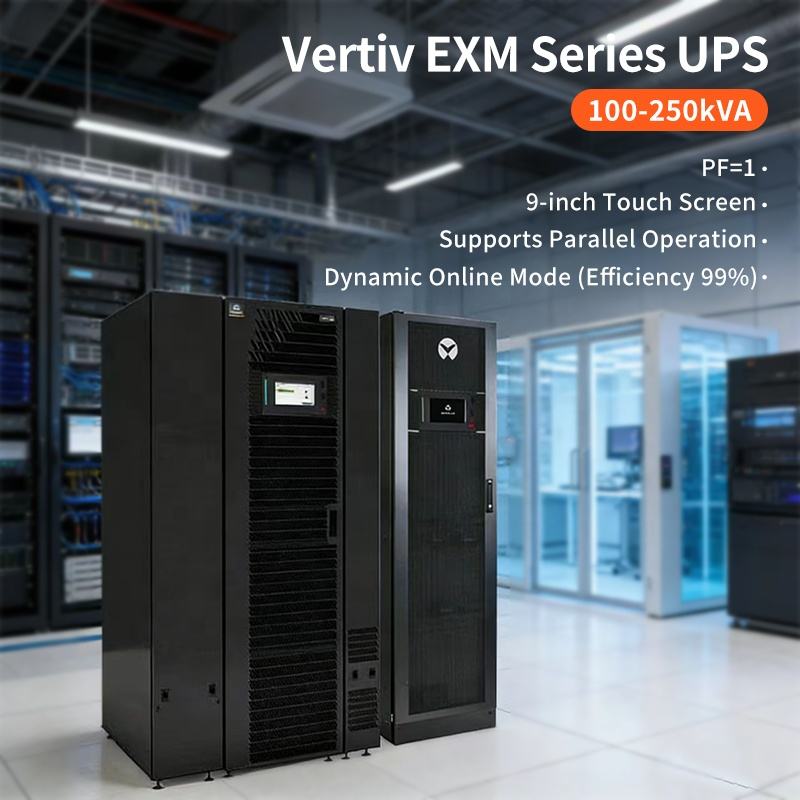
The Vertiv Liebert EXM2 — a three-phase, 100–250kW online UPS from one of the world’s most trusted power protection brands — is the solution for facilities that cannot afford power-related downtime. Available through MEGA BDM at $12,656–$21,370 depending on kW configuration, it brings enterprise-grade power protection to data centers, server rooms, and critical infrastructure at a globally competitive price.
Vertiv: The Power Protection Brand Behind the EXM2
Who Is Vertiv?
Vertiv (formerly Emerson Network Power) is one of the world’s three largest UPS and data center infrastructure manufacturers — alongside Schneider Electric (APC) and Eaton. With origins in Emerson Electric’s network power division, Vertiv was spun off as an independent company in 2016 and went public on the NYSE in 2020.
Vertiv by the numbers:
- Revenue: $7+ billion annually (2024)
- Employees: 29,000+ globally
- Presence: 130+ countries
- Products: UPS systems, precision cooling, power distribution, monitoring, and services
- Customers: Hyperscale cloud providers (AWS, Google, Microsoft), Fortune 500 enterprises, telecommunications carriers, healthcare systems, governments
The Liebert brand: Liebert is Vertiv’s flagship UPS and precision cooling brand — established in 1965 and recognized globally as a premium power protection brand. The Liebert name on a UPS signals enterprise-grade quality, reliability, and support.
Why Vertiv/Liebert matters for buyers: A UPS is a long-term investment — 10–15 years of operational life. The manufacturer’s ability to provide:
- Replacement batteries (every 3–5 years)
- Spare parts (capacitors, fans, control boards)
- Firmware updates
- Certified service engineers
- Technical support
…over the full product lifecycle is as important as the UPS’s initial specifications. Vertiv’s global presence and established service network provide confidence that support will be available throughout the EXM2’s operational life — a critical consideration that generic UPS brands cannot match.
UPS Topology: Why Online Double Conversion Is the Only Choice for Critical Loads
The Three UPS Topologies
UPS systems are classified by their operating topology — the fundamental architecture that determines how they protect the load:
Offline (Standby) UPS:
- Normal operation: Load powered directly from mains; UPS monitors mains voltage
- On mains failure: Transfer switch connects battery/inverter to load
- Transfer time: 4–25ms (may cause brief interruption)
- Protection: Outages only — no protection against sags, swells, harmonics, or noise
- Efficiency: 95–99% (low losses because inverter is not running continuously)
- Cost: Lowest
- Suitable for: Desktop computers, non-critical equipment
- NOT suitable for: Servers, networking equipment, or any critical load
Line-Interactive UPS:
- Normal operation: Load powered from mains through AVR (Automatic Voltage Regulator); battery/inverter on standby
- On mains failure: Transfer switch connects battery/inverter to load
- Transfer time: 2–10ms
- Protection: Outages + voltage sags/swells (AVR corrects ±15–20% voltage variation without switching to battery)
- Efficiency: 95–99%
- Cost: Medium
- Suitable for: Small servers, networking equipment in stable power environments
- Limitations: No protection against harmonics, noise, or frequency variation; transfer time may cause issues with sensitive equipment
Online Double Conversion UPS:
- Normal operation: Mains power converted to DC (rectifier), then back to AC (inverter) — load always powered by inverter
- On mains failure: Battery takes over DC bus — zero transfer time (inverter continues running)
- Transfer time: Zero — no transfer occurs; load never sees mains power directly
- Protection: Complete — outages, sags, swells, harmonics, noise, frequency variation, micro-interruptions
- Efficiency: 92–96% in double conversion mode; 98–99% in ECO mode
- Cost: Highest
- Suitable for: All critical loads — data centers, servers, networking, medical, industrial
For any load where downtime has a significant cost, online double conversion is the only appropriate topology. The Vertiv Liebert EXM2 is an online double conversion UPS.
The Double Conversion Advantage: Zero Transfer Time
The most important advantage of online double conversion is zero transfer time — the load never experiences a power interruption, even during a complete mains failure.
Why zero transfer time matters:
- Server power supplies have hold-up time of 16–20ms — they can ride through brief interruptions
- But this hold-up time is consumed by the UPS transfer time in offline and line-interactive topologies
- If the mains failure coincides with a voltage sag (which reduces the hold-up time), even a 10ms transfer can cause a server crash
- Online double conversion eliminates this risk entirely — the inverter is always running, always powering the load
The isolation advantage: Because the load is always powered by the inverter (not directly from mains), the load is completely isolated from:
- Voltage sags and swells
- Harmonics and electrical noise
- Frequency variations
- Micro-interruptions
- Any mains power quality problem
The inverter generates a clean, stable, regulated sine wave regardless of what the mains power looks like — providing the cleanest possible power to sensitive IT and electronic equipment.
Liebert EXM2: Technical Architecture and Key Features
Three-Phase Power: Why It Matters at 100–250kW
At power levels of 100kW and above, three-phase power distribution is standard — and for good reason:
Physics of three-phase power:
- Three-phase power uses three conductors, each carrying current 120° out of phase with the others
- For the same power level, three-phase requires lower current per conductor than single-phase
- Lower current = smaller cable cross-section = lower installation cost
- Lower current = lower I²R losses = higher efficiency
Practical advantages for data centers:
- Three-phase PDUs (Power Distribution Units) distribute power to server racks more efficiently
- Three-phase UPS output matches three-phase utility input — no phase conversion losses
- Balanced three-phase loading reduces neutral current and associated losses
- Three-phase power is standard for all equipment above 20–30kW
The EXM2’s three-phase input and output matches the power infrastructure of any facility large enough to need 100–250kW of UPS protection.
Double Conversion Architecture
Rectifier stage:
- Converts three-phase AC mains to DC
- IGBT-based active rectifier with power factor correction (PFC)
- Input power factor: >0.99 — draws nearly pure sinusoidal current from the mains
- Low input harmonic distortion (THDi): <3% — does not pollute the mains with harmonics
- Wide input voltage range: Typically 380–480V ±20% — handles poor mains voltage without switching to battery
DC bus:
- Intermediate DC stage connects rectifier, battery, and inverter
- Battery connected to DC bus through bidirectional DC/DC converter
- On mains failure: Battery maintains DC bus voltage — inverter continues operating without interruption
Inverter stage:
- Converts DC bus voltage to clean three-phase AC output
- IGBT-based PWM inverter generates pure sine wave output
- Output voltage regulation: ±1% — tighter than mains voltage
- Output frequency regulation: ±0.1Hz — tighter than mains frequency
- Output THDv (voltage harmonic distortion): <2% — cleaner than mains power
Static bypass:
- If the UPS inverter fails or is overloaded, static bypass switch transfers load to mains in <1ms
- Provides continuity of supply during UPS maintenance or fault
- Synchronized transfer — bypass switch waits for voltage synchronization before transferring
Maintenance bypass:
- Manual bypass switch allows UPS to be completely isolated for maintenance
- Load continues to be powered from mains during maintenance
- Essential for zero-downtime maintenance of critical facilities
Efficiency: The EXM2’s Operating Cost Advantage
UPS efficiency directly affects electricity cost — a UPS that is 94% efficient wastes 6% of the power it processes as heat:
Efficiency impact at 200kW load:
- 94% efficient UPS: 200kW load ÷ 0.94 = 212.8kW input → 12.8kW wasted as heat
- 96% efficient UPS: 200kW load ÷ 0.96 = 208.3kW input → 8.3kW wasted as heat
- Efficiency improvement: 4.5kW saved
- Annual electricity saving at $0.10/kWh: 4.5kW × 8,760 hours = $3,942/year
ECO mode (high efficiency mode): The EXM2 offers an ECO (Economy) mode where the load is powered from mains through a static switch, with the inverter on hot standby. In ECO mode:
- Efficiency: Up to 99%
- Transfer time on mains failure: <1ms (static switch transfer)
- Suitable for: Environments with stable, clean mains power where maximum efficiency is prioritized
The efficiency advantage compounds over the UPS lifetime — a 2% efficiency improvement on a 200kW UPS saves $78,840 over 20 years at $0.10/kWh.
Battery System: Lead Acid VRLA
The EXM2 uses VRLA (Valve Regulated Lead Acid) batteries — the industry standard for UPS applications:
VRLA battery advantages:
- Sealed, maintenance-free — no water topping required
- Can be installed in any orientation
- Low self-discharge — suitable for standby applications
- Proven technology — 40+ years of UPS application experience
- Wide temperature range: 0–40°C operating (optimal: 20–25°C)
Battery runtime: Runtime depends on battery capacity (Ah) and load level. Standard configurations provide:
- 5–10 minutes at full load (standard battery cabinet)
- 15–30 minutes at full load (extended battery cabinet)
- Longer runtimes available with additional battery cabinets
Battery replacement: VRLA batteries have a design life of 5 years at 25°C (actual life varies with temperature and cycling). Battery replacement is a planned maintenance activity — Vertiv’s service network provides battery replacement services globally.
Lithium-ion option: Some EXM2 configurations support lithium-ion batteries — confirm availability with the supplier. Li-ion advantages: longer life (10+ years), smaller footprint, faster recharge, wider temperature range. Li-ion disadvantage: higher initial cost.
Applications: Where the Liebert EXM2 Delivers Critical Protection
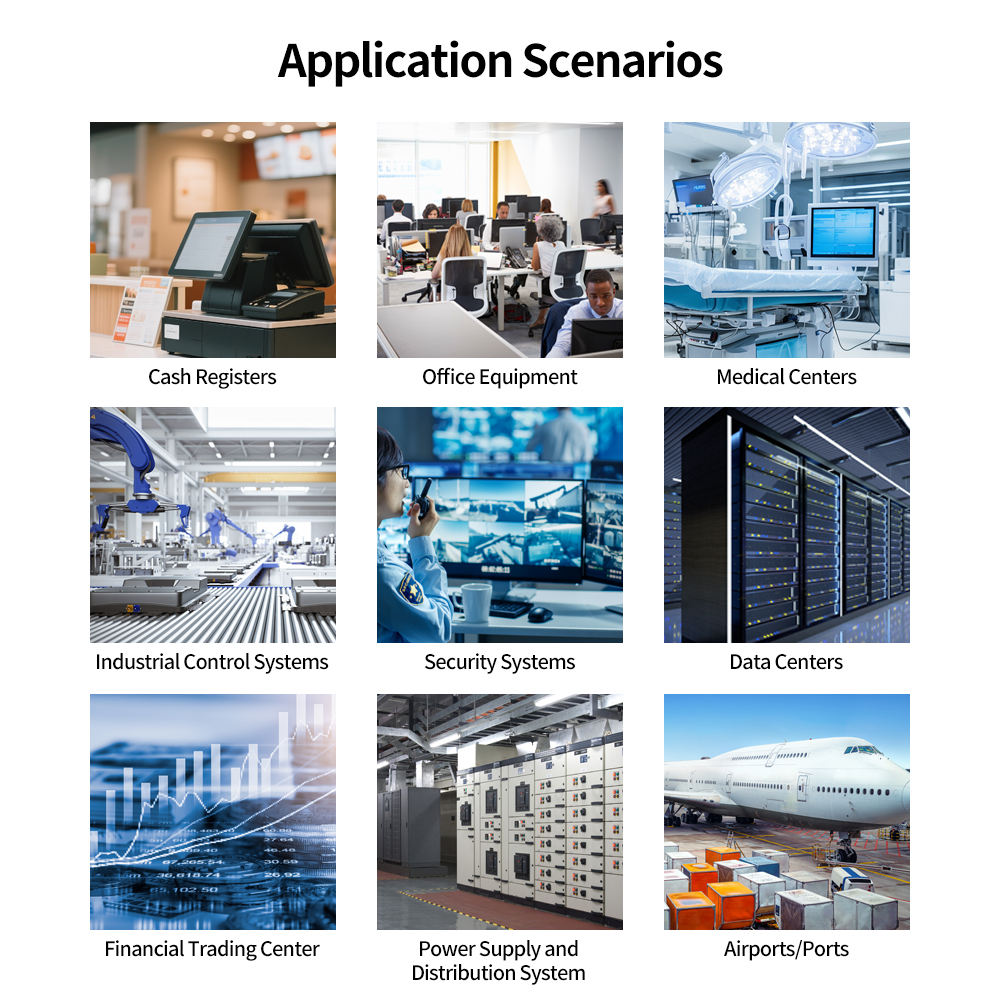
Data Centers and Server Rooms
The data center power challenge: Data centers are the most demanding UPS application — high power density, 24/7 operation, zero tolerance for downtime, and strict power quality requirements for sensitive IT equipment.
EXM2 data center applications:
- Edge data centers: 100–250kW UPS for regional edge computing facilities
- Enterprise data centers: Multiple EXM2 units in parallel for N+1 or 2N redundancy
- Colocation facilities: UPS for individual customer power zones
- Hyperscale data center pods: EXM2 as building block for large-scale deployments
Redundancy configurations:
- N+1 redundancy: One additional UPS module beyond the minimum required — any single UPS can fail without affecting the load
- 2N redundancy: Two complete, independent UPS systems — each capable of supporting the full load — for maximum reliability
Telecommunications Infrastructure
Telecom power requirements:
- 24/7 operation — no planned downtime
- Wide temperature range (outdoor and industrial environments)
- High reliability — telecom SLAs require 99.999% availability
- Remote monitoring — unmanned sites require remote management
EXM2 telecom applications:
- Mobile base station power (4G/5G BTS sites)
- Telecom exchange and switching center UPS
- Fiber optic network node power protection
- Satellite ground station power
Healthcare Facilities
Healthcare power requirements:
- Life-critical equipment (ventilators, monitors, surgical equipment) cannot tolerate any power interruption
- Regulatory requirements (IEC 60364-7-710, NFPA 99) mandate UPS for critical medical circuits
- Infection control requirements for equipment in clinical areas
EXM2 healthcare applications:
- Hospital data center and server room UPS
- Radiology and imaging equipment power (MRI, CT, PET)
- ICU and operating theater critical power
- Laboratory equipment power protection
Industrial and Manufacturing
Industrial power requirements:
- Process control systems (DCS, SCADA, PLC) cannot tolerate power interruptions
- Industrial environments have poor power quality — harmonics from VFDs, welding equipment, and motors
- Wide temperature range and harsh environment capability required
EXM2 industrial applications:
- Process control room UPS (oil and gas, chemical, power generation)
- Manufacturing execution system (MES) server power
- SCADA and industrial network infrastructure UPS
- Automated warehouse and logistics system power
Financial Institutions
Financial power requirements:
- Trading systems and financial databases have zero tolerance for downtime
- Regulatory requirements for business continuity
- High security requirements for UPS room access
EXM2 financial applications:
- Trading floor server room UPS
- Core banking system data center power
- ATM network infrastructure UPS
- Payment processing system power protection
Sizing the EXM2: Selecting the Right kW Configuration
Load Calculation
Selecting the correct UPS size requires accurate load calculation:
Step 1: Inventory all loads List all equipment to be protected with their power consumption:
- Servers: Nameplate power or measured power (use a power meter for accuracy)
- Networking equipment: Switches, routers, firewalls
- Storage systems: SAN, NAS, tape libraries
- Cooling equipment: In-row coolers, precision air conditioners (if UPS-protected)
- Lighting and other loads
Step 2: Calculate total load Sum all equipment power consumption. Note: IT equipment nameplate power is typically 50–70% of actual consumption — use measured values where possible.
Step 3: Apply growth factor Add 20–30% for future load growth — avoid sizing the UPS at >80% of rated capacity.
Step 4: Select UPS size Select the EXM2 configuration that provides the required kW with the growth factor applied.
Example:
- Current IT load: 120kW (measured)
- Growth factor (25%): 30kW
- Required UPS capacity: 150kW
- Selected EXM2: 160kW or 200kW configuration
Power Factor Consideration
Modern IT equipment has a power factor of 0.9–1.0 (near unity). The EXM2’s output power factor should match:
- Unity power factor (1.0) output: EXM2 kVA rating = kW rating — no derating required for modern IT loads
- 0.9 power factor output: EXM2 kW rating = kVA × 0.9 — older UPS designs require derating
Confirm the EXM2’s output power factor with the supplier — unity power factor output is preferred for modern data center applications.
Redundancy Configuration
N configuration (no redundancy):
- Single UPS sized for full load
- Any UPS failure causes load loss
- Suitable for: Non-critical applications, budget-constrained installations
N+1 configuration:
- One additional UPS module beyond minimum required
- Any single UPS failure does not affect load
- Suitable for: Most enterprise data centers
2N configuration:
- Two complete, independent UPS systems
- Each system capable of supporting full load
- Maximum reliability — any single system failure does not affect load
- Suitable for: Tier III and Tier IV data centers, mission-critical applications
Total Cost of Ownership: The EXM2 Investment
Investment: $12,656–$21,370 (depending on kW configuration)
Electricity Cost (Annual)
200kW UPS at 96% efficiency, $0.10/kWh, 8,760 hours/year:
- Input power: 200kW ÷ 0.96 = 208.3kW
- Annual electricity cost: 208.3kW × 8,760h × $0.10 = $182,471/year
Comparison with 92% efficient UPS:
- Input power: 200kW ÷ 0.92 = 217.4kW
- Annual electricity cost: $190,422/year
- Annual saving with EXM2: $7,951/year
Downtime Cost Avoidance
Data center downtime cost (industry average): $9,000/minute Annual downtime events prevented by UPS: 2–5 events (power disturbances that would cause downtime without UPS) Average event duration without UPS: 5–30 minutes Annual downtime cost avoided: $90,000–$1,350,000
Battery Replacement Cost
VRLA battery replacement (every 5 years):
- Battery cost: $5,000–$20,000 depending on capacity
- Labor: $2,000–$5,000
- Total: $7,000–$25,000 per replacement cycle
Plan for battery replacement in the total cost of ownership calculation.
Comparison: Vertiv EXM2 vs. Generic UPS