
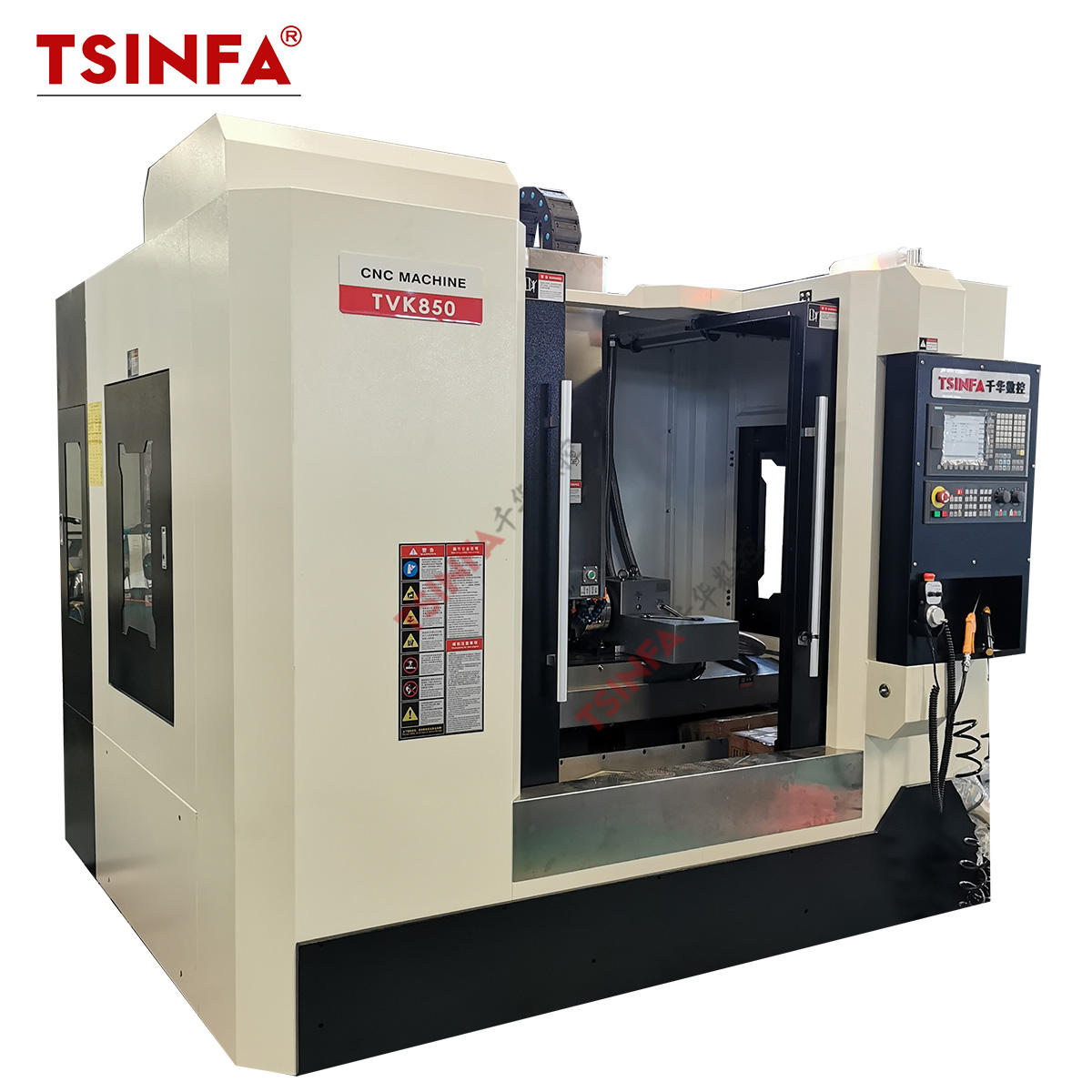
Introduction: The VMC850 — The Industry’s Most Popular Machine Size
In the world of CNC machining, there is one machine size that dominates job shops, precision engineering workshops, and manufacturing facilities on every continent: the VMC850. With 850mm of X-axis travel, a table large enough to accommodate the vast majority of precision machined parts, and a work envelope that balances capability with footprint, the VMC850 is the universal precision machining workhorse.
Walk into any job shop in Germany, India, Vietnam, Mexico, or South Korea, and you will almost certainly find VMC850-class machines on the floor. They machine automotive brackets, mold inserts, hydraulic valve bodies, aerospace fixtures, medical device components, and electronic enclosures — the full spectrum of precision engineering work that modern manufacturing demands.
But not all VMC850s are equal. The difference between a capable, long-lasting machine and a frustrating, unreliable one often comes down to two components: the spindle and the CNC control system. These are the components that determine cut quality, accuracy, reliability, and the total cost of ownership over the machine’s 15–20 year operational life.
The VMC850 with Taiwan Spindle, Siemens CNC Control, and 24-Tool Disk Magazine at $28,000 addresses both of these critical specifications — delivering premium component quality at an economical machine price that makes professional-grade VMC machining accessible to job shops and manufacturers at every scale.
The VMC850: Understanding the Most Popular VMC Size Class
Why 850mm X-Travel Is the Sweet Spot
The VMC850’s 850mm X-axis travel places it in the most popular VMC size class globally — and for good reason:
Part size coverage: The 850mm × 500mm (typical) table accommodates the vast majority of precision machined parts:
- Automotive engine brackets and transmission components: 200–600mm
- Mold inserts and cavity blocks: 300–700mm
- Hydraulic manifolds and valve bodies: 100–400mm
- Aerospace structural brackets: 200–600mm
- Medical device housings and fixtures: 50–300mm
- Electronic enclosures and panels: 200–500mm
Studies of job shop part mix consistently show that 80–90% of parts can be machined on a VMC with 800–900mm X-travel. The VMC850 covers this range with margin.
Footprint efficiency: The VMC850 occupies approximately 3.5m × 2.5m of floor space — compact enough to fit multiple machines in a standard workshop bay, yet large enough to handle production-scale parts.
Tooling and fixturing ecosystem: The VMC850’s table size (typically 1,000mm × 500mm) accommodates standard modular fixturing systems, vise configurations, and tombstone fixtures — the full ecosystem of workholding solutions developed for this size class.
Operator ergonomics: The VMC850’s table height and spindle clearance are optimized for operator access — loading and unloading parts, setting up fixtures, and performing in-process inspection without awkward reaching or lifting.
VMC850 Standard Specifications
While specific dimensions vary by manufacturer, a standard VMC850 typically offers:
| Specification | Typical Value |
|---|---|
| X-axis travel | 850mm |
| Y-axis travel | 500mm |
| Z-axis travel | 500–600mm |
| Table size | 1,000mm × 500mm |
| Table load | 500–800 kg |
| Spindle speed | 8,000–12,000 RPM |
| Spindle power | 7.5–15 kW |
| Rapid traverse | 24–36 m/min |
| Positioning accuracy | ±0.005mm |
| Repeatability | ±0.003mm |
Confirm the exact specifications of this VMC850 configuration with the supplier — dimensions and specifications vary between manufacturers.
The Taiwan Spindle Advantage: Why Origin Matters
What Makes a Spindle “Taiwan Quality”?
The spindle is the most critical mechanical component of a VMC — it is the rotating assembly that holds and drives the cutting tool. Spindle quality determines:
- Runout: How much the tool tip deviates from the true rotation axis — directly affects surface finish and dimensional accuracy
- Rigidity: How much the spindle deflects under cutting forces — affects accuracy and chatter resistance
- Speed capability: Maximum RPM without vibration or heat generation
- Bearing life: How long the spindle operates before requiring bearing replacement
- Thermal stability: How much the spindle grows as it heats up during operation
Taiwan’s precision manufacturing heritage: Taiwan has been a global center of precision machine tool manufacturing since the 1970s. Taiwanese machine tool manufacturers — companies like Yeong Chin (YCM), Quaser, Tongtai, and Hartford — have built a global reputation for precision, reliability, and quality that rivals Japanese and European manufacturers at significantly lower prices.
The precision manufacturing ecosystem that supports Taiwan’s machine tool industry — precision bearing manufacturers, grinding specialists, and quality control infrastructure — produces spindle components to tolerances that mainland Chinese manufacturers at equivalent price points cannot consistently match.
Key Taiwan spindle quality indicators:
Bearing quality:
- Taiwan spindles typically use NSK, NTN, or FAG angular contact ball bearings — the same bearing brands used in Japanese and European spindles
- Bearing preload is precisely controlled during assembly — critical for runout and rigidity
- Bearing arrangement (typically DB or DT configuration) optimized for the speed and load requirements
Spindle runout:
- Taiwan spindles typically achieve ≤0.002mm (2 microns) runout at the spindle nose
- This translates to ≤0.003–0.005mm runout at the tool tip (depending on tool length)
- Sufficient for the vast majority of precision machining applications
Dynamic balance:
- Taiwan spindles are dynamically balanced to G1.0 or better at maximum speed
- Eliminates vibration that causes poor surface finish and premature bearing wear
Thermal management:
- Oil-air lubrication or grease lubrication systems optimized for the speed range
- Spindle housing designed for effective heat dissipation
- Thermal growth compensation parameters calibrated for the specific spindle
Taiwan Spindle vs. Mainland China Spindle: The Practical Difference
At the $28,000 price point, the choice of Taiwan vs. mainland China spindle has significant practical implications:
Runout consistency:
- Taiwan spindle: ≤0.002mm runout — consistent across production batches
- Mainland China spindle (economy): 0.005–0.015mm runout — variable, may not meet specification
Bearing life:
- Taiwan spindle with quality bearings: 15,000–25,000 hours before replacement
- Economy mainland spindle: 5,000–10,000 hours — more frequent replacement, higher lifetime cost
Maximum speed reliability:
- Taiwan spindle: Rated speed achievable continuously without vibration or heat issues
- Economy spindle: May vibrate or overheat at rated speed — operators run below rated speed
Spindle replacement cost:
- Taiwan spindle replacement: $3,000–$8,000
- Economy spindle replacement: $1,000–$3,000
- But Taiwan spindle lasts 2–3× longer — lower lifetime cost
The Taiwan spindle premium at $28,000 is essentially free — the machine is priced competitively despite the higher-quality spindle, making it exceptional value.
Siemens CNC Control: The Premium Standard
Why Siemens for This Machine?
The Siemens CNC control system on the VMC850 is a significant differentiator — most VMC850s at this price point use domestic Chinese control systems (GSK, KND, Syntec) or Fanuc. Siemens at $28,000 is unusual and valuable.
Siemens advantages for VMC operation:
ShopMill conversational programming: Siemens’ ShopMill graphical programming system enables operators to program complex parts directly at the machine without G-code expertise. The conversational interface guides the operator through:
- Contour milling cycles (pocket, boss, slot, circular pocket)
- Drilling cycles (drilling, reaming, boring, tapping)
- Thread milling cycles
- Engraving and text machining
ShopMill dramatically reduces programming time for prismatic parts — a part that takes 2 hours to program in G-code can be programmed in 20–30 minutes in ShopMill.
Advanced surface quality: Siemens’ Advanced Surface Quality (ASQ) function optimizes the machine’s dynamic behavior for surface finish — automatically adjusting acceleration, jerk, and look-ahead parameters. Critical for mold and die applications.
Global support and training: Siemens has a global support network with trained technicians, spare parts, and training centers in virtually every country. Operators trained on Siemens can find work anywhere in the world — and employers can hire from a large pool of Siemens-trained operators.
CAM software compatibility: Every major CAM software (Mastercam, Hypermill, PowerMill, Siemens NX CAM, Fusion 360) has proven Siemens post-processors. No custom post-processor development required.
Preferred in key markets: Siemens is the preferred CNC control in Europe, the Middle East, India, and Southeast Asia — markets where the VMC850 is widely used. Buyers in these markets specifically request Siemens-controlled machines.
Siemens Control Series on VMC850
The specific Siemens series on this VMC850 should be confirmed with the supplier. Common options:
Siemens 808D: Entry-level Siemens control — basic functionality, lower cost. Suitable for simple machining operations.
Siemens 828D: Mid-range — full ShopMill, advanced cycles, 5-axis capability (with appropriate hardware). The most common Siemens control on mid-range VMCs. Most likely on this machine.
Siemens 840D sl: High-performance — full 5-axis simultaneous, highest speed and accuracy. Typically on premium machines above $50,000.
Confirm the specific Siemens series with the supplier — the 828D is the most likely and most valuable option at this price point.
The 24-Tool Disk Magazine: Speed and Reliability
Disk vs. Chain ATC: The Design Choice
Automatic Tool Changers (ATCs) come in two primary configurations for VMC-class machines:
Disk (umbrella) type ATC:
- Tools stored in a rotating disk (carousel) adjacent to the spindle
- Tool change: Disk rotates to the required tool position, spindle moves to tool change position, tool is exchanged
- Tool change time: 3–6 seconds (chip-to-chip)
- Capacity: Typically 16–24 tools
- Advantages: Simple, reliable, low maintenance, fast for sequential tool use
- Disadvantages: Slower random access (must rotate through all positions to reach a tool)
Chain (arm) type ATC:
- Tools stored in a chain magazine, separate from the spindle
- Tool change: Robotic arm picks tool from magazine and exchanges with spindle tool simultaneously
- Tool change time: 1.5–3 seconds (chip-to-chip)
- Capacity: 20–120+ tools
- Advantages: Faster random access, higher capacity, simultaneous tool change
- Disadvantages: More complex, higher maintenance, larger footprint
For the VMC850 at $28,000, the 24-tool disk ATC is the appropriate choice:
- 24 tools covers the vast majority of machining operations (most parts require 8–16 tools)
- Disk ATC reliability is excellent — fewer moving parts than chain ATC
- Maintenance is simpler — disk ATC requires less frequent service
- The 3–6 second tool change time is acceptable for most job shop applications
24-Tool Capacity: Is It Enough?
For most VMC850 applications, 24 tools is more than sufficient:
Typical tool requirements by application:
| Application | Typical Tool Count |
|---|---|
| Simple prismatic part (drilling, milling) | 4–8 tools |
| Complex prismatic part (multiple features) | 8–16 tools |
| Mold insert (roughing + finishing) | 10–20 tools |
| Automotive bracket (complete machining) | 6–14 tools |
| Medical device housing | 8–18 tools |
24 tools covers 95%+ of typical VMC850 applications — only very complex parts with many different operations require more than 24 tools, and these are typically machined on larger machines with chain ATCs.
Tool management with 24 tools:
- Assign permanent tool positions for frequently used tools (drills, end mills, taps)
- Use remaining positions for job-specific tools
- Tool offset management in the Siemens control stores length and diameter offsets for all 24 tools
Applications: What the VMC850 Machines
Mold and Die Manufacturing
The VMC850 is one of the most widely used machines in mold and die manufacturing — the demanding application that defines VMC performance standards:
Injection mold inserts:
- Cavity and core inserts for plastic injection molds
- Material: P20, 718H pre-hardened steel (30–36 HRC), H13 hardened steel (44–52 HRC)
- Features: Complex 3D surfaces, precise parting lines, cooling channels, ejector pin holes
- Tolerances: ±0.01–0.02mm on critical surfaces
- Surface finish: Ra 0.4–0.8 μm (mirror finish after polishing)
Die casting dies:
- Aluminum and zinc die casting dies
- Material: H13 hot work tool steel
- Features: Complex cavity geometry, overflow wells, cooling channels
Stamping dies:
- Sheet metal stamping dies for automotive and appliance parts
- Material: D2, Cr12MoV cold work tool steel
- Features: Precise punch and die profiles, guide pin holes, mounting features
The VMC850’s combination of Taiwan spindle (for surface finish quality) and Siemens control (for complex cycle programming) makes it particularly well-suited for mold and die work.
Automotive Parts Production
Engine and transmission components:
- Aluminum engine brackets, covers, and housings
- Transmission shift forks and selector components
- Suspension brackets and steering components
Body and chassis:
- Structural brackets and reinforcements
- Door hinge and latch components
- Seat frame components
Tolerances: ±0.01–0.05mm typical Materials: Aluminum alloys (6061, 7075), mild steel, high-strength steel
Aerospace Subcontract Machining
Structural components:
- Aluminum alloy brackets, fittings, and structural members
- Titanium fasteners and structural components
- Stainless steel fittings and fluid system components
Tolerances: ±0.005–0.025mm typical Materials: 7075 aluminum, Ti-6Al-4V titanium, 17-4PH stainless steel
The Taiwan spindle’s low runout is particularly important for aerospace machining — tight tolerances on hole diameters and surface finishes require a spindle that maintains accuracy throughout the production shift.
Medical Device Manufacturing
Implants and surgical instruments:
- Orthopedic implant components (titanium, cobalt-chrome)
- Surgical instrument handles and components
- Dental prosthetic components
Equipment components:
- Diagnostic equipment housings and frames
- Surgical robot components
- Medical imaging equipment parts
Tolerances: ±0.005–0.01mm typical Surface finish: Ra 0.2–0.8 μm typical
General Job Shop Machining
The VMC850 is the backbone of job shop operations worldwide — machining whatever the customer brings:
- Hydraulic manifolds and valve bodies
- Pneumatic cylinder components
- Gearbox housings and covers
- Pump bodies and impellers
- Electronic enclosures and heat sinks
- Fixture plates and tooling components
- Prototype parts and small-batch production
ROI Analysis: The Economics of the VMC850
Investment: $28,000
Revenue Generation
Job shop / contract machining:
- VMC utilization: 16 hours/day, 300 days/year = 4,800 hours/year
- Hourly machine rate: $50–$100/hour
- Annual revenue: $240,000–$480,000
In-house production (replacing outsourced machining):
- Outsourced machining cost: $60–$120/hour
- In-house cost (amortization + labor + overhead): $20–$35/hour
- Saving per hour: $25–$85
- Annual saving (4,800 hours): $120,000–$408,000
Payback Period
Job shop scenario:
- Annual revenue: $300,000 (conservative)
- Operating cost (labor, tooling, overhead): $100,000
- Annual profit: $200,000
- Payback: 1.7 months
In-house production scenario:
- Annual machining cost saving: $200,000
- Payback: 1.7 months
Value Comparison: VMC850 Taiwan Spindle + Siemens vs. Alternatives
| Configuration | Price | Spindle | Control | Value |
|---|---|---|---|---|
| This VMC850 | $28,000 | Taiwan | Siemens | ⭐⭐⭐⭐⭐ Exceptional |
| Economy VMC850 | $18,000–$22,000 | China | GSK/KND | ⭐⭐⭐ Good |
| Mid-range VMC850 | $30,000–$45,000 | Taiwan | Fanuc/Siemens | ⭐⭐⭐⭐ Good |
| Japanese VMC850 | $80,000–$120,000 | Japan | Fanuc | ⭐⭐⭐⭐ Premium |
| European VMC850 | $100,000–$180,000 | Europe | Siemens | ⭐⭐⭐⭐ Premium |
The VMC850 with Taiwan spindle and Siemens control at $28,000 delivers premium component quality at economy machine pricing — the most compelling value proposition in the VMC850 market.
Featured Product: VMC850 with Taiwan Spindle and Siemens Control on MEGA BDM
MEGA BDM has sourced and verified the VMC850 Vertical CNC Machining Center — 24T Disk Tool Magazine, BT40 Taiwan Spindle, Siemens CNC Control from a verified global CNC machine tool manufacturer with proven VMC design, manufacturing, and international export experience across Asia, the Middle East, Southeast Asia, and global markets.
👉 View the VMC850 Machining Center on MEGA BDM
Frequently Asked Questions
What is the exact spindle speed and power?
Confirm the spindle speed (RPM) and power (kW) with the supplier. Standard VMC850 configurations typically offer 8,000–12,000 RPM and 7.5–15 kW. Higher spindle speeds are available for aluminum machining applications.
Which Siemens control series is installed?
Confirm the specific Siemens series (808D, 828D, or 840D) with the supplier. The 828D is the most common and most capable option for this machine class — confirm it includes ShopMill programming.
What is the Taiwan spindle brand?
Confirm the specific Taiwan spindle manufacturer with the supplier. Common Taiwan spindle brands include Kenturn, Posa, and other established Taiwan precision spindle manufacturers.
What are the exact axis travels and table dimensions?
Confirm X/Y/Z travel and table size (L × W) with the supplier. Standard VMC850 configurations are approximately 850 × 500 × 500mm travel with a 1,000 × 500mm table — verify exact dimensions for your workpiece requirements.
What is the positioning accuracy and repeatability?
Request the machine’s accuracy test report from the supplier. Confirm positioning accuracy (±mm) and repeatability (±mm) over the full travel range — not just at the center of travel.
What foundation and power supply are required?
Confirm foundation requirements (concrete pad thickness and reinforcement) and electrical supply (voltage, phase, kVA) with the supplier before site preparation. VMC850-class machines typically require 380V/3-phase, 20–30 kVA.
Conclusion
The VMC850 Vertical CNC Machining Center with Taiwan Spindle, Siemens CNC Control, and 24-Tool Disk Magazine delivers a combination that is rare at $28,000: premium component quality — Taiwan spindle precision, Siemens control intelligence — in an economically priced machine that makes professional-grade VMC machining accessible to job shops, small manufacturers, and businesses entering precision machining for the first time.
With payback periods under 2 months and annual profit potential of $200,000+, the VMC850 is one of the highest-ROI capital investments available in precision manufacturing. For mold makers, automotive suppliers, aerospace subcontractors, medical device manufacturers, and general job shops, this machine delivers the spindle quality and control system sophistication that demanding applications require — at a price that makes the investment decision straightforward.
👉 View the full product details on MEGA BDM