Introduction: The Laser Cutting Revolution and the Safety Imperative
Fiber laser cutting has transformed metal fabrication over the past decade. What was once a slow, expensive process — plasma cutting with rough edges, waterjet cutting with high operating costs, or mechanical punching with limited flexibility — has been replaced by fiber laser cutting: fast, precise, flexible, and increasingly affordable.
The global fiber laser cutting machine market exceeded $5 billion in 2024 and continues to grow at 8–12% annually, driven by falling laser source costs, rising labor costs that make automation compelling, and the expanding range of materials and thicknesses that modern fiber lasers can cut.
But as laser cutting machines have proliferated — from premium European brands to economical Chinese manufacturers — a critical differentiator has emerged beyond cutting speed and power: safety and intelligence. A laser cutting machine that injures an operator, damages its own cutting head through collision, or requires constant manual supervision is not a productive asset — it is a liability.
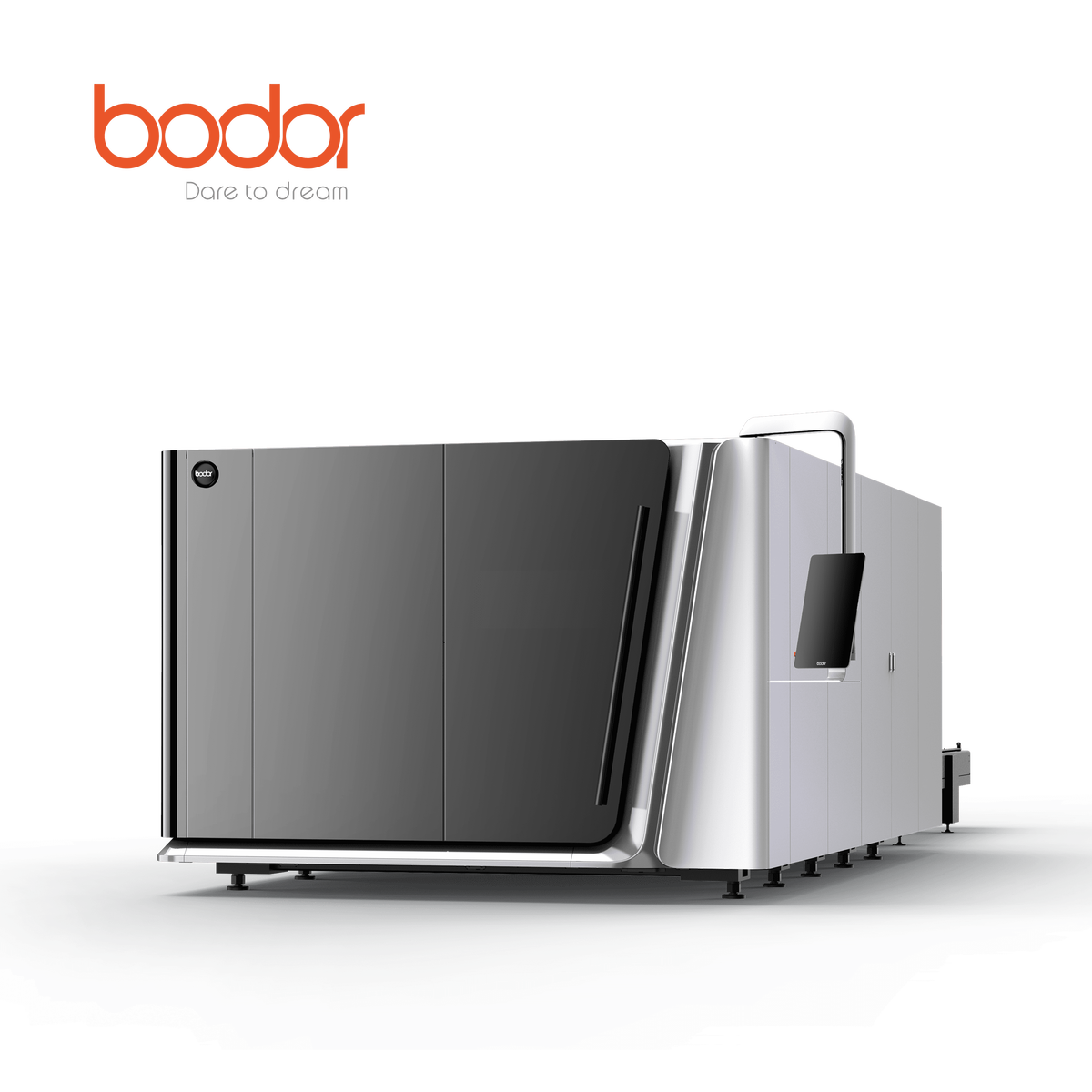
The Bodor Economical C Series CNC Fiber Laser Cutting Machine addresses this challenge directly. With intelligent operator protection, active anti-collision function, and Bodor’s proven fiber laser technology — at $121,000 — it represents the convergence of economical laser cutting capability and the safety intelligence that modern manufacturing environments demand.
Bodor: A Global Laser Cutting Leader
Who Is Bodor?
Bodor Laser (Shandong Bodor Laser Co., Ltd.) is one of China’s — and the world’s — leading fiber laser cutting machine manufacturers. Founded in 2004 and headquartered in Jinan, Shandong Province, Bodor has grown to become a globally recognized brand with:
- 10,000+ machines installed in 130+ countries
- Global service network with offices and service centers across Asia, Europe, Middle East, and Americas
- Continuous R&D investment — Bodor holds hundreds of patents in laser cutting technology
- Full product range — from economical entry-level machines to high-power (40kW+) ultra-high-speed cutting systems
- ISO 9001 and CE certified — meeting international quality and safety standards
Why Bodor matters for buyers: Purchasing a laser cutting machine is a long-term investment — 10–15 years of operational life. The manufacturer’s ability to provide spare parts, technical support, and software updates over that period is as important as the machine’s initial specifications. Bodor’s global presence and established service network provide confidence that support will be available throughout the machine’s operational life.
Bodor’s Product Range
Bodor organizes its product line into several series:
P Series (Premium): High-performance machines for demanding applications — high power (6–40kW), high speed, advanced features. For large-scale manufacturers with high-volume production requirements.
C Series (Economical): ← This product — Core fiber laser cutting performance at a competitive price point. Designed for job shops, small-to-medium manufacturers, and businesses entering laser cutting. Balances capability, reliability, and affordability.
T Series (Tube): Specialized for tube and pipe cutting — round, square, rectangular, and special-section profiles.
BCL Series (Bevel): Bevel cutting capability for weld preparation and complex 3D cutting.
The C Series is Bodor’s volume product — the machine that has established Bodor’s global reputation for reliable, affordable fiber laser cutting. It incorporates Bodor’s core technology and manufacturing quality at a price point accessible to a wide range of manufacturers.
Fiber Laser Technology: Why It Dominates Metal Cutting
The Fiber Laser Advantage
Fiber laser cutting has displaced CO₂ laser cutting, plasma cutting, and waterjet cutting as the dominant metal cutting technology for sheet metal fabrication. Understanding why helps evaluate the Bodor C Series in context.
Fiber laser vs. CO₂ laser:
| Factor | Fiber Laser | CO₂ Laser |
|---|---|---|
| Wavelength | 1.06 μm | 10.6 μm |
| Electrical efficiency | 25–35% | 8–15% |
| Cutting speed (thin sheet) | 3–5× faster | Baseline |
| Reflective materials | Excellent (Cu, brass, Al) | Poor (reflection damage) |
| Maintenance | Minimal (no mirrors, no gas) | Regular (mirror alignment, laser gas) |
| Operating cost | Low | High |
| Beam delivery | Fiber optic cable | Mirror train |
Fiber laser vs. plasma cutting:
| Factor | Fiber Laser | Plasma |
|---|---|---|
| Cut quality | Excellent (narrow kerf, smooth edge) | Good (wider kerf, rougher edge) |
| Thin sheet (<6mm) | Superior | Adequate |
| Thick plate (>25mm) | Limited | Better |
| Operating cost | Low | Medium |
| Precision | ±0.05mm | ±0.5–1.0mm |
| Heat affected zone | Minimal | Significant |
Fiber laser vs. waterjet:
| Factor | Fiber Laser | Waterjet |
|---|---|---|
| Cutting speed | 5–20× faster | Baseline |
| Operating cost | Low | High (abrasive, water) |
| Heat affected zone | Minimal | None |
| Material range | Metals (primarily) | Any material |
| Precision | ±0.05mm | ±0.1–0.5mm |
For metal sheet fabrication, fiber laser cutting is the clear winner on speed, operating cost, cut quality, and material flexibility — which is why it has become the dominant technology.
Fiber Laser Power and Material Capability
The laser power (measured in kW) determines what materials and thicknesses can be cut:
| Laser Power | Mild Steel | Stainless Steel | Aluminum | Copper/Brass |
|---|---|---|---|---|
| 1.5 kW | ≤10mm | ≤5mm | ≤3mm | ≤2mm |
| 3 kW | ≤20mm | ≤10mm | ≤8mm | ≤5mm |
| 6 kW | ≤25mm | ≤20mm | ≤16mm | ≤10mm |
| 12 kW | ≤40mm | ≤30mm | ≤25mm | ≤16mm |
| 20 kW+ | ≤60mm+ | ≤40mm+ | ≤40mm+ | ≤25mm+ |
Confirm the specific laser power of the Bodor C Series configuration with the supplier for your material and thickness requirements. The C Series is available in multiple power configurations — the $121,000 price point corresponds to a specific power level that should be confirmed.
The Intelligence Advantage: What Makes the C Series Smart
Intelligent Operator Protection
Traditional laser cutting machines rely on physical safety enclosures — light curtains, safety doors, and interlocks — to protect operators. These passive systems prevent access to the cutting zone but do not adapt to the operator’s presence or behavior.
The Bodor C Series’ intelligent operator protection system goes beyond passive barriers:
Proximity sensing:
- Sensors detect operator proximity to the machine
- Machine automatically adjusts behavior based on operator location
- Reduces speed or pauses operation when operator is in proximity zones
- Resumes full speed when operator moves to safe distance
Smart door interlocks:
- Cutting automatically pauses when access doors are opened
- Resumes automatically when doors are closed and locked
- Eliminates the need for manual restart after material loading/unloading
- Reduces cycle time vs. traditional interlock systems that require manual reset
Operator presence detection:
- Camera or sensor-based detection of operator presence at the machine
- Automatic safety mode activation when operator is detected near cutting zone
- Logging of operator proximity events for safety management
Why intelligent protection matters: Traditional passive safety systems create a binary choice: machine running (operator excluded) or machine stopped (operator can access). Intelligent protection enables a more nuanced approach — the machine can continue operating at reduced speed or in a safe mode while the operator performs tasks near the machine, then automatically return to full production speed when the operator moves away. This reduces downtime while maintaining safety.
Active Anti-Collision Function
Cutting head collision is one of the most common and costly failures in laser cutting operations. When the cutting head strikes a raised piece of material — a tipped-up cut part, a warped sheet, or a fixture — the collision can damage the cutting head, the nozzle, the focus lens, and the motion system. Repair costs of $5,000–$20,000 and downtime of days to weeks are common consequences of cutting head collisions.
The Bodor C Series’ active anti-collision function prevents these costly incidents:
Capacitive height sensing:
- Capacitive sensor continuously measures the distance between the cutting nozzle and the workpiece surface
- Detects surface variations, raised cut parts, and material warpage in real time
- Adjusts Z-axis height automatically to maintain optimal focal distance
Collision prediction:
- The control system analyzes the cutting path and material surface data
- Predicts potential collision points before the cutting head reaches them
- Automatically adjusts the cutting path or raises the cutting head to avoid collision
Emergency retraction:
- If a collision is imminent, the cutting head retracts at high speed
- Retraction speed: Typically 50–100m/min — faster than the cutting head can be damaged
- Protects the cutting head, nozzle, and lens from impact damage
Collision detection and stop:
- If contact occurs despite prediction and retraction, force sensors detect the impact
- Machine immediately stops all motion
- Prevents secondary damage from continued motion after initial contact
The economic value of anti-collision: A single cutting head collision can cost $5,000–$20,000 in parts and labor, plus 1–5 days of downtime. At a machine utilization rate of $100–$200/hour, 5 days of downtime costs $12,000–$24,000 in lost production. The anti-collision system pays for itself by preventing a single collision event.
Additional Intelligence Features
Automatic focus adjustment:
- Automatically adjusts the focal position for different material thicknesses
- Eliminates manual focus adjustment when switching between materials
- Reduces setup time and operator error
Cutting parameter database:
- Pre-programmed cutting parameters for common materials and thicknesses
- Operator selects material and thickness — machine automatically sets power, speed, gas pressure, and focus
- Reduces setup time and ensures consistent cut quality
Remote monitoring:
- Machine status, production data, and alarm information accessible remotely
- Enables production monitoring without constant operator presence
- Supports predictive maintenance through performance data analysis
Automatic nozzle cleaning:
- Automated nozzle cleaning cycle removes spatter and contamination
- Maintains consistent cut quality without manual cleaning
- Reduces operator intervention during production runs
Applications: What the Bodor C Series Cuts
Sheet Metal Fabrication
Sheet metal fabrication is the primary application for fiber laser cutting — and the market where the Bodor C Series delivers the most immediate value:
Electrical enclosures and cabinets:
- Control panels, distribution boards, and electrical enclosures
- Material: 1–3mm mild steel or stainless steel
- Features: Precise cutouts for switches, displays, and connectors
- Volume: High — electrical enclosures are produced in large quantities
HVAC ductwork and components:
- Rectangular and round duct sections, fittings, and transitions
- Material: 0.5–2mm galvanized steel or stainless steel
- Features: Complex shapes with precise dimensions for leak-free assembly
- Volume: High — HVAC systems require large quantities of duct components
Automotive body panels and brackets:
- Structural brackets, reinforcements, and body panels
- Material: 1–3mm high-strength steel, aluminum
- Features: Complex shapes with tight tolerances for assembly fit
- Volume: High — automotive production requires consistent, high-volume cutting
Furniture and decorative metalwork:
- Metal furniture frames, decorative panels, and architectural elements
- Material: 1–6mm mild steel, stainless steel, aluminum
- Features: Complex decorative patterns, precise dimensions
- Volume: Medium — custom and semi-custom production
Structural Steel Fabrication
Construction components:
- Gusset plates, connection plates, and structural brackets
- Material: 6–25mm mild steel
- Features: Precise hole patterns and profiles for structural connections
- Volume: Medium — project-based production
Industrial equipment frames:
- Machine frames, support structures, and equipment bases
- Material: 6–20mm mild steel
- Features: Complex profiles with precise dimensions for assembly
- Volume: Low to medium — custom fabrication
Agricultural and Construction Equipment
Equipment body panels:
- Tractor hoods, combine harvester panels, excavator covers
- Material: 2–6mm mild steel or high-strength steel
- Features: Complex shapes with precise cutouts for components
- Volume: Medium — OEM production for equipment manufacturers
Wear parts and attachments:
- Bucket teeth, cutting edges, and wear plates
- Material: 10–25mm high-strength or wear-resistant steel
- Features: Precise profiles for fit and function
- Volume: Medium — replacement parts production
Signage and Architectural Metalwork
Signage:
- Laser-cut metal letters, logos, and decorative panels
- Material: 1–6mm mild steel, stainless steel, aluminum, brass
- Features: Complex decorative patterns with smooth edges
- Volume: Low to medium — custom production
Architectural elements:
- Decorative screens, balustrades, and facade panels
- Material: 2–10mm mild steel, stainless steel, aluminum
- Features: Intricate patterns with consistent quality
- Volume: Low to medium — project-based production
Machine Configuration: Key Specifications to Evaluate
Bed Size (Working Area)
The bed size determines the maximum sheet size that can be processed:
Standard bed sizes:
- 1500mm × 3000mm (1.5m × 3m): Most common — fits standard 1500×3000mm sheets
- 2000mm × 4000mm (2m × 4m): For larger sheets and higher productivity
- 2000mm × 6000mm (2m × 6m): For very large sheets or multiple smaller sheets
Confirm the bed size of the C Series configuration with the supplier for your standard sheet sizes and production requirements.
Laser Power
As discussed above, laser power determines material and thickness capability. The C Series is available in multiple power configurations — confirm the specific power (kW) for the $121,000 price point.
Laser Source Brand
The laser source is the most critical component of a fiber laser cutting machine — it determines cutting performance, reliability, and operating cost:
IPG Photonics (USA): The global market leader — highest performance, highest reliability, highest cost. Industry standard for premium machines.
Raycus (China): Leading Chinese laser source manufacturer — good performance, competitive price, widely used in Chinese machines including Bodor.
MAX Photonics (China): Growing Chinese laser source manufacturer — competitive with Raycus.
nLIGHT (USA): High-performance American laser source — used in premium applications.
Confirm the laser source brand and model with the supplier — this is a critical specification that affects long-term performance and support.
Motion System
Linear guides: High-precision linear guide rails for smooth, accurate motion Servo motors: High-performance servo motors for fast acceleration and precise positioning Rack and pinion drive: For X and Y axis motion — confirm gear quality and backlash specification Ball screw: For Z axis (cutting head height) — precision ball screw for accurate focus control
Control System
Bodor proprietary control: Bodor develops its own CNC control system — optimized for laser cutting with integrated laser parameter management, nozzle database, and production monitoring.
Third-party control options: Some configurations may offer Beckhoff, PA, or other control systems — confirm with supplier.
ROI Analysis: The Economics of Fiber Laser Cutting
Investment: $121,000
Revenue Generation
Job shop / contract cutting:
- Machine utilization: 16 hours/day, 300 days/year = 4,800 hours/year
- Hourly cutting rate: $80–$150/hour (depending on market and material)
- Annual revenue: $384,000–$720,000
In-house production (replacing outsourced cutting):
- Outsourced laser cutting cost: $80–$150/hour
- In-house cost (amortization + labor + gas + electricity): $25–$45/hour
- Saving per hour: $35–$105
- Annual saving (4,800 hours): $168,000–$504,000
Payback Period
Job shop scenario:
- Annual revenue: $500,000 (conservative)
- Operating cost (labor, gas, electricity, maintenance): $120,000
- Annual profit: $380,000
- Payback: 4 months
In-house production scenario:
- Annual cutting cost saving: $300,000
- Payback: 5 months
Operating Cost Breakdown
Electricity: 20–40 kW average consumption × $0.10/kWh × 4,800 hours = $9,600–$19,200/year
Assist gas:
- Nitrogen (stainless steel, aluminum): $0.50–$2.00/hour = $2,400–$9,600/year
- Oxygen (mild steel): $0.20–$0.80/hour = $960–$3,840/year
Consumables (nozzles, lenses, protective windows): $3,000–$8,000/year
Maintenance: $2,000–$5,000/year
Total annual operating cost: $18,000–$36,000 — very low relative to revenue generation.
Comparison: Bodor C Series vs. European Equivalent
| Factor | Bodor C Series | European Equivalent (Trumpf, Bystronic, Amada) |
|---|---|---|
| Price | $121,000 | $300,000–$600,000 |
| Laser source | Raycus/IPG | IPG/nLIGHT |
| Cut quality | Excellent | Excellent |
| Cutting speed | Excellent | Excellent |
| Software | Bodor proprietary | OEM proprietary |
| Service network | Global (130+ countries) | Global |
| Brand recognition | Growing globally | Established |
| Resale value | Good | Excellent |
The Bodor C Series delivers 85–95% of the capability of a European equivalent at 25–40% of the price — making it the rational choice for manufacturers who need proven fiber laser cutting capability without the premium brand price tag.
Featured Product: Bodor C Series CNC Laser Cutting Machine on MEGA BDM
MEGA BDM has sourced and verified the Bodor Economical C Series CNC Laser Cutting Machine with Intelligent Operator Protection and Active Anti-Collision Function directly from Bodor — one of the world’s leading fiber laser cutting machine manufacturers with 10,000+ global installations and a proven track record of reliability, performance, and after-sales support.
👉 View the Bodor C Series Laser Cutting Machine on MEGA BDM
Frequently Asked Questions
What laser power is included at the $121,000 price?
Confirm the specific laser power (kW) with the supplier for this price point. The Bodor C Series is available in multiple power configurations — the included power determines material and thickness capability.
What bed size (working area) does this machine have?
Confirm the standard bed size with the supplier. Common configurations are 1500×3000mm and 2000×4000mm — confirm which is included and whether larger bed sizes are available.
What laser source brand is used?
Confirm the laser source brand (Raycus, IPG, MAX, or other) with the supplier. The laser source brand affects long-term performance, reliability, and spare parts availability.
What assist gases are required?
Fiber laser cutting typically uses nitrogen (for stainless steel and aluminum — oxide-free cuts) and oxygen (for mild steel — faster cutting with oxide edge). Confirm gas requirements and consumption rates with the supplier for your materials.
What software is used for nesting and programming?
Confirm the included nesting and CAM software with the supplier. Bodor typically includes its own nesting software — confirm compatibility with your CAD software (DXF, DWG, STEP file import).
What warranty and after-sales support does Bodor provide?
Bodor provides warranty and after-sales support through its global service network. Confirm the warranty terms (duration, coverage), local service availability in your country, and spare parts lead times with the supplier.
Conclusion
The Bodor Economical C Series CNC Fiber Laser Cutting Machine represents the convergence of three critical requirements for modern metal fabrication: proven fiber laser cutting performance, intelligent safety systems that protect operators and equipment, and an economical price point that makes professional-grade laser cutting accessible to job shops and manufacturers at every scale.
At $121,000 — with payback periods of 4–5 months and annual profit potential of $300,000–$380,000 — the Bodor C Series is one of the highest-ROI capital investments available in metal fabrication. With Bodor’s global service network, proven reliability, and continuous technology development, it is a long-term asset that will deliver competitive cutting capability for 10–15 years.
For sheet metal fabricators, structural steel shops, automotive suppliers, and general metal fabricators who are ready to move from plasma cutting, waterjet, or outsourced laser cutting to in-house fiber laser capability, the Bodor C Series is the intelligent, safe, and economical choice.
👉 View the full product details on MEGA BDM