
Introduction: When the Workpiece Is Too Big for a VMC
There is a class of precision metal components that defines the limits of conventional machining. Large mold bases for automotive body panels. Structural frames for heavy construction equipment. Wind turbine main shafts and hubs. Aerospace wing spars and fuselage frames. Ship propeller hubs and marine engine beds. Rail bogie frames and locomotive components.
These parts share a common characteristic: they are too large, too heavy, and require too much rigidity for a conventional vertical machining center (VMC). A VMC with a 1,000mm × 600mm table simply cannot accommodate a 3,000mm × 2,000mm mold base. A VMC spindle with 15 kW of power cannot remove material fast enough from a 5-tonne steel casting to be economically viable.
The machine tool designed for these applications is the CNC Gantry Machining Center — a bridge-type machine where the spindle travels on a rigid gantry structure spanning the workpiece, enabling large-format machining with the rigidity and precision that heavy-duty metal processing demands.
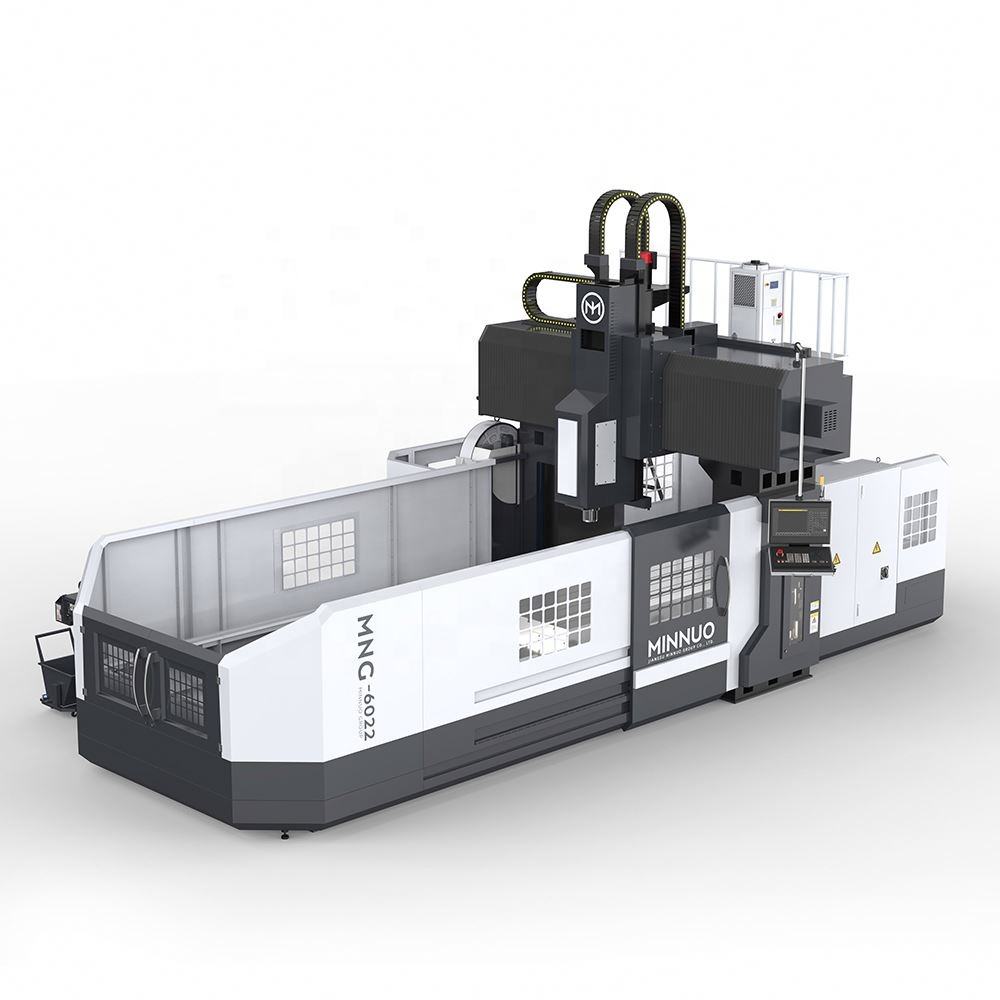
The MNG-6022 — equipped with the Siemens 828D CNC control system, configurable from 3-axis to full 5-axis simultaneous machining, and priced at $88,888 — represents a capable, globally-sourced gantry machining center for manufacturers who need to move beyond the limitations of conventional VMC machining.
Gantry Machining Centers: Architecture and Advantages
What Is a Gantry Machining Center?
A gantry machining center (also called a bridge-type machining center or portal machining center) is a CNC machine tool where the spindle is mounted on a crossrail that spans two vertical columns — forming a bridge or gantry structure over the workpiece.
The three primary axis configurations:
Moving gantry (moving bridge):
- The gantry (bridge + columns) moves along the X-axis over a stationary table
- Workpiece remains stationary — ideal for very heavy workpieces
- Gantry movement requires a longer machine footprint
- Most common configuration for heavy-duty applications
Moving table (fixed gantry):
- The gantry is fixed; the table moves along the X-axis
- Simpler gantry structure — higher rigidity
- Table movement limits maximum workpiece weight
- Common for medium-weight workpieces
Moving crossrail:
- The crossrail moves vertically (Z-axis) on fixed columns
- Spindle moves along the crossrail (Y-axis)
- Table moves along the X-axis
- Provides large Z-axis travel for tall workpieces
The MNG-6022 uses a moving gantry configuration — the most common choice for heavy-duty applications where workpiece weight and size are the primary constraints.
Why Gantry vs. VMC for Large Parts?
Structural rigidity: The gantry’s bridge structure — two massive columns connected by a rigid crossrail — provides far greater structural rigidity than a VMC’s C-frame or box-column structure. This rigidity is essential for:
- Heavy cutting of steel and cast iron without chatter
- Maintaining accuracy across large travel distances
- Supporting heavy spindle heads and 5-axis attachments
Large work envelope: Gantry machines can accommodate workpieces that are physically impossible to machine on a VMC:
- Table dimensions: 2,000mm × 6,000mm and larger
- Table load capacity: 5,000–50,000 kg
- Z-axis clearance: 1,000–2,000mm
Thermal stability: The symmetric gantry structure distributes thermal expansion more evenly than asymmetric VMC structures — important for maintaining accuracy during long machining cycles on large parts.
Accessibility: The open gantry structure provides excellent access to the workpiece from all sides — important for loading, fixturing, and in-process inspection of large, heavy workpieces.
The Siemens 828D: Why This Control System Matters
Siemens in CNC: The Premium Standard
Siemens is one of the two dominant CNC control manufacturers globally (alongside Fanuc), with a particularly strong position in Europe, the Middle East, and for high-performance multi-axis applications. The Siemens 828D is the mid-to-high performance CNC series — positioned above the entry-level 808D and below the flagship 840D sl.
Why manufacturers specify Siemens 828D:
ShopMill programming: Siemens’ graphical workshop programming system enables operators to program complex parts directly at the machine without G-code expertise. ShopMill’s conversational interface guides the operator through cycle selection, parameter entry, and tool path definition — dramatically reducing programming time for prismatic parts.
Advanced Surface Quality (ASQ): The 828D’s ASQ function optimizes the machine’s dynamic behavior for surface finish quality — automatically adjusting acceleration, jerk, and look-ahead parameters to produce the smoothest possible surface finish on complex contoured parts. Critical for mold and die applications where surface finish directly affects part quality.
CYCLE800 — 3+2 Positioning: The 828D’s CYCLE800 function enables 3+2 machining (positioning the rotary axes to a fixed angle, then machining with 3 linear axes) — the most common multi-axis strategy for complex prismatic parts. CYCLE800 simplifies 3+2 programming dramatically compared to manual G-code.
Simultaneous 5-axis: The 828D supports full 5-axis simultaneous machining with TRAORI (Transformation Orientation) — enabling complex surface machining, undercut removal, and single-setup machining of complex aerospace and mold components.
Integrated measurement cycles: Built-in probing cycles for workpiece setup, tool length measurement, and in-process gauging — reducing setup time and enabling closed-loop dimensional control.
SINUMERIK Operate: The 828D’s modern touchscreen HMI (Human Machine Interface) provides an intuitive, Windows-like operating environment with integrated help, simulation, and diagnostics — reducing operator training time and improving usability.
828D vs. Fanuc: The Control System Choice
Both Siemens 828D and Fanuc 0i/30i are excellent CNC systems. The choice depends on:
Choose Siemens 828D when:
- Your operators are trained on Siemens (common in Europe, Middle East, India)
- You need ShopMill conversational programming for complex parts
- Surface finish quality is critical (ASQ function)
- You need advanced 5-axis simultaneous capability
- Your CAM software has proven Siemens post-processors
Choose Fanuc when:
- Your operators are trained on Fanuc (dominant in Asia, Americas)
- You prioritize maximum reliability and global support network
- You need the widest CAM software compatibility
- You prefer the largest global spare parts ecosystem
For the MNG-6022, the Siemens 828D is an excellent choice for manufacturers targeting European, Middle Eastern, or South Asian markets where Siemens is the preferred control system.
Machine Specifications: Understanding the MNG-6022
The “6022” Designation
The model number MNG-6022 typically encodes the machine’s primary dimensions:
- 60: 6,000mm X-axis travel (table length)
- 22: 2,200mm Y-axis travel (crossrail span / table width)
This gives the MNG-6022 a work envelope of approximately 6,000mm × 2,200mm — suitable for very large mold bases, structural frames, and large aerospace components. Confirm the exact travel dimensions with the supplier.
Key Specifications to Evaluate
Table specifications:
- Table size: ~6,000mm × 2,000mm (confirm with supplier)
- Table load capacity: Typically 10,000–30,000 kg for this size class
- T-slot configuration: For workholding fixture attachment
- Table surface flatness: Critical for large workpiece accuracy
Axis travel:
- X-axis (longitudinal): ~6,000mm
- Y-axis (transverse): ~2,200mm
- Z-axis (vertical): 800–1,200mm (confirm with supplier)
- W-axis (ram): Additional vertical travel on some configurations
Spindle specifications:
- Spindle power: 22–45 kW (typical for this size class — confirm with supplier)
- Spindle speed: 6,000–12,000 RPM (confirm with supplier)
- Spindle taper: BT50, ISO50, or HSK-A100 (confirm with supplier)
- Spindle torque: 500–2,000 Nm (critical for heavy steel cutting)
Feed rates:
- Rapid traverse: 20–40 m/min (confirm with supplier)
- Cutting feed: Up to 10 m/min
Accuracy:
- Positioning accuracy: ±0.01–0.02mm over full travel (confirm with supplier)
- Repeatability: ±0.005–0.01mm
Automatic Tool Changer:
- Tool capacity: 24–60 tools (confirm with supplier)
- Tool change time: 5–10 seconds (chip-to-chip)
- Maximum tool weight: 15–25 kg (for large milling cutters)
3-Axis, 4-Axis, and 5-Axis Configurations
The MNG-6022’s configurable axis count is one of its most important commercial features — buyers can select the axis configuration that matches their application requirements and budget:
3-Axis configuration (X, Y, Z):
- Standard gantry machining — linear motion in three axes
- Suitable for: Flat surface milling, drilling, boring, tapping
- Applications: Large plate machining, structural steel fabrication, simple mold bases
- Lowest cost configuration
4-Axis configuration (X, Y, Z + A or B rotary):
- Adds one rotary axis — typically a rotary table (A-axis) or tilting head (B-axis)
- Enables: Multi-face machining in a single setup, angled hole drilling, simple contoured surfaces
- Applications: Complex mold bases, structural components with angled features, large fixtures
- Mid-range cost
5-Axis configuration (X, Y, Z + A + B or C):
- Full 5-axis capability — two rotary axes in addition to three linear axes
- Enables: Complex 3D surface machining, undercut removal, single-setup machining of complex parts
- Applications: Aerospace structural components, complex molds and dies, turbine components, impellers
- Highest capability and cost
The 5-axis advantage for large parts is particularly significant. On a large workpiece, repositioning and re-fixturing between setups is time-consuming, expensive, and introduces positioning errors. 5-axis machining completes complex parts in a single setup — eliminating repositioning errors and dramatically reducing total machining time.
Applications: What the MNG-6022 Machines
Large Mold and Die Manufacturing
Large mold and die manufacturing is the primary application for gantry machining centers in the mid-size class:
Automotive body panel molds:
- Stamping dies for car doors, hoods, fenders, and roof panels
- Die size: 1,500mm × 3,000mm to 2,000mm × 5,000mm
- Material: Cast iron (GG25, GGG70) or steel (P20, H13)
- Weight: 5,000–30,000 kg
- Tolerances: ±0.02–0.05mm on critical surfaces
Injection molds (large format):
- Molds for bumpers, dashboards, large plastic panels
- Mold base size: 1,000mm × 2,000mm and larger
- Material: P20, 718H pre-hardened steel
- 5-axis machining for complex parting surfaces and side actions
Forging dies:
- Hot forging dies for large structural components
- Material: H13, H21 hot work tool steel (hardened to 44–48 HRC)
- High-power spindle required for hard material machining
The MNG-6022’s large work envelope, high spindle power, and 5-axis capability make it a complete solution for large mold and die manufacturing — from rough milling of the mold base to finish machining of complex cavity surfaces.
Aerospace Structural Components
Aerospace manufacturing requires large, complex structural components machined to tight tolerances from aluminum alloys and titanium:
Wing spars and ribs:
- Aluminum alloy (7075, 7050) structural members
- Length: 3,000–15,000mm
- Complex pocket and web structures requiring 5-axis machining
- Tight tolerances: ±0.05–0.1mm on critical interfaces
Fuselage frames and bulkheads:
- Large aluminum or titanium structural frames
- Complex 3D geometry requiring 5-axis simultaneous machining
- Multiple features (holes, pockets, flanges) in a single setup
Engine nacelle and thrust reverser components:
- Complex curved surfaces requiring 5-axis machining
- Titanium and aluminum alloys
- Surface finish requirements: Ra 1.6–3.2 μm
The MNG-6022’s 5-axis capability and large work envelope address the two primary challenges of aerospace structural machining — part size and geometric complexity.
Heavy Equipment and Construction Machinery
Heavy equipment manufacturers require large, precision-machined structural components:
Excavator and crane components:
- Boom arms, stick arms, and counterweights
- Material: High-strength structural steel (S690, S960)
- Machined surfaces for bearing fits, pin bores, and attachment points
Mining equipment components:
- Crusher frames and jaw plates
- Grinding mill liners and trunnions
- Drill rig mast sections and crown blocks
Agricultural machinery:
- Large gearbox housings and frames
- Combine harvester structural components
- Tractor transmission cases
Energy Sector — Wind and Power Generation
The global energy transition is driving demand for large precision components:
Wind turbine components:
- Main shaft: 3,000–5,000mm long, 500–800mm diameter
- Hub: 2,000–3,000mm diameter, complex geometry
- Nacelle bedplate: 4,000–6,000mm long structural casting
- Material: Nodular cast iron (GGG40, GGG70) or forged steel
Power generation:
- Steam turbine casings and diaphragms
- Gas turbine compressor casings
- Hydro turbine runner hubs and crowns
- Generator frames and end shields
The wind turbine market alone represents a massive and growing demand for large-format gantry machining — a single wind turbine requires dozens of large precision components, and global wind turbine installation is accelerating rapidly.
Rail and Shipbuilding
Rail components:
- Bogie frames and side frames
- Wheel sets and axle boxes
- Locomotive engine beds and frames
- Rail switch components
Shipbuilding:
- Propeller hubs and blades (large format)
- Marine engine beds and frames
- Rudder stocks and pintles
- Stern tube housings
5-Axis Machining on a Gantry: The Technical Advantage
Why 5-Axis on a Gantry Is Different from 5-Axis on a VMC
5-axis machining on a gantry machine presents different challenges and opportunities than 5-axis on a compact VMC:
Scale advantage: On a gantry, 5-axis machining is applied to large workpieces where the alternative — multiple setups with repositioning — is extremely time-consuming and introduces significant positioning errors. The ROI of 5-axis on a gantry is often higher than on a VMC precisely because the parts are larger and more complex.
Rigidity challenge: 5-axis heads on gantry machines are large and heavy — the additional mass of the rotary axes must be supported by the gantry structure without compromising rigidity. The MNG-6022’s heavy-duty gantry structure is designed to maintain rigidity with 5-axis head configurations.
Thermal management: Large gantry machines generate significant heat during operation — from spindle motors, servo drives, and cutting. Thermal compensation is critical for maintaining accuracy over long machining cycles. The Siemens 828D’s thermal compensation functions address this challenge.
5-Axis Head Configurations for Gantry Machines
Fork-type (A+C axes):
- Spindle mounted in a fork that rotates around the A-axis (tilting) and C-axis (rotating)
- A-axis range: ±90° to ±120°
- C-axis range: ±360° (continuous)
- Suitable for: Complex surface machining, undercut removal
- Most common 5-axis head for gantry machines
Nutating head (B+C axes):
- Spindle tilts around a nutating axis
- Compact design — smaller interference envelope
- Suitable for: Aerospace structural components, complex molds
Swivel head (A+B axes):
- Spindle tilts in two perpendicular planes
- High rigidity — suitable for heavy cutting in tilted positions
- Suitable for: Structural steel machining, heavy mold roughing
Confirm the specific 5-axis head configuration available for the MNG-6022 with the supplier for your application requirements.
ROI Analysis: The Economics of Gantry Machining
Investment: $88,888
Revenue Generation
Contract machining (large-format job shop):
- Gantry machine utilization: 16 hours/day, 300 days/year = 4,800 hours/year
- Hourly machine rate for large gantry: $100–$200/hour
- Annual revenue: $480,000–$960,000
In-house production (replacing outsourced large-format machining):
- Outsourced gantry machining cost: $120–$250/hour
- In-house cost (amortization + labor + overhead): $40–$70/hour
- Saving per hour: $50–$180
- Annual saving (4,800 hours): $240,000–$864,000
Payback Period
Job shop scenario:
- Annual revenue: $600,000 (conservative)
- Operating cost (labor, tooling, overhead): $200,000
- Annual profit: $400,000
- Payback: 2–3 months
In-house production scenario:
- Annual machining cost saving: $350,000
- Payback: 3 months
Comparison: MNG-6022 vs. European/Japanese Equivalent
| Specification | MNG-6022 (China) | European/Japanese Equivalent |
|---|---|---|
| Price | $88,888 | $300,000–$800,000 |
| CNC Control | Siemens 828D | Siemens 840D / Fanuc 30i |
| Work envelope | ~6,000×2,200mm | Similar |
| Axis config | 3/4/5 axis | 3/4/5 axis |
| Accuracy | ±0.01–0.02mm | ±0.005–0.01mm |
| Support | Supplier + Siemens | OEM + Siemens |
The MNG-6022 delivers 70–90% of the capability of a European or Japanese equivalent at 15–30% of the price — a compelling value proposition for manufacturers who need large-format gantry capability without the capital cost of premium European or Japanese machines.
Featured Product: MNG-6022 Siemens 828D Gantry Machining Center on MEGA BDM
MEGA BDM has sourced and verified the MNG-6022 Heavy Duty Siemens 828D CNC Gantry Type Milling Machining Center — 3/4/5 axis configurable, large-format metal processing — from a verified global CNC machine tool manufacturer with proven gantry machining center design, manufacturing, and international export experience.
👉 View the MNG-6022 Gantry Machining Center on MEGA BDM
Frequently Asked Questions
What are the exact table dimensions and axis travel?
Confirm the exact table size (L × W), axis travel (X × Y × Z), and table load capacity with the supplier. The “6022” designation suggests approximately 6,000mm × 2,200mm — verify this and all other dimensions before ordering.
What spindle power and speed does the machine have?
Confirm spindle power (kW), maximum speed (RPM), taper (BT50/ISO50/HSK), and maximum torque with the supplier for your material and cutting requirements. Heavy steel cutting requires high torque; aluminum high-speed machining requires high RPM.
What is the 5-axis head configuration?
Confirm the specific 5-axis head type (fork, nutating, swivel), A/B/C axis range, and maximum tilt angle with the supplier. The head configuration determines which parts can be machined in a single setup.
What is the positioning accuracy over full travel?
Request the machine’s accuracy test report (ISO 230-2 or equivalent) from the supplier. Confirm positioning accuracy and repeatability over the full X, Y, and Z travel range — not just at the center of travel.
What foundation and installation requirements are needed?
Gantry machines of this size require a substantial reinforced concrete foundation — typically 800–1,200mm deep with specific reinforcement. Request the foundation drawing from the supplier before site preparation begins.
What is the lead time and installation support?
Confirm lead time (typically 3–6 months for custom-configured gantry machines), shipping method (typically by sea freight in multiple crates), and installation support (supplier technicians for commissioning and operator training).
Conclusion
The MNG-6022 Heavy Duty Siemens 828D CNC Gantry Machining Center addresses the fundamental limitation of conventional VMC machining: the inability to handle large, heavy workpieces with the rigidity and precision that demanding applications require.
With a work envelope of approximately 6,000mm × 2,200mm, Siemens 828D control with full 5-axis simultaneous capability, heavy-duty gantry structure for rigid cutting of steel and cast iron, and a price of $88,888 — a fraction of equivalent European or Japanese machines — the MNG-6022 makes large-format precision machining accessible to manufacturers who previously could not justify the capital cost of a gantry machining center.
For mold makers, aerospace subcontractors, heavy equipment manufacturers, energy sector suppliers, and large-format job shops, the MNG-6022 is the machine that removes the size constraint from precision machining — enabling the production of large, complex components that define the most demanding segments of modern manufacturing.