
Introduction: The LED Revolution and the Manufacturing Challenge
The global lighting industry has undergone its most dramatic transformation in over a century. In less than two decades, LED technology has displaced incandescent bulbs, fluorescent tubes, and halogen lamps across virtually every lighting application — residential, commercial, industrial, automotive, and outdoor. Global LED lighting market revenue exceeded $70 billion in 2024 and continues to grow as LED penetration deepens in emerging markets across Asia, Africa, the Middle East, and Latin America.
Behind every LED bulb is a precisely assembled printed circuit board — a small but complex assembly of LED chips, resistors, capacitors, driver ICs, and other surface mount components that must be placed with micron-level accuracy, soldered reliably, and tested before the bulb is assembled. The quality, speed, and cost of this PCB assembly process determines the competitiveness of every LED bulb manufacturer.
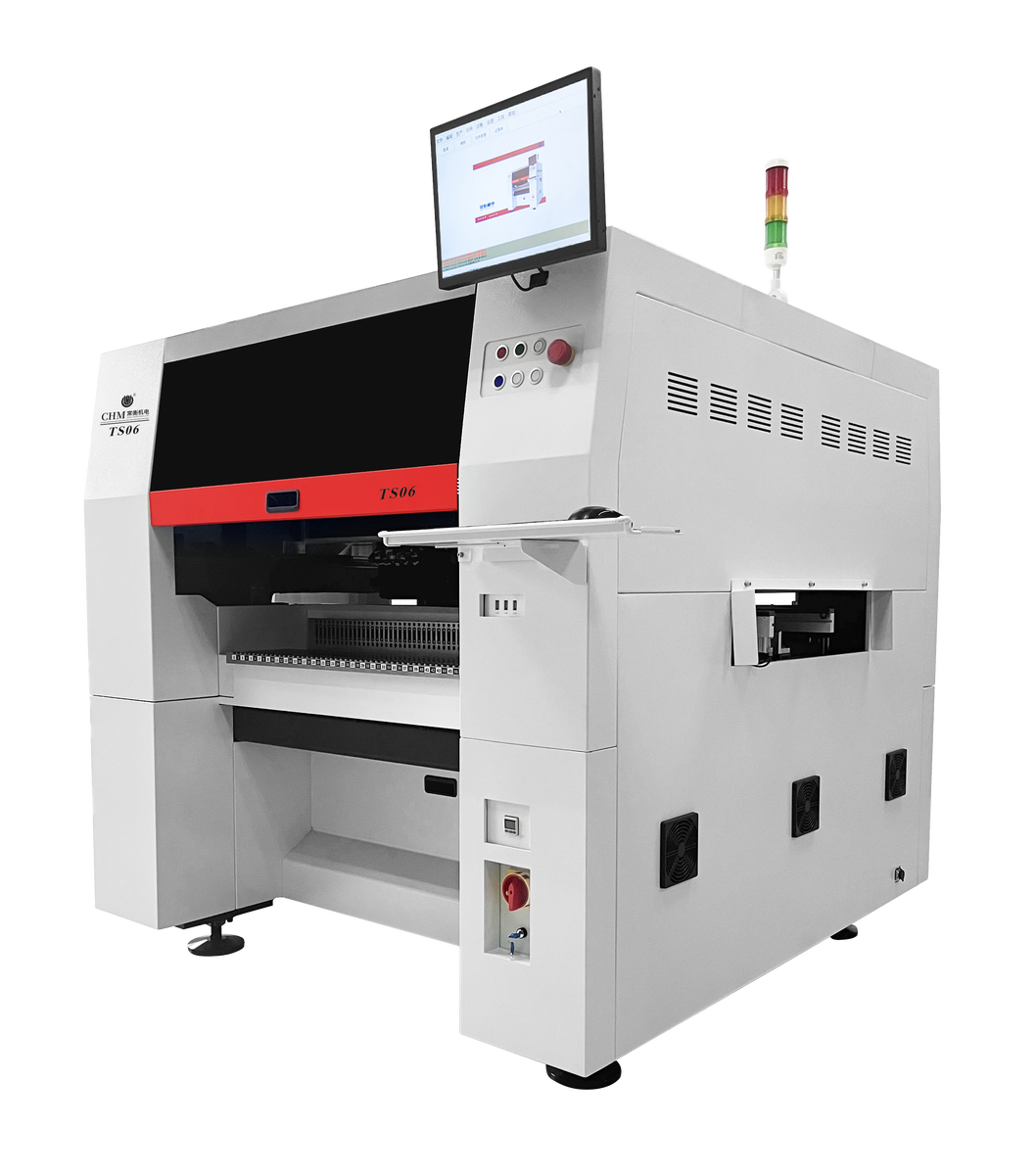
The technology at the heart of LED PCB assembly is the SMT pick and place machine — the automated system that picks surface mount components from tape feeders and places them precisely on the PCB, ready for reflow soldering. And the TS06 6-Head Pick and Place Machine — with six simultaneous placement heads, high-speed automatic operation, and customizable configuration for LED bulb production — is a purpose-optimized solution for LED bulb and driver PCB manufacturing at $28,500–$30,000.
SMT Technology: The Foundation of LED PCB Assembly
What Is Surface Mount Technology?
Surface Mount Technology (SMT) is the dominant method for assembling electronic components onto printed circuit boards. Unlike through-hole technology (where component leads pass through holes in the PCB), SMT components are mounted directly onto pads on the PCB surface.
SMT advantages over through-hole:
- Smaller components: SMT components are dramatically smaller — enabling higher component density and smaller PCBs
- Both sides of PCB: Components can be placed on both sides of the PCB
- Higher speed: Automated SMT placement is much faster than through-hole insertion
- Lower cost: Smaller components, less material, and higher automation reduce cost per assembly
- Better electrical performance: Shorter lead lengths reduce parasitic inductance and capacitance
For LED bulb PCBs — where the goal is to pack maximum functionality into minimum space at minimum cost — SMT is the only viable assembly technology.
The SMT Assembly Process
Step 1: Solder paste printing A stencil printer deposits solder paste (a mixture of solder alloy powder and flux) onto the PCB pads through a laser-cut stainless steel stencil. Paste thickness and coverage are critical for solder joint quality.
Step 2: Component placement (Pick and Place) The pick and place machine picks components from tape feeders, aligns them using vision systems, and places them precisely on the solder paste-covered pads. This is the step performed by the TS06.
Step 3: Reflow soldering The PCB passes through a reflow oven — a conveyor oven with precisely controlled temperature zones. The solder paste melts and flows, forming reliable solder joints between component leads/pads and PCB pads. The PCB then cools, solidifying the joints.
Step 4: Inspection Automated Optical Inspection (AOI) systems photograph the assembled PCB and compare it to a reference image, detecting missing components, misaligned components, solder bridges, and other defects.
Step 5: Testing Functional testing verifies that the assembled PCB operates correctly before it is incorporated into the finished LED bulb.
LED Bulb PCB: What the TS06 Assembles
Anatomy of an LED Bulb PCB
Understanding what components the TS06 places helps explain why a 6-head machine optimized for LED production is the right choice:
LED chips (SMD LEDs)
- The light-emitting components — typically 2835, 5630, or 3030 package SMD LEDs
- Placed in arrays on the PCB — a typical 9W LED bulb uses 9–18 LED chips
- Placement accuracy critical — misaligned LEDs affect light distribution and thermal management
- Component size: 2.8mm × 3.5mm (2835) to 3.0mm × 3.0mm (3030)
Resistors
- Current limiting and voltage dividing resistors
- Typical size: 0402 (1.0mm × 0.5mm) to 0805 (2.0mm × 1.25mm)
- Quantity per PCB: 2–10 resistors
Capacitors
- Filtering and energy storage capacitors
- Typical size: 0402 to 1206
- Quantity per PCB: 3–15 capacitors
Driver IC
- The LED driver integrated circuit controls current to the LEDs
- Typical package: SOT-23, SOP-8, or larger IC packages
- One driver IC per PCB (sometimes two for more complex designs)
Diodes and transistors
- Rectification and switching components
- Various SMD packages
A complete 9W LED bulb PCB typically contains 15–40 SMT components — all placed by the pick and place machine in a single automated cycle.
LED Driver PCB
The LED driver (power supply) is a separate PCB in many LED bulb designs — converting mains AC voltage to the DC current required by the LEDs:
- More complex than the LED board — 30–80 components
- Includes larger components: electrolytic capacitors, inductors, transformers
- Higher mix of component types and sizes
- Requires a machine capable of handling a wide component size range
The TS06’s wide component handling range — from 0201 chip components to larger ICs — makes it suitable for both LED board and driver PCB assembly.
The TS06 Machine: 6-Head Architecture and Capability
Why 6 Heads? The Throughput Mathematics
The number of placement heads is the primary determinant of machine throughput. Each head independently picks a component, moves to the placement position, and places it — while other heads are simultaneously picking their next components.
Single-head machine:
- Cycle time: 0.5–1.0 seconds per component
- Throughput: 3,600–7,200 components per hour (CPH)
Dual-head machine:
- Effective cycle time: 0.3–0.5 seconds per component
- Throughput: 7,200–12,000 CPH
6-head machine (TS06):
- Effective cycle time: 0.1–0.2 seconds per component
- Throughput: 18,000–36,000+ CPH
LED bulb production example:
- LED board: 20 components per PCB
- TS06 throughput: 25,000 CPH
- PCBs per hour: 25,000 / 20 = 1,250 LED boards per hour
- Daily production (20 hours): 25,000 LED boards per day
- Annual production (300 days): 7,500,000 LED boards per year
A single TS06 machine can supply the LED boards for a substantial LED bulb manufacturing operation — producing enough boards for 7.5 million bulbs per year.
Vision Alignment System
Precise component placement is critical for LED bulb quality. The TS06’s vision system ensures accuracy:
Fiducial recognition:
- Camera reads fiducial marks (reference points) on the PCB
- Corrects for PCB positioning errors and warpage
- Ensures all placements are accurate relative to the actual PCB position
Component vision:
- Camera images each component after pickup
- Detects component orientation, centering on nozzle, and component presence
- Corrects placement position and angle for each individual component
- Rejects components that are missing, wrong orientation, or damaged
Placement accuracy:
- Typical SMT pick and place accuracy: ±0.05mm (50 microns)
- Sufficient for 0402 components and standard LED packages
- Confirm accuracy specification with supplier for your smallest component
Feeder System
Feeders hold component tape reels and advance tape to present components to the pickup nozzle:
Tape feeders:
- 8mm feeders for 0402, 0603, 0805 chip components and small LEDs
- 12mm feeders for larger chip components and SOT packages
- 16mm, 24mm feeders for larger components
- Quantity: Typically 20–60 feeders on a 6-head machine
Feeder configuration for LED bulb production:
- 8mm feeders × 4: LED chips (2835/5630), resistors, capacitors
- 12mm feeders × 2: Driver IC, diodes
- Total: 6 feeders covers a complete simple LED board
For more complex boards with more component types, additional feeders are loaded.
Tray feeders:
- For components supplied in trays (matrix trays) rather than tape
- Common for larger ICs and some LED packages
- Optional on most machines
Nozzle System
Nozzles are the vacuum pickup tools that pick components from feeders:
Nozzle types:
- Different nozzle sizes for different component sizes
- Small nozzles for 0402 chip components
- Medium nozzles for 0805, SOT, and small LED packages
- Large nozzles for larger ICs and components
Nozzle management:
- Each head has a nozzle changer — automatically selects the correct nozzle for each component
- Nozzle wear is a maintenance item — inspect and replace worn nozzles regularly
- Nozzle cleanliness is critical — contaminated nozzles cause placement errors
Programming and Changeover
Offline programming:
- PCB assembly programs created on a PC using the machine’s offline software
- Import component placement data from PCB design files (Gerber, CAD data)
- Assign components to feeders and nozzles
- Optimize placement sequence for maximum throughput
Program loading:
- Programs loaded to machine via USB or network
- Changeover between different PCB designs: 15–30 minutes (feeder changes + program load)
Production monitoring:
- Real-time production counter (boards completed, components placed)
- Error logging (pickup errors, placement errors, vision failures)
- Feeder empty alerts
LED Bulb Manufacturing Line: The Complete Picture
The TS06 is one machine in a complete LED bulb PCB assembly line. Understanding the full line helps plan the investment:
Complete SMT Line for LED Bulb Production
1. Solder paste printer
- Automatic stencil printer
- Cost: $5,000–$20,000
- Prints solder paste on PCB pads
2. Pick and place machine (TS06)
- Cost: $28,500–$30,000
- Places all SMT components
3. Reflow oven
- 6–10 zone conveyor reflow oven
- Cost: $8,000–$25,000
- Solders all components simultaneously
4. AOI (Automated Optical Inspection)
- Camera-based inspection system
- Cost: $10,000–$30,000
- Detects assembly defects
5. Wave soldering (optional)
- For through-hole components on mixed-technology boards
- Cost: $8,000–$20,000
Total SMT line investment: $60,000–$125,000
The TS06 at $28,500 represents approximately 25–45% of the total line investment — the largest single equipment cost in the line, reflecting its central role in the assembly process.
LED Bulb Assembly Line (Post-PCB)
After PCB assembly, the LED bulb assembly line includes:
- LED board testing
- Driver PCB testing
- Bulb assembly (PCB into housing, lens attachment, base assembly)
- Final testing (lumen output, color temperature, power factor)
- Packaging
The complete LED bulb manufacturing operation — from bare PCB to packaged bulb — can be established for $150,000–$400,000 in equipment investment, producing 5–15 million bulbs per year.
Market Opportunity: LED Bulb Manufacturing Economics
Global LED Bulb Market
- Global LED bulb market: $15+ billion annually
- Unit volume: 15+ billion LED bulbs per year
- Average selling price: $0.80–$3.00 per bulb (depending on market and specification)
- Manufacturing cost: $0.30–$1.20 per bulb (depending on specification and volume)
Regional Manufacturing Opportunities
Southeast Asia (Vietnam, Thailand, Indonesia, Cambodia)
- Growing domestic LED demand
- Lower labor costs than China
- Preferential trade access to EU and US markets
- Government incentives for electronics manufacturing
South Asia (India, Bangladesh, Pakistan)
- Massive domestic LED demand (India alone: 1+ billion bulbs/year)
- Government LED promotion programs (UJALA scheme in India)
- Growing export capability
Africa (Egypt, Ethiopia, Kenya, Nigeria)
- Rapidly growing LED adoption
- Import substitution opportunity — currently importing most LED bulbs
- Government energy efficiency programs driving LED adoption
Middle East
- High LED adoption rates
- Re-export opportunity to Africa and South Asia
Production Economics Example
TS06 production line (single shift, 8 hours/day):
- LED boards produced: 10,000/day
- Bulbs assembled: 8,000/day (accounting for testing yield)
- Annual production (300 days): 2,400,000 bulbs
Revenue at $1.50/bulb average selling price:
- Annual revenue: $3,600,000
Manufacturing cost breakdown (per bulb):
- LED chips and components: $0.25
- PCB: $0.05
- Housing and lens: $0.15
- Labor: $0.10
- Overhead and equipment amortization: $0.10
- Total cost: $0.65/bulb
Gross margin: $0.85/bulb = 57% Annual gross profit: $2,040,000
Equipment payback:
- TS06 machine: $28,500
- Complete SMT line: $80,000
- Payback: less than 2 months
Featured Product: TS06 6-Head SMT Pick and Place Machine on MEGA BDM
MEGA BDM has sourced and verified the TS06 6-Head Pick and Place Machine — Automatic High Speed SMT LED Bulb Making Machine from a verified global SMT equipment manufacturer with proven LED manufacturing line deployment experience across Asia and international markets.
👉 View the TS06 SMT Pick and Place Machine on MEGA BDM
Frequently Asked Questions
What component sizes can the TS06 handle?
The TS06 handles a wide range of SMT component sizes. Confirm the minimum component size (typically 0402 or 0201) and maximum component size with the supplier for your specific component mix. LED bulb production typically uses 0402–1206 chip components and standard LED packages.
What is the placement accuracy?
Typical SMT pick and place accuracy is ±0.05mm (50 microns) for standard components. Confirm the placement accuracy specification with the supplier for your smallest component and most critical placement requirements.
How many feeders does the machine support?
Feeder count depends on the machine configuration. Confirm the number of feeder slots and supported feeder sizes (8mm, 12mm, 16mm, 24mm) with the supplier for your component mix. A typical LED bulb board requires 6–15 different component types.
Can the machine be customized for our specific LED bulb PCB?
Yes — the TS06 is described as customizable. Provide your PCB design files, component list, and production requirements to the supplier for a customized configuration recommendation.
What software is used for programming?
Confirm the programming software platform with the supplier. Most modern SMT machines use Windows-based offline programming software that imports data from standard PCB design formats (Gerber, CAD). Confirm compatibility with your PCB design software.
What after-sales support and spare parts availability is provided?
Confirm the supplier’s support network, spare parts availability, and response time commitments. Key spare parts to stock: nozzles, feeder components, vision system consumables. Confirm the recommended spare parts kit with the supplier.
Conclusion
The TS06 6-Head SMT Pick and Place Machine is a purpose-optimized solution for LED bulb PCB assembly — combining 6-head simultaneous placement, high-speed automatic operation, vision alignment, and customizable configuration in a package priced at $28,500–$30,000 that makes professional-grade SMT assembly accessible to LED manufacturers at every scale.
With the global LED bulb market continuing to grow and manufacturing opportunities expanding across Southeast Asia, South Asia, Africa, and the Middle East, the TS06 provides the production foundation for a competitive, profitable LED bulb manufacturing operation — with equipment payback measured in weeks, not years.
👉 View the full product details on MEGA BDM