Introduction: The Deep Ocean Frontier of Industrial Operations
More than 70% of the Earth’s surface is covered by ocean. Beneath those waters lies a vast industrial infrastructure — oil and gas pipelines stretching thousands of kilometers across the seabed, subsea wellheads producing billions of dollars of hydrocarbons, submarine power cables connecting nations, offshore wind farm foundations anchored to the ocean floor, and telecommunications cables carrying 99% of international internet traffic.
All of this infrastructure must be inspected, maintained, repaired, and expanded. And virtually none of it can be accessed by human divers — the depths involved, the pressures encountered, and the distances from shore make human diving impossible for most subsea industrial work.
The technology that makes subsea industrial operations possible is the ROV — the Remotely Operated Vehicle. A tethered, unmanned submarine controlled from the surface, the ROV is the hands and eyes of the offshore industry in the deep ocean. And the most capable class of ROV — the work-class ROV — is not merely an observation platform. It is a fully capable subsea intervention system, equipped with powerful manipulator arms, high-thrust propulsion, and the tooling interfaces needed to perform complex mechanical work at depths of 3,000 meters or more.
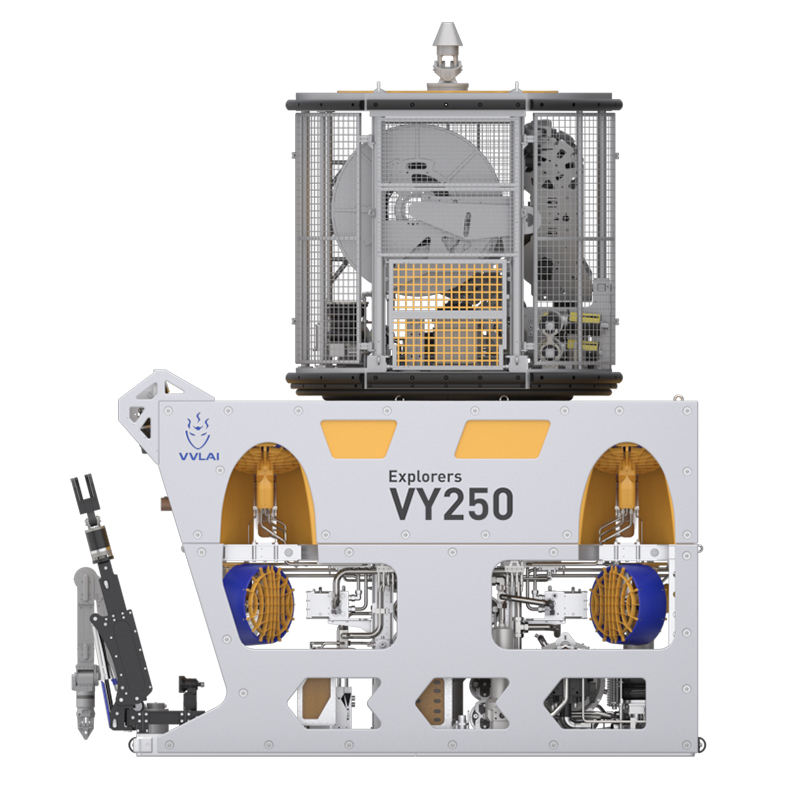
The VVLAI Work-Class ROV with Containerized Control Room — priced at $4,000,000–$7,000,000 depending on configuration — represents a complete, deployable subsea intervention system that combines work-class ROV capability with the operational flexibility of containerized deployment.
ROV Classification: Understanding Work-Class Capability
The ROV industry classifies vehicles by their capability and intended application:
Observation-Class ROVs
- Size: Small (10–100 kg)
- Depth: 100–1,000m typical
- Capability: Video observation, basic inspection
- Tooling: None or minimal (single camera, lights)
- Applications: Shallow water inspection, scientific survey, recreational
- Price: $5,000–$200,000
Light Work-Class ROVs
- Size: Medium (100–500 kg)
- Depth: 500–2,000m typical
- Capability: Inspection + light intervention
- Tooling: One or two manipulators, basic tooling
- Applications: Pipeline inspection, light cleaning, basic intervention
- Price: $200,000–$1,000,000
Work-Class ROVs ← This product
- Size: Large (1,000–5,000+ kg)
- Depth: 2,000–6,000m typical
- Capability: Full intervention — heavy manipulation, complex tooling operations
- Tooling: Two or more heavy-duty manipulators, full tooling skid
- Applications: Wellhead intervention, subsea construction, heavy lift, complex repair
- Price: $2,000,000–$10,000,000+
Trenching & Heavy Work ROVs
- Size: Very large (5,000–20,000+ kg)
- Depth: Varies
- Capability: Cable burial, trenching, heavy construction
- Applications: Cable laying, pipeline burial, seabed preparation
- Price: $5,000,000–$30,000,000+
The work-class ROV is the workhorse of the offshore oil & gas industry — capable of performing virtually any subsea task that a human diver could perform, at depths far beyond human diving limits, and with greater precision and endurance.
The Containerized Control Room: The Operational Revolution
Traditional ROV Deployment — The Problem
Conventional work-class ROV systems are permanently installed on dedicated ROV support vessels (ROVSVs) — specialized ships built specifically to deploy and operate ROVs. These vessels cost $50,000–$150,000 per day to charter and require weeks of advance booking.
Problems with dedicated vessel deployment:
- High day rate: $50,000–$150,000/day vessel charter cost dominates project economics
- Advance booking: Dedicated ROVSVs are booked months in advance — no flexibility for emergency response
- Geographic limitation: Vessel must transit to the work location — transit time adds cost and schedule
- Single-purpose asset: Dedicated ROVSV is expensive when not actively working
- Mobilization time: Installing and commissioning ROV equipment on a dedicated vessel takes days to weeks
The Containerized Solution
The VVLAI containerized control room transforms ROV deployment by packaging the entire surface control system — pilot workstations, electronics, power systems, and support equipment — into standard ISO shipping containers.
What “containerized” means in practice:
ISO container format:
- Standard 20-foot or 40-foot ISO shipping container dimensions
- Fits standard container ship slots, flatbed trucks, and rail cars
- Stackable for efficient storage and transport
- Lockable and weatherproof for secure transport
Self-contained systems:
- All pilot workstations and displays
- ROV control electronics and computers
- Fiber optic and electrical tether management systems
- Power distribution and UPS systems
- Air conditioning for electronics cooling
- Communication systems (satellite, radio, intercom)
- Tool control panels and hydraulic power unit interfaces
Vessel-agnostic deployment: The containerized system can be deployed on virtually any vessel with:
- Sufficient deck space for the container(s)
- A crane or A-frame capable of deploying the ROV
- Electrical power supply (typically 440V/60Hz or 400V/50Hz, 200–500 kW)
- Adequate deck strength for container and ROV weight
This includes platform supply vessels (PSVs), anchor handling tugs (AHTVs), construction vessels, cable lay vessels, and even large barges — all available at $15,000–$40,000/day, dramatically less than dedicated ROVSVs.
The Economics of Containerized Deployment
Traditional ROVSV deployment:
- Vessel day rate: $80,000/day
- 30-day project: $2,400,000 vessel cost alone
- Plus ROV mobilization, crew, consumables
Containerized deployment on PSV:
- Vessel day rate: $20,000/day
- 30-day project: $600,000 vessel cost
- Saving: $1,800,000 on vessel cost alone
- Annual saving on 6 projects: $10,800,000
For operators running multiple ROV projects per year, the containerized system pays for itself in vessel cost savings within the first year of operation.
Work-Class ROV Technical Architecture
Propulsion System
Work-class ROVs require powerful, redundant propulsion for station-keeping in currents and precise maneuvering during intervention tasks:
Thruster configuration (typical work-class):
- 6–8 thrusters in vectored arrangement
- Horizontal thrusters: 4 (fore/aft and lateral)
- Vertical thrusters: 2–4 (depth control and roll)
- Total thrust: 200–500+ kgf (kilogram-force)
- Thruster power: 10–30 kW per thruster
Current capability:
- Station-keeping in 2–3 knot currents (typical)
- Transit speed: 2–4 knots
- Precise positioning for tooling operations: ±0.1m
Hydraulic power:
- Hydraulic power unit (HPU) provides power for manipulators and tools
- Typical hydraulic power: 50–150 kW
- Operating pressure: 200–350 bar
- Flow rate: 50–200 L/min
Manipulator Systems
The manipulators are the defining capability of a work-class ROV — they are what make it a working machine rather than an observation platform:
Master-slave manipulator (7-function):
- 7 degrees of freedom: shoulder rotate, shoulder tilt, elbow, wrist rotate, wrist tilt, wrist bend, jaw
- Jaw force: 500–1,000 N
- Reach: 1.5–2.0m
- Payload: 50–150 kg
- Control: Force-feedback master-slave (operator feels resistance)
Grabber/manipulator (5-function):
- 5 degrees of freedom
- Higher force capability for heavy lifting and torque application
- Jaw force: 2,000–5,000 N
- Used for: Valve operation, connector make/break, heavy lifting
Tooling skid:
- Interchangeable tool packages mounted on the ROV front
- Common tools: Torque tools, cutting tools, cleaning tools, survey tools, sampling tools
- Hot-stab connections for hydraulic and electrical tool power
- Tool change performed at surface between dives
Sensor and Imaging Suite
Navigation:
- USBL (Ultra-Short Baseline) acoustic positioning — ROV position relative to vessel
- DVL (Doppler Velocity Log) — ROV velocity and altitude above seabed
- Depth sensor — pressure-based depth measurement
- Heading sensor — gyrocompass or AHRS
- Altimeter — distance above seabed
Imaging:
- Main color zoom camera (HD or 4K)
- Wide-angle overview cameras (multiple)
- Low-light cameras for deep water
- Laser scaling system — measures object dimensions in video
- Still photography capability
Sonar:
- Multibeam sonar — 3D seabed mapping
- Profiling sonar — pipeline and structure profiling
- Scanning sonar — 360° obstacle detection
- Forward-looking sonar — navigation in low visibility
Inspection tools:
- CP (Cathodic Protection) probe — measures corrosion protection on pipelines
- Thickness gauge — measures pipe wall thickness ultrasonically
- Magnetic particle inspection — detects surface cracks in steel
- Eddy current inspection — detects subsurface defects
Tether Management System (TMS)
The tether management system is a critical component of deep-water ROV operations:
Function:
- Stores and manages the umbilical tether between vessel and ROV
- Provides a “garage” for the ROV during deployment and recovery
- Decouples ROV from vessel motion — allows ROV to work stably while vessel moves
TMS types:
- Garage TMS: ROV docks inside TMS cage — most common for deep water
- Clump weight TMS: Heavy weight on tether reduces catenary — simpler, lower cost
Umbilical tether:
- Length: 1,000–6,000m depending on operating depth
- Contains: Electrical power conductors, fiber optic data cables, hydraulic hoses (on some systems)
- Diameter: 40–80mm
- Breaking strength: 50–200 kN
Applications: Where Work-Class ROVs Operate
Offshore Oil & Gas — The Primary Market
The offshore oil & gas industry is the largest market for work-class ROVs, accounting for approximately 70% of global ROV utilization:
Drilling support:
- BOP (Blowout Preventer) inspection and function testing
- Wellhead monitoring during drilling operations
- Riser inspection and monitoring
- Emergency disconnect and well control support
Production support:
- Subsea tree inspection and maintenance
- Flowline and pipeline inspection
- Manifold and jumper inspection
- Valve operation and intervention
- Hydrate remediation
Construction support:
- Jacket and template installation monitoring
- Pile driving monitoring
- Mooring installation and inspection
- Subsea structure installation guidance
- Tie-in and connection operations
Integrity management:
- Annual pipeline inspection programs
- Anode inspection and replacement
- Corrosion monitoring
- Structural inspection of platforms and jackets
- Leak detection
Offshore Wind — The Fastest Growing Market
Offshore wind is the fastest-growing market for subsea ROV services:
Foundation inspection:
- Monopile and jacket foundation inspection
- Scour protection monitoring
- Corrosion and coating inspection
- Cable entry point inspection
Cable inspection:
- Inter-array cable inspection
- Export cable inspection
- Cable burial depth verification
- Cable damage assessment and repair support
Operations & maintenance:
- Subsea equipment inspection
- Debris removal
- Marine growth removal from foundations
- Anode inspection
Submarine Cable Operations
The global submarine cable network — carrying internet, telephone, and power — requires regular inspection and repair:
Cable survey:
- Pre-lay route survey
- Cable burial depth verification
- Cable condition inspection
Cable repair:
- Fault location
- Cable recovery and repair
- Cable burial and protection
Power cable:
- Offshore wind export cable installation support
- Interconnector cable inspection
- Cable protection installation
Scientific and Environmental
Deep-sea research:
- Geological survey and sampling
- Biological survey and specimen collection
- Hydrothermal vent exploration
- Archaeological survey
Environmental monitoring:
- Pipeline leak detection
- Produced water discharge monitoring
- Seabed habitat survey
- Marine protected area monitoring
Mobilization & Deployment: The Containerized Advantage in Practice
Mobilization Sequence
Day 1: Container delivery to port
- Container transported by road to port
- Loaded onto vessel by crane
- Container secured to deck with twist locks
Day 2: System setup and testing
- Container opened and systems powered up
- ROV deployed from container for deck testing
- All systems checked and calibrated
- Crew briefing and safety checks
Day 3: Transit to work site
- Vessel transits to work location
- ROV pre-dive checks completed during transit
Day 4: Operations commence
- ROV deployed and operational
Total mobilization: 3–4 days vs. 2–4 weeks for permanent vessel installation.
Vessel Requirements
The containerized system can be deployed from vessels meeting these minimum requirements:
| Requirement | Specification |
|---|---|
| Deck space | 20m × 10m minimum (for container + ROV) |
| Deck strength | 5–10 tonnes/m² |
| Crane/A-frame | 10–30 tonne SWL, 5–10m outreach |
| Power supply | 440V/60Hz or 400V/50Hz, 300–500 kW |
| Accommodation | 4–6 additional berths for ROV crew |
| DP capability | DP1 minimum (DP2 preferred for intervention) |
Vessels meeting these requirements include PSVs, AHTVs, construction vessels, and large barges — all available at significantly lower day rates than dedicated ROVSVs.
Global Deployment Flexibility
The containerized format enables deployment anywhere in the world:
Sea freight: Container shipped on standard container vessel to any port worldwide — 2–4 weeks transit time Air freight: For urgent deployment, container can be air-freighted (20-foot container) — 2–5 days transit Road transport: Container transported by flatbed truck to any accessible port or offshore base Helicopter transport: Smaller equipment packages can be helicopter-lifted to remote locations
This global mobility is particularly valuable for:
- Emergency subsea intervention (pipeline leak, wellhead failure)
- Short-duration projects in remote locations
- Multi-region operators needing flexible asset deployment
- New market entry without permanent vessel commitment
Featured Product: VVLAI Work-Class ROV on MEGA BDM
MEGA BDM has sourced and verified the VVLAI Engineering Equipment Factory Containerized Control Room Work-Class ROV — a complete, deployable subsea intervention system from VVLAI, a verified specialist ROV manufacturer with proven subsea system design, manufacturing, and international deployment experience.
👉 View the VVLAI Work-Class ROV on MEGA BDM
Frequently Asked Questions
What is the maximum operating depth?
Operating depth depends on the specific configuration — tether length, pressure ratings of electronics and hydraulics, and thruster performance at depth. Confirm the maximum rated operating depth with the supplier for your application. Work-class ROVs typically operate to 2,000–6,000m.
What certifications does the system carry?
Confirm certifications with the supplier for your target market and application. Common certifications for offshore ROV systems include DNV GL, Bureau Veritas, ABS, and Lloyd’s Register. Confirm which certification body’s approval is required by your client or regulatory authority.
How many crew are required to operate the system?
A work-class ROV system typically requires 4–6 personnel: 2 ROV pilots (one active, one standby), 1 supervisor/engineer, 1–2 technicians, and 1 deck crew supervisor. Confirm the crew complement with the supplier for your specific system configuration.
What is the lead time for delivery?
Work-class ROV systems are complex, custom-configured equipment. Lead time from order to delivery is typically 6–18 months depending on configuration and supplier production schedule. Confirm current lead time with the supplier.
Can the system be configured for specific tooling requirements?
Yes — work-class ROV systems are highly configurable. Tooling skids, manipulator specifications, sensor packages, and control systems can be customized for specific applications. Provide your tooling requirements to the supplier for a customized configuration quote.
What training and support is provided?
Confirm training and support provisions with the supplier. Typical provisions include: factory acceptance testing (FAT) with client attendance, operator training at supplier facility, commissioning support at first deployment, and ongoing technical support. Confirm the support package for your specific purchase.
Conclusion
The VVLAI Work-Class ROV with Containerized Control Room represents the convergence of two critical capabilities: the full intervention power of a work-class ROV and the operational flexibility of containerized deployment. By eliminating dependence on dedicated ROV support vessels, the containerized system dramatically reduces mobilization cost, increases deployment flexibility, and enables rapid response to subsea emergencies anywhere in the world.
At $4,000,000–$7,000,000 — with vessel cost savings of $1,500,000–$2,000,000 per project compared to dedicated ROVSV deployment — the system pays for itself within the first few projects for operators with regular subsea intervention requirements. For offshore oil & gas operators, subsea construction contractors, cable operators, and offshore wind developers, the VVLAI containerized work-class ROV is a strategic asset that delivers both operational capability and economic advantage.
👉 View the full product details on MEGA BDM