
Introduction: The Data Problem at the Heart of Modern Logistics
Every package that moves through a logistics network carries three pieces of critical data: its dimensions, its weight, and its identity (barcode or tracking number). These three data points determine the shipping cost, the carrier billing, the routing decision, the WMS record, and the customer tracking update.
In most logistics operations today, capturing this data is still largely manual — workers read barcodes with handheld scanners, place packages on static scales, and estimate or manually measure dimensions. This process is slow, error-prone, and creates a bottleneck at every induction point in the operation.
The cost of getting this data wrong is significant. Incorrect volumetric weight calculations result in revenue leakage — packages billed at actual weight when volumetric weight is higher, or vice versa. Missed scans create tracking gaps that generate customer service calls. Manual measurement errors create billing disputes with carriers. And the sheer time required for manual DWS (Dimensioning, Weighing, and Scanning) limits throughput at exactly the point where speed matters most.
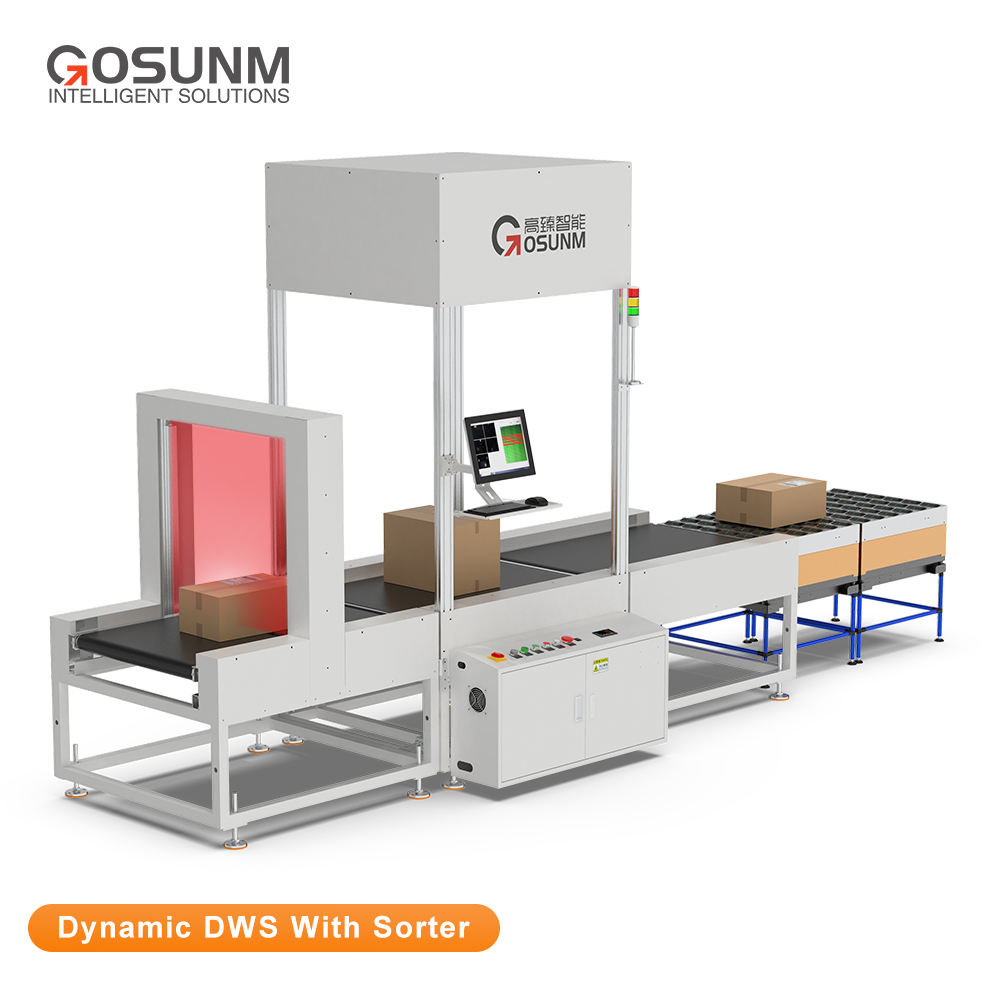
The solution is the Dynamic DWS System — an automated inline measurement system that captures package dimensions, weight, and barcode data simultaneously, while the package is moving on the conveyor, at full line speed, with no manual intervention required.
The Automatic E-commerce Logistics Warehouse Express Package Sorting Dynamic DWS System — stainless steel construction, adjustable configuration, priced at $14,800 — represents one of the most accessible and capable DWS solutions available through global sourcing channels today.
What Is a Dynamic DWS System?
DWS stands for Dimensioning, Weighing, and Scanning — the three measurement functions that must be performed on every package entering or leaving a logistics operation.
Dynamic refers to the fact that all three measurements are performed while the package is in motion on the conveyor — as opposed to static systems where packages must be stopped for measurement.
The Three Functions
D — Dimensioning Measures the external dimensions of the package (length × width × height) using:
- Laser distance sensors
- Camera-based vision systems
- Structured light or time-of-flight sensors
The dimensional data is used to calculate volumetric weight (also called dimensional weight or DIM weight) — the shipping weight calculated from package volume rather than actual mass. For lightweight but bulky packages, volumetric weight is higher than actual weight and determines the billing weight.
W — Weighing Measures the actual mass of the package using:
- Dynamic checkweigher scales integrated into the conveyor
- Load cell-based weighing platforms
- Belt scale systems
The weighing system must compensate for conveyor vibration and package movement to achieve accurate dynamic weight measurement.
S — Scanning Reads the package barcode or QR code using:
- Fixed-position barcode scanners (multiple angles for omnidirectional reading)
- Camera-based barcode readers
- RFID readers (on systems with RFID capability)
The scan links the dimensional and weight data to the specific package identity in the WMS/TMS system.
Why All Three Together?
The power of DWS is the simultaneous capture of all three data points in a single pass. A package passes through the DWS system once and emerges with its identity confirmed, its dimensions recorded, and its weight measured — all in less than one second, at full conveyor speed.
This replaces three separate manual processes (scan, weigh, measure) that previously required a worker to stop, handle, and process each package individually.
The Stainless Steel Advantage
The stainless steel construction of this DWS system is a significant differentiator from standard carbon steel or aluminum alternatives:
Durability in Demanding Environments
Logistics environments are harsh — packages are dropped, conveyors vibrate, forklifts operate nearby, and the system runs 24/7. Stainless steel provides:
- Superior corrosion resistance — no rust even in humid or wet environments
- Higher impact resistance — withstands the mechanical stress of continuous operation
- Longer service life — stainless steel structures routinely last 15–25+ years in industrial service
Hygiene Compliance
For logistics operations handling food products, pharmaceuticals, or other hygiene-sensitive goods, stainless steel is often a regulatory requirement:
- Easy to clean — smooth surfaces don’t harbor bacteria or contaminants
- Chemical resistant — withstands cleaning agents and sanitizers
- FDA/food-grade compatible — suitable for food-adjacent logistics environments
Professional Appearance
Stainless steel conveys quality and professionalism — important for operations where clients or auditors visit the facility.
The Adjustable Configuration: Flexibility for Real-World Operations
The adjustable design of this DWS system addresses one of the most common challenges in logistics automation: the need to handle a wide variety of package sizes and to fit into existing facility layouts.
Package Size Adaptability
- Height adjustment — sensor array height adjusts to accommodate packages from small envelopes to large cartons
- Width adjustment — conveyor width and sensor span adjusts for different package width ranges
- Speed adjustment — conveyor speed configurable to match upstream and downstream line speeds
Facility Integration
- Height-adjustable legs — conveyor height matches existing conveyor lines without ramps or transitions
- Modular length — system length configurable for available floor space
- Infeed/outfeed options — connects to existing conveyor systems or operates as standalone
Multi-Package Type Handling
The adjustable configuration handles:
- Rigid cardboard boxes (all sizes)
- Polybag mailers and soft packages
- Padded envelopes
- Irregular-shaped packages (with appropriate sensor configuration)
- Cylindrical packages (with appropriate support)
DWS Data: What It Enables
The data captured by the DWS system is not just a measurement — it is the foundation of multiple downstream business processes:
Freight Billing Accuracy
Volumetric weight calculation: Most carriers (FedEx, UPS, DHL, SF Express, J&T, etc.) bill on the greater of actual weight or volumetric weight:
Volumetric weight = (L × W × H) / DIM factor
Where DIM factor is typically 5,000 (cm³/kg) for international air freight or 139 (in³/lb) for domestic US ground.
For a package measuring 40cm × 30cm × 20cm:
- Volumetric weight = (40 × 30 × 20) / 5,000 = 4.8 kg
- If actual weight is 2 kg, the billing weight is 4.8 kg
Without accurate dimensional measurement, this package would be billed at 2 kg — a 58% revenue shortfall for the carrier or 3PL.
Revenue leakage prevention: For a 3PL or express courier processing 10,000 packages per day with an average volumetric weight premium of $0.50 per package:
- Daily revenue leakage without DWS: $5,000
- Annual revenue leakage: $1,825,000
- DWS system payback: less than 3 days
Carrier Compliance
Major carriers audit shipments for dimensional weight compliance. Systematic under-billing due to inaccurate measurement results in:
- Carrier surcharges and penalties
- Account review and potential rate renegotiation
- Billing disputes and administrative cost
Automated DWS eliminates measurement inconsistency and provides documented proof of package dimensions for dispute resolution.
WMS Integration & Package Tracking
Every package scan creates a WMS record linking:
- Package identity (barcode/tracking number)
- Dimensions (L × W × H)
- Actual weight
- Volumetric weight
- Timestamp and location
- Routing decision
This data enables:
- Real-time package tracking — customers and operations teams know exactly where every package is
- Exception management — oversize, overweight, or unreadable packages flagged automatically
- Productivity reporting — throughput, error rates, and system performance metrics
- Billing documentation — complete audit trail for carrier billing and dispute resolution
Routing & Sorting Integration
DWS data feeds directly into sorting system routing decisions:
- Route packages by weight class (standard vs. heavy)
- Route by size (standard vs. oversize)
- Route by carrier or service level
- Flag packages requiring special handling
Applications: Who Needs a Dynamic DWS System?
E-Commerce Fulfillment Centers
Outbound processing: Every outbound order must be weighed and dimensioned for carrier label generation. Manual weighing and dimensioning is the bottleneck in most fulfillment operations. DWS automates this completely — packages flow through the system at conveyor speed with no manual measurement required.
Returns processing: Returned packages must be identified, weighed, and dimensioned for restocking or disposition. DWS speeds up returns processing and provides accurate data for restocking decisions.
Express Courier Hubs
Inbound processing: Packages arriving at courier hubs must be scanned, weighed, and dimensioned for billing verification and routing. DWS enables high-speed inbound processing without manual handling.
Billing verification: Courier companies use DWS to verify shipper-declared dimensions and weights — identifying under-declared packages and recovering revenue.
3PL Operators
Client billing: 3PLs bill clients based on package dimensions and weight. Accurate DWS data ensures correct billing and eliminates disputes.
Multi-client operations: DWS data is automatically attributed to the correct client account, simplifying billing for multi-client warehouse operations.
Freight Forwarding & Air Cargo
Chargeable weight calculation: Air freight is billed on chargeable weight (greater of actual or volumetric weight). Accurate DWS measurement is essential for correct billing and IATA compliance.
Cargo manifest preparation: DWS data feeds directly into cargo manifest systems, reducing manual data entry and errors.
Postal Operations
Postage calculation: Postal services use DWS to calculate correct postage for packages based on weight and dimensions.
Automation integration: DWS systems integrate with postal sorting machines for fully automated package processing.
Technical Specifications to Evaluate
When comparing dynamic DWS systems:
| Specification | What to Confirm |
|---|---|
| Measurement accuracy (dimensions) | ±1–2mm typical |
| Measurement accuracy (weight) | ±10–50g typical |
| Package size range | Min/max L×W×H |
| Package weight range | Min/max weight |
| Conveyor speed | Packages per minute at rated accuracy |
| Barcode read rate | % of packages successfully scanned |
| Barcode types supported | 1D, 2D, QR code |
| Data output format | TCP/IP, serial, OPC-UA, API |
| WMS integration | Standard API or custom integration |
| Construction material | Stainless steel (this system) |
| IP rating | IP54 or higher for industrial environments |
| Power supply | 220V/50Hz or 110V/60Hz |
| Certification | CE, ISO |
ROI Analysis: The Numbers at $14,800
Scenario 1: Revenue Leakage Recovery (3PL / Courier)
- Daily volume: 5,000 packages
- Average volumetric weight premium: $0.30/package
- Annual revenue recovery: 5,000 × $0.30 × 300 days = $450,000/year
- Payback: less than 2 weeks
Scenario 2: Labor Savings (Fulfillment Center)
- Manual DWS time: 30 seconds per package
- Daily volume: 2,000 packages
- Daily labor time saved: 2,000 × 30s = 16.7 hours
- Labor cost saved: 16.7 hours × $15/hour = $250/day
- Annual saving: $250 × 300 days = $75,000/year
- Payback: less than 3 months
Scenario 3: Error Reduction
- Manual measurement error rate: 2%
- Daily volume: 3,000 packages
- Daily errors: 60 packages
- Cost per error (re-billing, customer service, carrier dispute): $5
- Annual error cost: 60 × $5 × 300 = $90,000/year
- Payback: less than 2 months
In virtually every logistics scenario, the DWS system pays for itself within weeks to months — making it one of the highest-ROI automation investments available to logistics operators.
Featured Product: Dynamic DWS Package Sorting System on MEGA BDM
MEGA BDM has sourced and verified the Automatic E-commerce Logistics Warehouse Express Package Sorting Dynamic DWS System — stainless steel construction, adjustable configuration, complete with dimensioning, weighing, and scanning capability — from a verified global manufacturer with proven logistics automation deployment experience.
👉 View the Dynamic DWS Sorting System on MEGA BDM
Frequently Asked Questions
What package sizes can the system measure?
The adjustable configuration handles a wide range of package sizes. Confirm the specific minimum and maximum dimensions (L×W×H) with the supplier for your package mix. Most systems handle packages from small envelopes (10×10×1cm) to large cartons (120×80×80cm).
How accurate is the dynamic weight measurement?
Dynamic weighing accuracy is typically ±10–50g depending on conveyor speed and package weight. For most logistics billing applications, ±50g accuracy is sufficient. Confirm the accuracy specification for your specific application.
Can the system read damaged or partially obscured barcodes?
Multi-angle scanning arrays significantly improve read rates on damaged labels. Camera-based readers with image processing can often decode partially obscured barcodes. Confirm the read rate specification and exception handling for unreadable packages.
How does the system integrate with our WMS?
The DWS system outputs measurement data via standard interfaces (TCP/IP, serial, or API). Integration with your WMS requires a data interface that maps DWS output to your WMS package records. Confirm the integration requirements with both the DWS supplier and your WMS vendor.
What happens to packages that cannot be scanned?
Unreadable packages are typically diverted to a manual exception lane where an operator resolves the identification manually. The system logs the exception for reporting and analysis.
What maintenance does the system require?
Regular maintenance includes cleaning of scanner windows and sensor surfaces, calibration verification (typically monthly), and inspection of conveyor components. The stainless steel construction minimizes corrosion-related maintenance. The supplier provides a maintenance manual and schedule.
Conclusion
The Dynamic DWS Package Sorting System addresses one of the most universal and high-value automation opportunities in logistics: the simultaneous, automated capture of package dimensions, weight, and identity at full conveyor speed.
At $14,800, with stainless steel construction and adjustable configuration, this system delivers enterprise-grade DWS capability at a price point accessible to operations of all sizes — from growing e-commerce fulfillment centers to established express courier hubs and 3PL operators.
The ROI case is among the strongest in logistics automation: revenue leakage recovery alone typically pays for the system within days to weeks, while labor savings and error reduction provide additional ongoing returns that compound year after year.
👉 View the full product details on MEGA BDM