
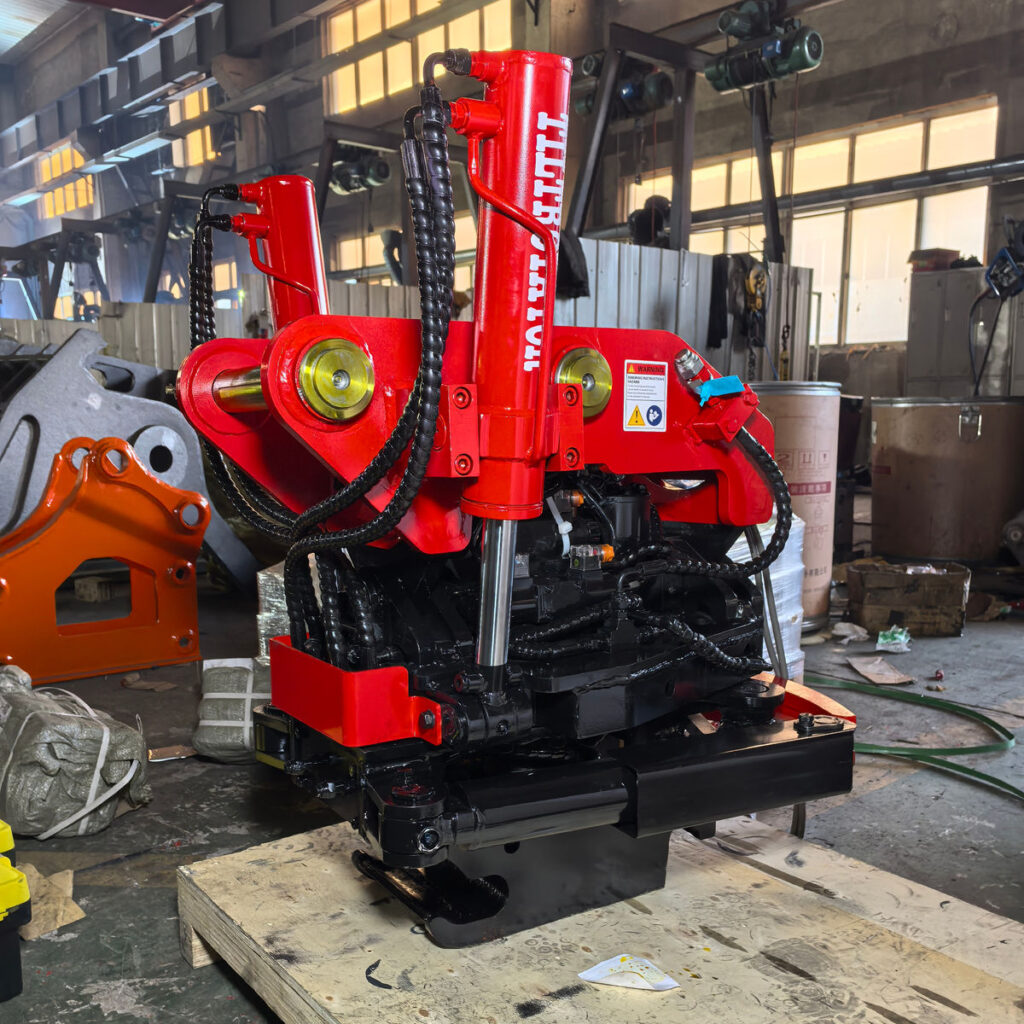
👉 View the Quick Hitch Tiltrotator on MEGA BDM
Introduction: The Attachment That Transforms Every Excavator
In the world of excavator attachments, few innovations have had as profound an impact on job site productivity as the tiltrotator. Combined with a quick hitch system, this technology transforms a standard excavator into a precision multi-tool machine capable of performing tasks that would otherwise require multiple machines, additional manual labor, or complete repositioning of the excavator itself.
For contractors, civil engineers, utility companies, and equipment importers operating in competitive construction markets, understanding the tiltrotator — its mechanics, applications, specifications, and sourcing considerations — is increasingly essential. This guide covers everything you need to know.
Price Range
| Size Class | Compatible Excavator | Price Range (FOB China) |
|---|---|---|
| Mini tiltrotator | 1–4 ton | $2,500 – $6,000 USD |
| Small tiltrotator | 4–8 ton | $5,000 – $12,000 USD |
| Medium tiltrotator | 8–14 ton | $10,000 – $22,000 USD |
| Large tiltrotator | 14–22 ton | $18,000 – $35,000 USD |
| Heavy tiltrotator | 22–40+ ton | $28,000 – $55,000 USD |
European brand equivalents (Engcon, Rototilt) typically cost 2–4x these prices. Chinese alternatives offer significant cost savings with improving quality.
What Is a Quick Hitch Tiltrotator?
A tiltrotator is a hydraulic attachment mounted between an excavator’s arm (dipper) and its working tool (bucket, grapple, breaker, etc.) that provides two additional axes of movement:
- Tilt — tilts the attachment left and right, typically ±40° to ±45°
- Rotate — rotates the attachment a full 360° continuously in both directions
A quick hitch (also called a quick coupler) is the locking mechanism that allows the operator to change attachments rapidly — in 30–60 seconds — without leaving the cab or using manual tools.
Together, the quick hitch tiltrotator gives the excavator operator unprecedented control and flexibility:
- Work at any angle without repositioning the machine
- Reach into corners, under obstacles, and along slopes
- Change attachments in under a minute
- Perform fine grading, pipe laying, and precision work with a single machine
Core Engine Components: What Powers the Tiltrotator
The featured product highlights core engine components — referring to the hydraulic and mechanical systems at the heart of the tiltrotator’s performance. Understanding these components helps buyers evaluate quality and long-term reliability:
Hydraulic Rotary Motor
The rotary motor converts hydraulic flow from the excavator into continuous 360° rotation. Key specs:
- Displacement: Determines torque output and rotation speed
- Operating pressure: Must match the excavator’s auxiliary hydraulic circuit (typically 200–350 bar)
- Sealing quality: Critical for longevity — look for high-grade seals rated for continuous rotation under load
Tilt Cylinder(s)
Hydraulic cylinders that drive the tilt movement. Double-acting cylinders provide controlled tilt in both directions. Key specs:
- Bore diameter and stroke — determines tilt force and angle range
- Seal quality — must withstand high cycle counts and contaminated environments
- Chrome rod finish — corrosion resistance for outdoor use
Slewing Ring / Swing Bearing
The structural bearing that supports the full load of the attachment while rotating. This is the most mechanically stressed component in the tiltrotator:
- Load rating — must exceed the maximum attachment weight and dynamic forces
- Gear type — internal or external gear ring for motor engagement
- Material — hardened alloy steel for durability
Quick Hitch Locking Mechanism
The coupler that connects the tiltrotator to the excavator arm and the working attachment to the tiltrotator. Safety-critical component:
- Automatic vs. semi-automatic — automatic couplers lock without operator leaving the cab
- Safety lock — secondary locking mechanism prevents accidental release
- Pin diameter compatibility — must match the excavator’s bucket pin dimensions
Hydraulic Swivel (Rotary Union)
Allows hydraulic fluid to pass through the rotating joint to power attachments below the tiltrotator. Essential for operating hydraulic attachments (breakers, grapples, augers) through the tiltrotator:
- Number of circuits — typically 2–6 hydraulic circuits through the swivel
- Pressure rating — must match system pressure
- Flow capacity — must support attachment hydraulic requirements
Excavator Compatibility: Getting the Right Size
Tiltrotators are manufactured in size classes matched to excavator operating weight. Selecting the correct size class is critical — undersized units risk structural failure; oversized units add unnecessary weight and reduce performance.
| Tiltrotator Size Class | Compatible Excavator Weight | Typical Attachment Weight |
|---|---|---|
| Mini (TR01–TR03) | 1–4 ton excavators | Up to 200kg |
| Small (TR04–TR06) | 4–8 ton excavators | Up to 400kg |
| Medium (TR07–TR12) | 8–14 ton excavators | Up to 700kg |
| Large (TR13–TR20) | 14–22 ton excavators | Up to 1,200kg |
| Heavy (TR21+) | 22–40+ ton excavators | Up to 2,500kg+ |
Always confirm:
- Excavator operating weight and arm/boom dimensions
- Auxiliary hydraulic flow and pressure available at the excavator’s coupler
- Bucket pin diameter and width for quick hitch compatibility
- Maximum attachment weight you intend to use
Key Technical Specifications to Evaluate
Tilt Angle
Standard: ±40° to ±45°. Some premium models offer ±50°. Greater tilt angle improves reach into corners and along slopes but adds mechanical complexity.
Rotation
Full 360° continuous rotation is standard. Confirm there are no rotation stops that limit continuous operation.
Hydraulic Flow Requirement
Tiltrotators require 40–120 L/min of hydraulic flow depending on size class. Confirm your excavator’s auxiliary circuit can supply sufficient flow — insufficient flow results in slow, jerky operation.
Operating Pressure
Typically 200–350 bar. Must match or be within the excavator’s auxiliary circuit pressure range.
Weight
The tiltrotator adds weight to the excavator’s arm — reducing effective lift capacity. Typical weights: 150–800kg depending on size class. Factor this into your lift capacity calculations.
Grease Points & Lubrication
Quality tiltrotators have centralized greasing systems or automatic lubrication. Confirm greasing interval requirements — daily greasing is standard for high-cycle applications.
Control System
- Proportional hydraulic control — smooth, precise operation via joystick
- Electrical control system — some models include CAN bus integration with excavator controls
- Dedicated control box — separate controller mounted in cab for tilt/rotate functions
Types of Quick Hitch Systems
Mechanical Quick Hitch
Manual locking — operator must exit the cab to confirm attachment is locked. Lower cost but slower and less safe for frequent attachment changes.
Hydraulic Quick Hitch (Semi-Automatic)
Hydraulically operated from the cab but requires visual confirmation of locking. Most common type for general construction use.
Fully Automatic Quick Hitch
Locks and confirms attachment engagement automatically from the cab. Fastest and safest option for high-frequency attachment changes. Required by safety regulations in some markets (notably Scandinavia and the UK).
Tiltrotator-Integrated Quick Hitch
The quick hitch is built into the tiltrotator as a single unit — the most compact and mechanically efficient configuration. This is the design of the featured product.
Applications: Where the Tiltrotator Delivers Maximum Value
The tiltrotator’s value is greatest in applications requiring precision, complex angles, or frequent attachment changes:
Civil & Infrastructure:
- Pipe laying and utility trenching — precise bucket angle for clean trench walls and pipe bedding
- Road construction — fine grading along cambers and cross-falls
- Kerb and gutter installation — precise concrete placement
- Cable laying — controlled excavation around existing services
Landscaping & Environmental:
- Slope grading and embankment shaping
- Pond and waterway construction
- Tree planting and root ball handling
- Topsoil spreading and fine grading
Demolition:
- Precision concrete breaking at complex angles
- Structural steel cutting and sorting
- Interior demolition in confined spaces
Forestry:
- Stump removal at any angle
- Log handling and sorting
- Land clearing on slopes
Urban Construction:
- Confined site work alongside existing structures
- Foundation excavation with precise wall angles
- Basement construction
Agriculture:
- Drainage ditch construction and maintenance
- Irrigation channel shaping
- Land leveling
Productivity Impact: The Business Case for a Tiltrotator
The productivity gains from a tiltrotator are well-documented across the construction industry:
Without tiltrotator:
- Excavator must reposition frequently to achieve correct working angle
- Manual labor required for fine grading and finishing
- Multiple attachment changes require machine shutdown and manual coupling
- Complex angles require additional passes and time
With tiltrotator:
- Work at any angle without repositioning — 30–50% reduction in machine repositioning time
- Fine grading and finishing achievable with the excavator alone — reduced manual labor
- Attachment changes in under 60 seconds from the cab — minimal downtime
- Complex profiles achievable in fewer passes — 20–40% reduction in cycle time
For contractors billing by the hour or competing on fixed-price tenders, these productivity gains translate directly to higher margins and more competitive pricing.
Sourcing Considerations: Global Market Overview
Tiltrotators were pioneered by Scandinavian manufacturers (notably Engcon and Rototilt) and remain premium-priced in European markets. However, Chinese manufacturers have made significant advances in tiltrotator technology and now offer competitive alternatives at substantially lower price points — making the technology accessible to contractors in developing markets.
What to Look for in a Supplier
- Core component quality — hydraulic motor, slewing ring, and swivel joint are the critical components; request specifications and brand information
- Material certifications — high-strength steel (S355 or equivalent) for structural components
- Seal quality — Hallite, Parker, or equivalent seal brands for hydraulic components
- Surface treatment — powder coating or paint system rated for outdoor construction environments
- Testing documentation — pressure test certificates, load test reports
- Compatibility confirmation — supplier should confirm compatibility with your specific excavator model
- Warranty — minimum 12 months; confirm what is covered
- Spare parts — confirm availability of seals, bearings, and wear parts
Shipping Considerations
Tiltrotators ship via sea freight (LCL or FCL) or air freight for urgent orders. Most size classes fit easily in a standard container. Factor in:
- Ocean freight and insurance
- Import duties (HS code: 8431.49 — parts for excavating machinery)
- Customs clearance and port handling
- Compatibility testing and commissioning at destination
Featured Product: Construction Quick Hitch Tiltrotator with Core Engine Components
MEGA BDM has sourced and verified the Construction Quick Hitch Tiltrotator with Core Engine Components — a precision hydraulic tiltrotator system built for professional excavator operators who demand maximum versatility and productivity from their machines.
This unit combines a high-quality hydraulic rotary system, robust tilt cylinders, precision slewing ring, and integrated quick hitch coupler — all core engine components engineered for demanding construction environments.
👉 View the Quick Hitch Tiltrotator on MEGA BDM
Need compatibility confirmation for your excavator model, bulk pricing, or a sourcing agent to coordinate your order?
Frequently Asked Questions
Will a tiltrotator fit any excavator?
Tiltrotators are manufactured in size classes matched to specific excavator weight ranges. You must confirm your excavator’s operating weight, auxiliary hydraulic flow and pressure, and bucket pin dimensions before ordering. Most suppliers can confirm compatibility for specific excavator models.
Does installing a tiltrotator reduce the excavator’s lift capacity?
Yes — the tiltrotator adds weight to the arm, reducing effective lift capacity by the weight of the unit. For a medium-class tiltrotator weighing 300–500kg, this is a meaningful reduction. Always calculate remaining lift capacity for your heaviest intended attachment.
Can I use all my existing attachments with a tiltrotator?
Attachments must be compatible with the tiltrotator’s quick hitch pin dimensions. Many existing attachments can be adapted with new pins or adapter plates. Confirm compatibility with your supplier before ordering.
How much hydraulic flow does a tiltrotator require?
Typically 40–120 L/min depending on size class. Your excavator’s auxiliary circuit must supply sufficient flow for smooth operation. Insufficient flow results in slow, jerky tilt and rotation movement.
What maintenance does a tiltrotator require?
Daily greasing of all grease points (or automatic lubrication system check), weekly inspection of hydraulic connections and seals, and periodic slewing ring gear inspection and lubrication. Seal replacement is the most common maintenance item — typically every 2,000–5,000 hours depending on operating conditions.
Is a tiltrotator suitable for mini excavators?
Yes — mini tiltrotators are specifically designed for 1–4 ton excavators and are increasingly popular for landscaping, utility work, and confined-space construction where the productivity benefits are most pronounced.
Conclusion
The quick hitch tiltrotator is no longer a niche attachment for Scandinavian contractors — it is rapidly becoming standard equipment for professional excavator operators worldwide who demand maximum productivity, precision, and versatility from their machines.
With Chinese manufacturers now producing quality tiltrotators at a fraction of European brand prices, the technology is accessible to contractors and equipment importers across Southeast Asia, the Middle East, Africa, and Latin America — markets where construction activity is growing rapidly and competitive pressure on job site efficiency is intensifying.
MEGA BDM connects buyers with verified global manufacturers, providing transparent pricing, compatibility support, and dedicated sourcing assistance for construction equipment procurement.
👉 View the Quick Hitch Tiltrotator on MEGA BDM and contact our sourcing team to discuss your excavator compatibility and configuration requirements.